


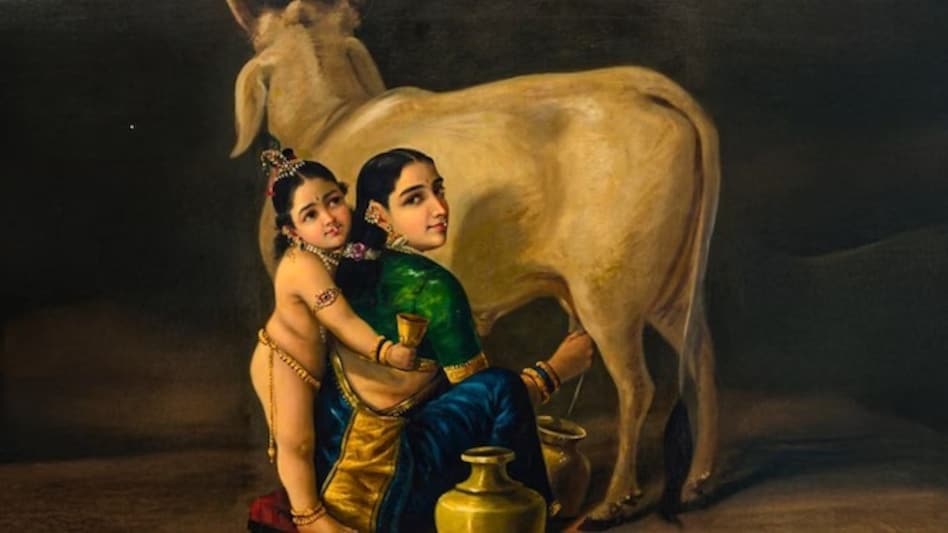
 Serum Institute's Cyrus Poonawalla buys record-breaking Raja Ravi Varma painting for Rs 167 crore
There are moments in the art market that feel less like transactions and more like declarations. The sale of Raja Ravi Varma’s Yashoda and Krishna for Rs 167.2 crore ($17,978,495) at Saffronart’s Spring Auction last evening was one such moment. By becoming the highest-value work of modern Indian art ever sold at auction, it has reset expectations for Indian art.
Must Read: 'Animals are not props': Foreign artist's viral Jaipur elephant photoshoot sparks ethical debate
Painted in the 1890s, at the height of Ravi Varma’s career, Yashoda and Krishna represent perhaps the most enduring theme in Indian visual culture: maternal love. The painting depicts the infant Krishna in the arms of his foster mother Yashoda, a subject that has appeared in countless devotional prints and calendars across India for more than a century.
What made Ravi Varma revolutionary was not the subject but the technique. He combined European academic realism, learned from oil painting traditions, with Indian mythological narratives, creating images that were both recognisable and elevated, devotional yet modern. In doing so, he effectively shaped how generations of Indians imagined their gods.
The painting had been estimated at Rs 80–120 crore before the sale, but the final price far exceeded expectations, demonstrating both the rarity of major Ravi Varma works in private hands and the depth of demand among Indian collectors. The previous auction record for Indian art had been held by M. F. Husain’s Untitled (Gram Yatra), which sold for over Rs 118 crore ($13.75 million) in March last year by Christie’s.
This is not the first time Ravi Varma’s works have commanded high prices. Over the past two decades, several major paintings have performed strongly at auction. Another Yashoda Krishna painting sold at Pundole’s in 2023 for over $4.5 million. Draupadi Vastraharan, an oil on canvas, fetched $2.88 million at Saffronart’s spring auction in 2022, while Damyanti sold at Sotheby’s for over $1.6 million.
“What this demonstrates is depth: of demand, of scholarship, and of confidence in works of true art-historical importance. Ravi Varma has long been central to India’s visual imagination; today, the market has aligned with that significance at the highest level,” says Ashish Anand, CEO and MD, DAG (formerly Delhi Art Gallery).
The buyer, industrialist Cyrus Poonawalla (Managing Director, Serum Institute of India), described the work as a national treasure and stated that he intended to make it available for public viewing periodically. He has also acquired works previously which he felt needed to be in India. In 2017, he bought a pencil sketch of Mahatma Gandhi for Rs 27 lakh at a Sotheby’s auction.
The Poonawallas have long been serious collectors. An excerpt from Coomi Kapoor’s book, The Tatas, Freddie Mercury & Other Bawas: An Intimate History of the Parsis, describes the family as enthusiastic auction participants who rarely stop bidding once they decide to acquire a work. Their collection includes modern Indian masters as well as European artists such as Rembrandt, Rubens, Van Gogh, Renoir, Picasso, Marc Chagall and Damien Hirst. Cyrus Poonawalla’s son, Adar Poonawalla, is also an active collector, with works by S. H. Raza, M. F. Husain, Jehangir Sabavala, Raja Ravi Varma and Amrita Sher-Gil in his collection. Taking his love for art, a step forward, he has acquired a stake in the auction house AstaGuru.
“Great art has a way of reaffirming its timeless value. The record-breaking sale of Raja Ravi Varma’s work… is not just a milestone for the market, but a powerful reminder of the enduring cultural and emotional resonance of Indian art,” says Minal Vazirani, President and Co-founder, Saffronart.
According to the India Art Market Report FY25, published by Asign Data Sciences, the Indian auction market alone was valued at Rs 1,620.6 crore last year, with auction sales growing at an annual rate of 12.8% since 2019–20. As per Anand, when gallery and private sales were factored in, the market size grew to an estimated Rs 3,000 crore. This one sale has changed that figure significantly.
“This is not simply a record. It is a redefinition of the category. The impact of this world record will percolate down to the entire Indian art market giving rise to Indian art being viewed as a serious financial asset and beyond its value for aesthetics and personal delight. And lastly, a growing recognition of mythology as a serious and desirable genre within the global art market,” he says.
He also emphasises that the painting’s status as a non-exportable national treasure reflects a maturing collector base that is globally competitive but is also invested in retaining cultural heritage within India.

 CBDT issues new crypto reporting guidance: No new tax, but exchanges must track and report all transactions
 Did Cockroach Janta Party's 'Chalo Sansad' 2.0 threat trigger Dharmendra Pradhan's resignation? What we know so far
 'Will discharge my responsibilities with complete humility': Pralhad Joshi after being appointed Education Minister
 Curious about Pralhad Joshi's wealth? A closer look at his assets, investments and liabilities
 On Cockroach Janta Party's lines, now E20 Janta Party demands choice of 100% petrol
 AI Data Centers, Aerospace & Gas Turbines: What's Powering Indo-MIM's Future Growth?
 Best Healthcare Stocks: Gaurang Shah's Outlook On Apollo Hospitals, Fortis & The Manipal Health IPO
 Is Indo-MIM's IPO Valuation Justified? Here's Why The Company Sees Strong Growth Ahead
 Treasury Bills Explained: Why T-Bills Are One Of The Safest Short-Term Investment Options
 FDs vs Markets: Where Should You Keep Your Short-Term Money?
 Gland Pharma stock: Price target of Rs 3,250 likely in medium term, says analyst
  Metal recycling stocks to buy: Gravita, Pondy Oxides, Jain Resource among top picks
 TRIL shares: Should you average the falling stock? Here's 'fixed and final' stop loss
 Adani Power: 45 GW target, Rs 2 lakh crore capex plan among conference call highlights
  ITC Hotels, Chalet, Ventive, IHCL, SAMHI: Hotel stocks to buy despite travel disruptions
 Delhi targets traffic bottlenecks on Aruna Asaf Ali Marg with ₹1.97 crore elevated road studyAI Data Centers, Aerospace & Gas Turbines: What's Powering Indo-MIM's Future Growth?
 'This is the behaviour of...' : Congress leader Kanhaiya Kumar detained by Delhi police after Kerala House altercation
 'You can do whatever you want?': Delhi HC questions EC over mandatory election duty for school teachers
 Mayor Zohran Mamdani taps tech-slayer Lina Khan to reshape New York City’s economy









