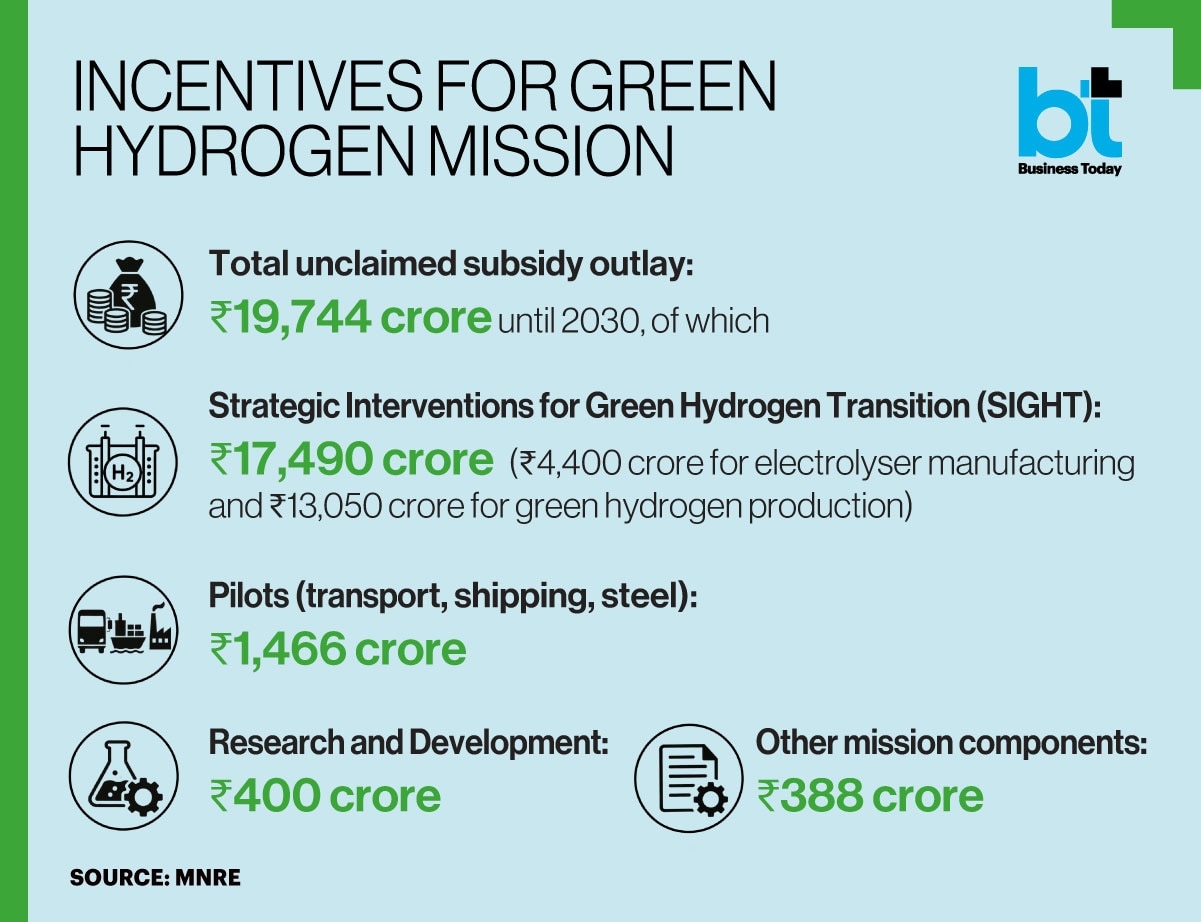
Despite the push to build a supply ecosystem, there are many reasons why demand for green hydrogen hasn’t picked up. Primary among them is cost, which remains well above that of conventional grey hydrogen. Proposed capacity is far ahead of actual production, and the policy support needed to create assured demand is still inadequate. The result: Rs 17,490 crore of incentives under the SIGHT, out of the mission's overall outlay of Rs 19,744 crore, still unclaimed, and an industry waiting for a clearer market signal.
Ambition vs reality
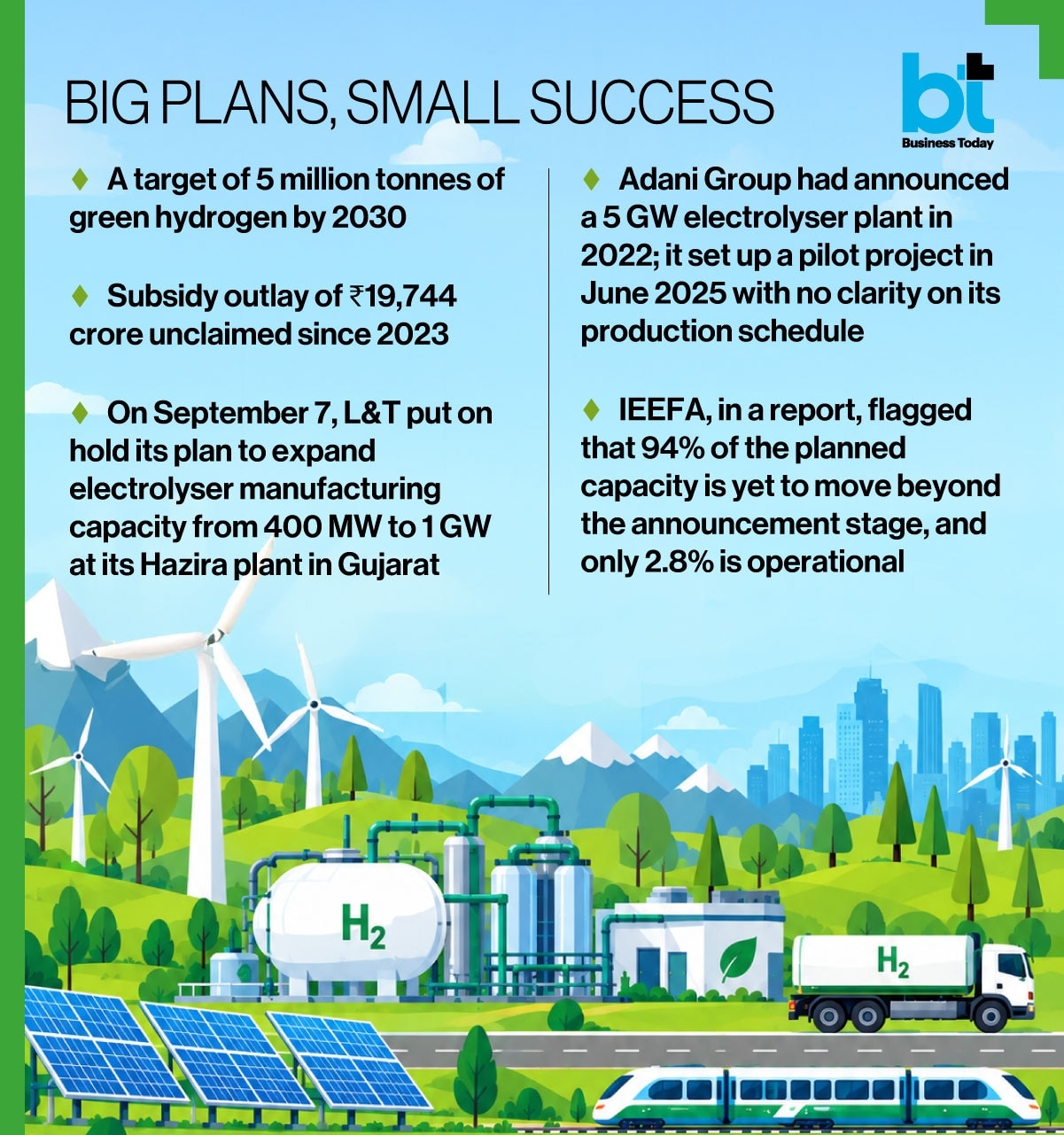
Notwithstanding the ambition to build a green hydrogen economy, corporate India has different plans. Larsen and Toubro (L&T) has put on hold plans to expand its electrolyser manufacturing capacity from 400 MW to 1 GW at its Hazira plant in Gujarat. Industry sources told Business Today, on condition of anonymity, that low demand has forced big players like Reliance Industries Limited and Adani Group, which had announced 3-GW and 5-GW electrolyser plants, respectively, to slow their expansion plans.
According to Nishaanth Balashanmugam, CEO and Director of the industry body, Green Hydrogen India (GH2 India), this is a “sector-wide issue.”
Reliance announced its electrolyser plant in August 2024, which was expected to be operational by the end of 2026. A company spokesperson, on condition of anonymity, said the plant was “under construction” with no clarity on its production schedule. It had also announced plans to produce 3 million tonnes (MT) of green hydrogen and derivatives (green ammonia) by 2032, work on which would commence in 2028 or 2029, the spokesperson added. The group’s electrolysers are meant for internal and external use, while green hydrogen is meant for captive use.
“As Mukesh Ambani has said, green hydrogen will become viable only when its price falls below $1 per kg,” the spokesperson said.
MUST READ: Maruti Suzuki commissions 300 kW green hydrogen plant at Manesar
Currently, green hydrogen costs $3.5-5 per kg without the SIGHT subsidy and $2.-3.75 with it.
The Adani Group announced a 5-GW electrolyser plant in 2022 and set up a pilot project in June 2025. However, the company did not clarify its production schedule. A spokesperson for the group has not responded to Business Today’s queries.
The demand constraint has been flagged for quite a while. In November 2025, the global think tank Institute for Energy Economics and Financial Analysis (IEEFA) wrote, “94% of the planned capacity is yet to move beyond the announcement stage, and only 2.8% is operational.”
It tracked 158 green hydrogen projects in India and found the “primary barriers” included “lack of committed buyers (i.e., unclear demand signals), high production costs, varying definitions of green hydrogen, and inadequate infrastructure — particularly for storage, transportation, and shared facilities.”
In April 2026, the Chintan Research Foundation (CRF) also said that while the NGHM has built an impressive supply-side architecture, there are hardly any committed buyers.
Low demand
The NGHM aims to generate 5 MT of green hydrogen by 2030 for use in refineries, fertiliser, city gas, steel, road transport, shipping, and high-altitude mobility (Leh) sectors.
Although “demand creation” is the first of the mission’s three components, the measures it envisages — including specifying a minimum share of green energy and its derivatives, such as green ammonia and green methanol, in industrial use, providing for legally enforceable consumption targets, and issuing model guidelines for transparent, competitive procurement — are yet to be implemented.
The industry is waiting for policy measures to boost demand.
Balashanmugam says the industry is not looking for subsidies to make green hydrogen viable but wants the government to create demand by mandating its use. “Similar mandates exist in the European Union (EU) for their industries to switch to green hydrogen, failing which a penalty is imposed. We are asking for an incremental rise in mandates, say 10% annual transition by users as part of the mission goal, either voluntary or compulsory. We have suggested this to the government”, he said. He also added that at this stage, the industry is not asking for penalties for defaults as the mandates can create better visibility and certainty for the sector.
Energy experts Debajit Palit and Akanksha Jain of the CRF warn that unless the demand crisis is addressed, the supply-side push “will end up in stranded assets, erosion in investor confidence and failure to export (part of the mission goals) or decarbonisation.”
In their view, creating demand will need a mix of price support, long-term contracts, and carbon pricing, as the EU, Germany and Japan have done. They also draw attention to India’s own experience in transitioning to renewable energy (RE) and electric vehicles (EVs). In the first case, demand-side push was given precedence over supply-side push (beginning in 2010), while in the second, both were pursued simultaneously (starting in 2014). That sequencing has been reversed in the case of NGHM.
For the green hydrogen transition, Palit suggests measures like a demand-side push, with subsidies to bridge the gap in contract prices of grey and green energy, purchase obligations, assured take-off agreements, transition finance, and conditionally disbursed subsidies. The other measure would be to focus on transiting to hydrogen, irrespective of the colour (grey, blue or green) until the market prices of green hydrogen decrease.
ALSO READ: 36,444 kg of CO₂ saved: India’s hydrogen train could change how the railways run in future
High cost
The easiest transition is from grey hydrogen used in refineries and fertiliser plants (ammonia) to green hydrogen. India currently produces 6.5 MT of grey hydrogen, which is exclusively for captive use.
Balashanmugam points out that transitioning from grey to green hydrogen would double production costs for refineries and increase them by 1-1.5 times for fertiliser plants. “The switch is economically unviable for the industry today. For non-traditional sectors of road transport and shipping, the challenges are creating supporting infrastructure, like fuelling facilities and engine modifications. Engines may require small or substantial modifications, depending on technology (direct hydrogen burning or fuel-cell based),” he explains.
However, the good news is that the NGHM push has lowered the cost of green hydrogen.
From $5-6 per kg before the mission was launched in 2023, the cost of production has fallen to $3.5-5 per kg (without subsidy) and $2-3.75 (with subsidy) in recent tenders. Even at this level, the cost is far higher than the baseline price of $1.9-2.5 per kg for grey hydrogen, according to CRF data.
Besides, the current manufacturing capacity is too low to support a meaningful transition.
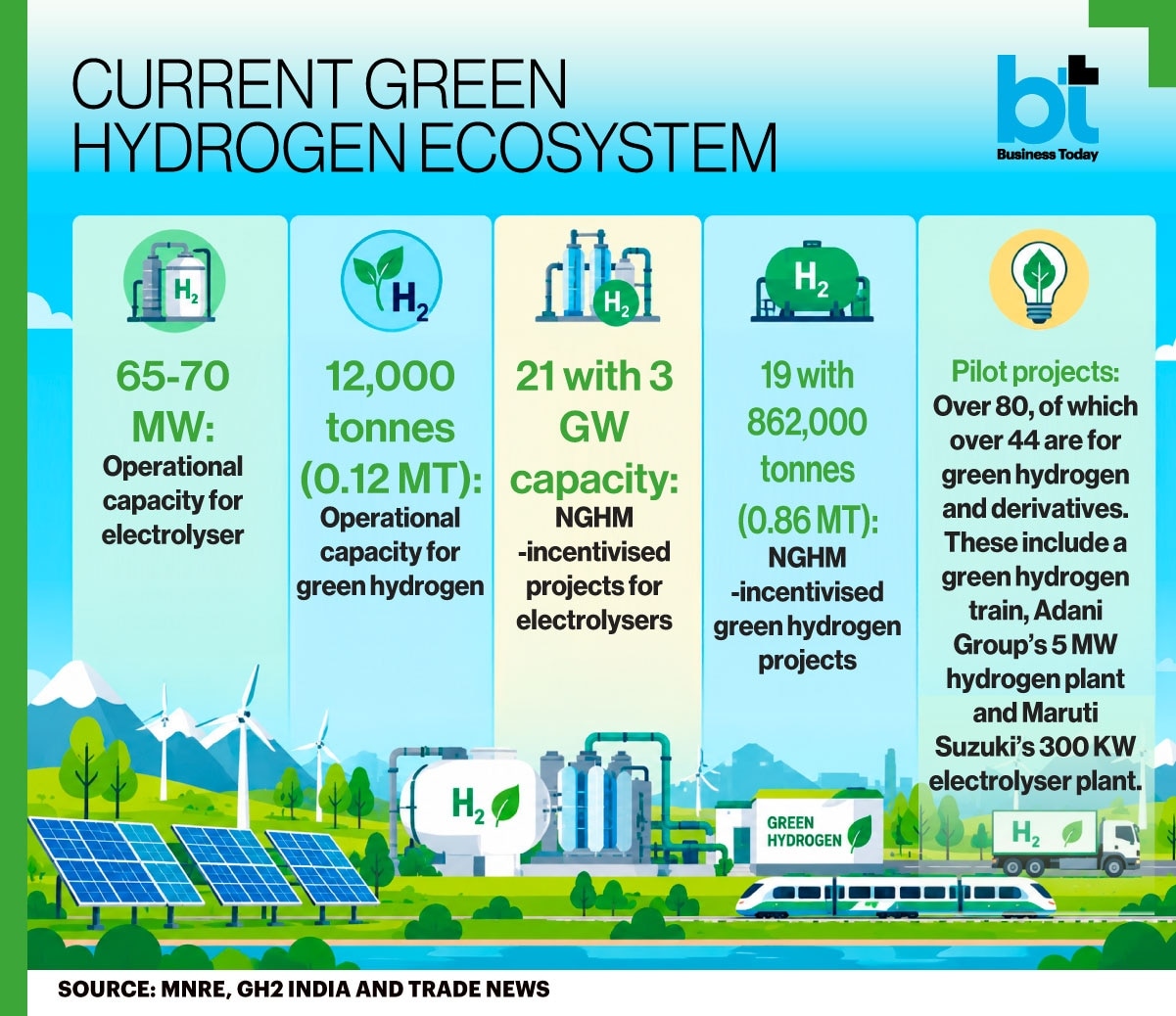
According to GH2 India, the operational capacity for electrolysers is 65-70 MW — against the announced capacity of 25 GW and incentivised capacity of 3 GW. For green hydrogen, it is 12,000 tonnes — against the announced capacity of 11.2 MT and incentivised capacity of 862,000 tonnes.
Though such capacities have been created, actual production has not begun. L&T’s electrolyser plant mentioned earlier hasn’t begun production, despite receiving a supply order of 100 MW from Indian Oil’s Panipat plant. Balashanmugam confirms that the entire SIGHT incentive of Rs 17,490 crore remains unclaimed. This subsidy is payable after production, as is the case with production-linked incentive (PLI) schemes.
Exports constraints
Surprisingly, in its “demand creation” segment, the NGHM gives greater emphasis to export markets than to domestic demand. It says global demand for green hydrogen and its derivatives is expected to be over 100 MT by 2030 and India is “aiming at” capturing about 10% of it (or 10 MT).
The export strategy rests on two assumptions: “expected lower cost of green hydrogen production in India and many countries are likely to rely on imports due to constraints on land and renewable resources required to produce green hydrogen domestically.”
But the global market tells a more complicated story.
On September 10, 2026, the Hydrogen Council, the largest CEO-led global hydrogen alliance, said in its Global Hydrogen Compass 2026 that committed investment has surpassed $130 billion, corresponding to 6.9 million tonnes per annum (MTPA) of committed capacity across more than 570 projects worldwide, 90% of which are under construction or already operational.
Its 2025 assessment said that global committed investment reached over $110 billion, with 6 MT of capacity across 500 projects.
MUST READ: LNG vs hydrogen trains: How India’s two new fuel technologies are changing rail travel
This takes global committed hydrogen production capacity to 6.9 MTPA, up from 6 MTPA in 2025. But the relatively modest increase in committed capacity points to continuing challenges around demand.
In July and August 2026, Reuters reported that investors are cutting back on investment and capacity creation plans for both electrolysers and green hydrogen production. In 2025, it reported that investors were scaling back and scrapping projects across Europe, the US, Australia, and Japan due to high costs, weak demand, and other factors.
With domestic demand yet to take off, India is also looking to export green hydrogen. But exporting has its own challenges. Energy expert Gopal Sarangi of the TERI School of Advanced Studies points to three stringent conditions the EU has put for importing green hydrogen, which are also valid for its domestic producers: “new” renewable energy (electricity) generation, hourly matching of production and consumption, and geographic correlation between the renewable energy source powering the electrolyser and hydrogen production.
In contrast, India’s 2025 certification scheme defines green hydrogen only in terms of carbon emissions — not more than 2 kg carbon dioxide equivalent per kg of hydrogen.
“Unless India aligns with the EU regulatory requirements for green hydrogen or develops some strategic approach, such as a coalition of like-minded countries in developing a common green hydrogen taxonomy and regulatory framework, it would be hard to export to regions like the EU,” Sarangi says.
Though India signed a free trade agreement with the EU earlier this year, the fine print of the Carbon Border Adjustment Mechanism is yet to be finalised.
New lessons
The NGHM’s supply-side push bears similarities with India’s solar PV manufacturing drive, which was supported by the PLI scheme.
An IEEFA-JMK research report in September pointed out that solar PV plants are operating at 35-40% capacity — well below the 50-65% level required for sustainable operations.
It said: “As demand grows gradually, manufacturers are likely to face increasing pressure on utilisation, margins, and investment returns, raising stranded asset risk for standalone manufacturers.”
India’s solar PV experience shows the risks of building manufacturing capacity faster than demand and the supporting supply chain can keep pace. The green-hydrogen push may therefore require a different sequencing, with demand creation keeping pace with manufacturing capacity.















 Currently, green hydrogen costs $3.5-5 per kg without the SIGHT subsidy and $2.-3.75 with it.
 RBI raises repo rate after nearly 4 years: Are more hikes coming? Here’s what economists say
 GST cuts insurance tax rates in 2025: A year on, consumers still await the full benefit in premiums
 Elon Musk says Starlink blocked by 'oligarchs' in India: 'You can guess who they are'
 Sensex, Nifty recovery attempt falters after RBI rate hike; is further caution warranted?
 RBI clears the air on new forex reporting rules: Framework does not apply to individuals
 Kotak Securities Rebrands Retail Business As Kotak Neo, Bets On Tech And New-Age Investors
 This Week In Cinema: Bokshi, Dongri, Other Mommy And More Hit Theatres This Week
 BT Golf Celebrates 27 Years Of Excellence With New Edition Coming Soon
 Amazon Demand From Tier 2, 3 Cities Ahead Of Great Indian Festival
 RBI Rate Hike Explained: Higher EMIs, Costlier Loans? What It Means For Your Money
 Your FDs, stocks and mutual funds in one statement: 5 ways RBI’s CAS move can help you
 Nithin Kamath: ‘IPOs are a full-on party’ as 67% of recent listings trade above issue price despite market slump
 MobiKwik shares zoom 30% in three days; what analysts say on next move?
 Sebi asks Jane Street to respond after sharing trade data in market manipulation case: Report
 Shriram Finance, other housing finance stocks look attractive post RBI rate hike: Expert
 This AI system can turn brain activity into images: Israeli scientists develop new visual decoding system
 BT BIG STORY: India is building the green hydrogen capacity — but where’s the demand?
 RBI rate hike: ICRA sees one more 25-bps hike, Axis MF expects up to 75 bps more
 FD rates rise: How much will ₹5 lakh earn under Bajaj Finance’s new rates?