"Many advised Ratan to take Tata Sons public," Ishaat Hussain, who served as Finance Director of Tata Sons, told Mathew. Ratan Tata was even "hounded by investment bankers" who built various enticing scenarios, hoping to make it happen.
Not just that, according to the book, during one meeting of Tata Sons in the early 2000s, a decision was even taken to take the holding company public. "[But] Ratan Tata kept his counsel close to his chest; he did not say anything in favour of it," Hussain revealed.
The book notes that the decision to list Tata Sons gave many of the Tata doyens sleepless nights. And by morning, they had changed their minds. Tata Sons Vice-Chairman Noshir Soonawala and Hussain led the move for a rethink.
"It was a question of losing control over many companies," Mathew writes. "If the parent company was listed, then it would lose the freedom to take some important decisions regarding the companies under it. There would be no freedom to raise the stake of Tata Sons in the group companies, for instance."
Soonawala was particularly fearful that in such an eventuality, the Tatas would lose control over the conglomerate. "The plan was not pursued any further. And not to act on the proposal to list Tata Sons would be the single most important decision, one of colossal significance, that Ratan took and conversely, did not take, as chairman, Tata Sons."
'Ratan Tata Feared Listing Would Destroy Group's Philanthropic Model'
The listing issue has once again divided the Tata house. Noel Tata, chairman of Tata Trusts, which owns a 66 per cent stake in Tata Sons, is dead against the listing of the holding company.
Mathew, who met Ratan Tata several times during the course of writing the book, told Business Today that Ratan Tata too was never in favour of listing Tata Sons.
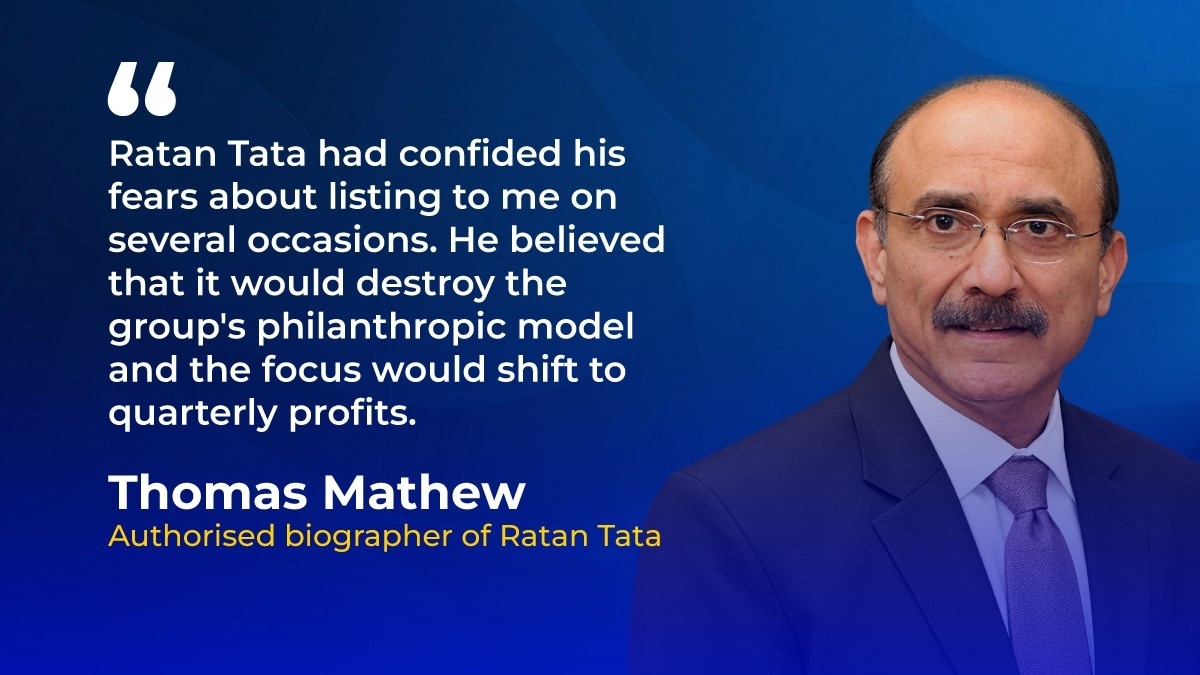
"Ratan Tata was not an extrovert. He often communicated his decision by choosing not to discuss the germane issue. He did the same with the listing of Tata Sons. He just buried it," Mathew told BT. "He (Ratan Tata) had confided his fears about listing to me on several occasions. He believed that it would destroy the group's philanthropic model. He said if Tata Sons were listed, the focus would shift from philanthropy to quarterly profits, and social welfare would no longer be the group's primary goal."
The author also revealed that when the RBI introduced the upper-layer NBFC classification in March 2024, Ratan Tata advised Tata Sons to take all necessary steps to exit the upper-layer NBFC classification, "and its board unanimously approved a resolution to do so."
In May and July 2025, Sir Ratan Tata Trust and Sir Dorabji Tata Trust passed separate resolutions, exhorting Tata Sons to take immediate action to ensure it was not listed.
"However, in September 2026, everything changed. The same directors, who were unequivocal votaries of Ratan Tata's view that Tata Sons should not be listed, suddenly did a volte-face," the former bureaucrat said. "It is befuddling that the directors who virtually fought over each other to be seen as more ardent adherents of the Tata Philosophy (by supporting Ratan Tata's view that Tata Sons should not be listed) could suddenly take such a contrarian position."
When asked whether Venu Srinivasan too opposed the listing of Tata Sons then, Mathew said: "All included."
Srinivasan, TVS Motor Chairman Emeritus, is a Tata Trusts nominee director on the board of Tata Sons. He was among the four directors who voted for N Chandrasekaran's reappointment as Tata Sons Chairman and the listing of the holding company in the September 17 board meeting.
Three other directors who favored listing were Harish Manwani, Anita George, and Saurabh Agrawal. Noel Tata voted against the proposal.
Mathew said that Ratan Tata appointed these individuals on the board of Tata Sons and in Tata Trusts "as he believed (and they made it appear) that they were wholly and unflinchingly aligned with the philosophy of the group." "It included its structure that would carry forward the vision of the founder Jamsetji, who believed that 'community is not just another stakeholder in business, but is in fact the very purpose of its existence'."
The former bureaucrat further said that these people who have changed their opinion on listing should, in all fairness, have expressed that view when Ratan Tata was alive, in March 2024, when the resolution came up for consideration.
"Their continued presence on the Tata Sons board today can only be justified as long as they adhere to the Tata philosophy. If they no longer agree with that philosophy, they should ask themselves whether it behoves them to continue sitting on the board of Tata Sons."
Mathew said the director (Srinivasan) nominated by Tata Trusts "must protect the interests of the Trusts." "He has fiduciary responsibility to do so. If any person has any compelling reason not to subscribe to it, he must step down. Tata Sons is the agency of Tata Trusts to generate profits for philanthropy. Neither Tata Sons nor Tata Companies can have a separate agenda that goes against the trusts' philosophy of unwavering commitment to philanthropy."
RBI Shifting Goalposts?
On September 11, the RBI rejected Tata Sons' application to remain as an unregistered investment company. It directed the holding company "to take necessary actions to ensure full compliance with all guidelines/instructions." Tata Sons had applied for deregistration in March 2024 to avoid the listing.
Noel Tata, in a statement on September 17, said that the RBI's communication "does not say that listing is the only option." He said the central bank had advised the group to ensure immediate compliance with the rules applicable to a non-banking financial company in the Upper Layer.
Mathew, however, believes that the "RBI is shifting its goalposts and that, on the face of it, is unjustifiable."
Initially, he added, the central bank said Tata Sons qualified as a core investment company (CIC) because of the amount of debt it had taken. "Tata Sons then repaid around Rs 22,000 crore and applied for declassification or surrender of its CIC licence."
Surprisingly, the author said, the RBI then held that becoming debt-free does not afford it exemption from the Upper Layer NBFC (Non-Banking Financial Company) category. "It added that any entity with access to public funds, through entities, or with standalone assets of ₹1 lakh crore or more, would still fall under the CIC category."
Mathew said that normally, one would expect a central bank to periodically assess the financial risks a nation's economy faces and take steps to assuage them. "But the sudden change in its criteria raises the question of whether the RBI was genuinely concerned about systemic risks or whether its intention was to bring Tata Sons within the definition, no matter what."
Noel Tata vs N Chandra: A Battle For Control?
The author rejected the belief that this was a fight for control. Noel Tata, he said, is fighting to protect the philosophy of the 158-year-old group. "As a Tata, from the same bloodline as the founder, he has a bounded duty to do so."
"No Tata family member takes even a penny from Tata Trusts because the money is meant solely for philanthropy," he said. "At Tata Trusts, the entire commitment is to philanthropy. Compare this with some of the large corporations in the country, which exist purely for profit and where family members benefit from the profits their companies generate."
If Tata Sons is listed, Mathew said, the group will be unable to continue the kind of social service it has carried out for over a hundred years. "What Tata Trusts has done in philanthropy is more than any other similar organisation in the world. From cancer hospitals where none existed to water purifiers for the rural areas to modifying the DNA of mosquitoes to prevent them from carrying the malarial parasite, the list of what the group has done for social welfare is endless."
"Just ask yourself one question: if Tata Sons were listed, would the group have been able to provide the quantum of assistance it extended to the victims of 26/11 (the 2008 Taj terror attack), whether they worked for the group or not?" Mathew asked.
If Tata Sons is listed, the former bureaucrat reiterated, the CEO will be worried about quarterly profits. Foreign portfolio investors, for instance, sitting in Texas, will own Tata Sons shares. "Will he be bothered about the social welfare activities of Tata companies? He won't. He will be interested only in his profits."
"So don't destroy a time-tested model. Don't break it. Don't dismantle it; if you must, watch over it."
















 Ratan Tata served as Chairman of Tata Sons from 1991 to December 28, 2012
 IDBI Bank employees and pensioners have nothing to fear: DIPAM Secretary
  'I wish I was 20 years younger': Sunil Mittal on India's next 20 years, recalls OneWeb pitch to Rishi Sunak
 RIL group to become India's largest conglomerate by m-cap after Jio IPO: Uday Kotak
 NDMC announces two-day closure of Connaught Place's Central Park ahead of CJP's 'Lehra Do Tiranga' march on Friday
 IDBI Bank sale to Fairfax faces union resistance, black-badge protest on October 16
 Jio Platforms IPO: ₹30,000 Crore Issue Opens October 21, Valuation At ₹10.3 Lakh Crore
 Weekend OTT Releases: The Diplomat 4, Aasha, Sacrifice And More
 How Jio Transformed India From Data Scarce to Data Abundant! | Akash Ambani | Jio Platforms IPO
 Akash Ambani Decodes Jio's Financial Muscle | Reveals The 5 Key Business Drivers | Jio Platforms IPO
 From Dhirubhai’s 1977 IPO to Jio's Mega Launch | Uday Kotak Calls Jio IPO a ‘Moment in History’
 Gold eyes sharp recovery; can MCX prices hit Rs 1.5 lakh? Vandana Bharti explains
 Tech Mahindra Q2 results: PAT rises 33% YoY to Rs 1,586 crore; recommends 1:1 bonus issue
 Jio Platforms IPO: How HFCL promoter Mahendra Nahata's investment could rise over 110 times
 South Indian Bank shares hit 52-week high on Q2 earnings, close higher
  Left ₹1.89 crore job at Microsoft, no co-founder and no salary: Why this 25-year-old chose to build an AI startup alone
 Why Falguni Pathak’s songs surge on YouTube every Navratri, year after year
 SBI Card launches Eternal credit card with Zomato Gold membership, cashback benefits
 From elderly care to hiking buddies: How China’s loneliness problem is becoming a $7.4 billion business
 Financial Horoscope Today, October 16, 2026: Taurus Should Focus on Budget, Know the Financial Status of All 12 Zodiac Signs


