















 Falguni Pathak’s appeal is not limited to traditional Garba music. Her album Yaad Piya Ki Aane Lagi introduced her to a much wider audience during the Indipop boom of the late 1990s.
Every Navratri, as cities across India prepare for nights of Garba and Dandiya, Falguni Pathak’s music finds its way back into the spotlight. Songs released decades ago continue to accompany festive gatherings, drawing listeners to YouTube and turning the singer’s catalogue into an annual soundtrack for the festival.
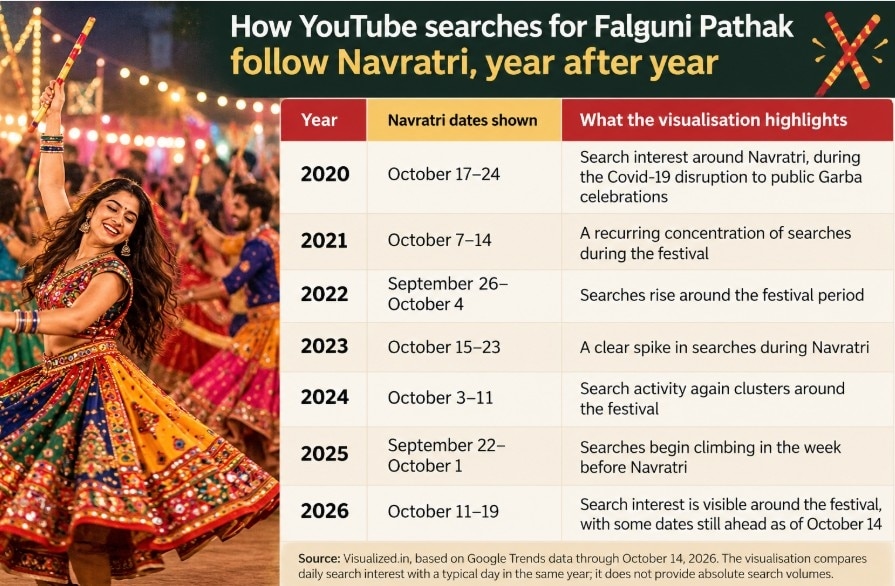
A visualisation by Visualized.in, tracking YouTube searches for Falguni Pathak in India from 2020 to 2026, illustrates this recurring pattern. Search interest rises sharply around Navratri, with the brighter dots on its calendar showing days when searches were higher than the usual daily level for that year. The pattern repeats across successive years, suggesting that interest in the singer is closely tied to the festival calendar.

 IDBI Bank employees and pensioners have nothing to fear: DIPAM Secretary
  'I wish I was 20 years younger': Sunil Mittal on India's next 20 years, recalls OneWeb pitch to Rishi Sunak
 RIL group to become India's largest conglomerate by m-cap after Jio IPO: Uday Kotak
 NDMC announces two-day closure of Connaught Place's Central Park ahead of CJP's 'Lehra Do Tiranga' march on Friday
 IDBI Bank sale to Fairfax faces union resistance, black-badge protest on October 16
 Jio Platforms IPO: ₹30,000 Crore Issue Opens October 21, Valuation At ₹10.3 Lakh Crore
 Weekend OTT Releases: The Diplomat 4, Aasha, Sacrifice And More
 How Jio Transformed India From Data Scarce to Data Abundant! | Akash Ambani | Jio Platforms IPO
 Akash Ambani Decodes Jio's Financial Muscle | Reveals The 5 Key Business Drivers | Jio Platforms IPO
 From Dhirubhai’s 1977 IPO to Jio's Mega Launch | Uday Kotak Calls Jio IPO a ‘Moment in History’
 RIL group to become India's largest conglomerate by m-cap after Jio IPO: Uday Kotak
 Gold eyes sharp recovery; can MCX prices hit Rs 1.5 lakh? Vandana Bharti explains
 Tech Mahindra Q2 results: PAT rises 33% YoY to Rs 1,586 crore; recommends 1:1 bonus issue
 Jio Platforms IPO: How HFCL promoter Mahendra Nahata's investment could rise over 110 times
 South Indian Bank shares hit 52-week high on Q2 earnings, close higher
  Financial Horoscope Today, October 16, 2026: Taurus Should Focus on Budget, Know the Financial Status of All 12 Zodiac Signs
 Now, fly non-stop to Hanoi! Vietnam Airlines launches direct flights from Ahmedabad
 Young entrepreneurs expand into clean energy, SpaceTech and defence, Hurun U35 list shows
 LIC launches three new insurance plans for retirement income, health and cancer cover
 Top 10 famous hindu temples in the US that showcase India’s rich heritage


