












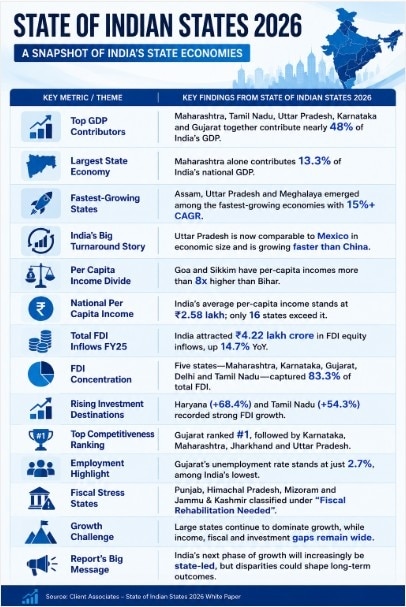



 India attracted ₹4.22 lakh crore in FDI inflows in FY2025, up 14.7% YoY, with five states accounting for 83.3% of total investments.
India’s economic growth story is increasingly being powered by a small group of states, raising fresh questions about how balanced the country’s development trajectory really is. Maharashtra, Tamil Nadu, Uttar Pradesh, Karnataka and Gujarat together contributed nearly 48% of India’s GDP in FY2025, underscoring a significant concentration of economic activity, according to Client Associates’ State of Indian States: 2026 white paper.
The report noted that India continues to remain the world’s fastest-growing major economy, with GDP growth projected at 7.5% in FY2026 and 6.8% in FY2027. However, the report highlights widening disparities in income, fiscal stability, employment and economic growth across states. Maharashtra’s economy is 133 times larger than Mizoram’s, while Goa’s per capita income exceeds Bihar’s by more than 8x.
FAQs
Which five states contributed nearly 48% of India’s GDP in FY2025?
Maharashtra, Tamil Nadu, Uttar Pradesh, Karnataka and Gujarat together contributed nearly 48% of India’s GDP in FY2025, showing a strong concentration of economic activity in a few large states.
Why does the report say India’s growth story is becoming a state-level story?
The report says growth is increasingly being shaped by individual states because there are widening gaps in income, investment, competitiveness, employment and fiscal health across the country.
How unequal is per capita income across Indian states?
The gap is very sharp. Goa and Sikkim have per capita incomes that are more than eight times higher than Bihar’s, while Bihar’s per capita income stands at ₹69,321. Only 16 states are above the national average.
Which states received the highest FDI inflows in FY2025?
Maharashtra, Karnataka, Gujarat, Delhi and Tamil Nadu together received 83.3% of India’s FDI equity inflows in FY2025, showing that private investment remains heavily concentrated in a few regions.
Which states are emerging as new growth and investment hubs in India?
Assam, Uttar Pradesh and Meghalaya have emerged among the fastest-growing state economies, while Uttar Pradesh and Rajasthan are gaining investor interest due to better infrastructure and policy reforms. Haryana and Tamil Nadu also posted strong growth in FDI inflows.

 20 Asia-Pacific stocks with up to 145% upside: Full ‘Going For Glory’ list, no Indian stock included
 Govt won't step into Singapore Airlines' Air India call, says Singapore minister
  India’s energy lifeline runs through the Indian Ocean: Why this maritime corridor matters
 Tax filing 2026: Missed crypto income in ITR? Why investors could receive an Income Tax notice
 CNG, hybrids and EVs reshape India's car market: What August sales reveal
 Home Loans & Insurance: How Couples Can Structure Them For Tax Efficiency
 Money & Marriage: How Couples Can Divide Household Expenses, Track Spending And Stay On Budget
 Parag Parikh Flexi Cap Fund Underperformance: Is Fund Size Becoming A Major Challenge For Investors?
 Midcap, Smallcap Funds: Strong Profit Growth Could Keep Investor Flows Robust, But Valuations Matter
 Travel Insurance Guide: Where To Buy, How Much Cover You Need & When To Get It
 20 Asia-Pacific stocks with up to 145% upside: Full ‘Going For Glory’ list, no Indian stock included
 Tata Technologies: Former CEO Patrick McGoldrick sells shares worth nearly Rs 165 crore
 Tata Power stock: Choice Broking expects recovery, assigns two price targets
  IPO rush next week: 11 issues eye to raise Rs 7,055 crore; 6 IPOs to open on same day, check details
 600% dividend stock: Check dividend per share, record date, payment date and other key detailsGovt won't step into Singapore Airlines' Air India call, says Singapore minister
  Corporate FDs: Muthoot offers 8.95%, Shriram 7.5%; what investors should know before investing
 Quote of the Day by Azim Premji: ‘Excellence endures and sustains. It goes beyond motivation into the realms of inspiration’20 Asia-Pacific stocks with up to 145% upside: Full ‘Going For Glory’ list, no Indian stock included
 Sending your bike by train? These rules could save you money and a lot of trouble


