


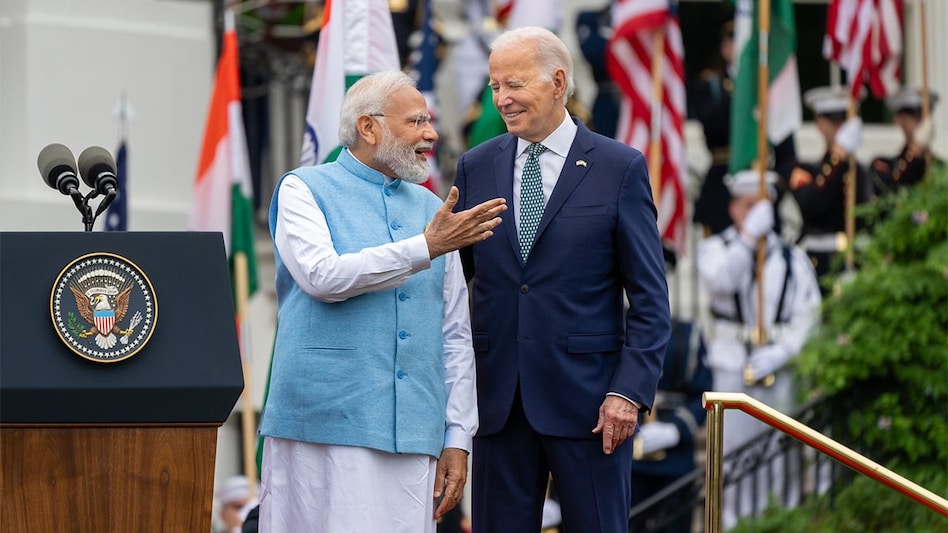
 PM Modi and President Biden meet during the PM's US visit
The State Bank of India’s research report, Ecowrap, while listing the economic aspects of Prime Minister Narendra Modi’s recent visits to the US and Egypt, said that this is the beginning of a new world order of collaborative knowledge economies. The report stated that the visits mark an important development both in the economic and strategic plane. The deepening of the ties between India and these two countries are of “vital importance for India’s economic development and position in the Indo-Pacific”, the report added.
Listing the aspects, the SBI Ecowrap report, stated that the US visit marks a shift in the onshoring of chip manufacturing in India. US chip manufacturers announced an FDI of $825 million with a combined investment of $2.75 billion to set up a semiconductor assembly and test facility in India.

 Global tax rules being rewritten, BRICS must have greater say: Finance Minister Nirmala Sitharaman
 SP Group seeks funds for Rs 3,500 crore debt payment amid Tata Sons IPO uncertainty: Report
 Setback for Subhash Chandra: NCLT puts media baron's repayment plan on hold, seeks CBI response in 4 weeks
 Tata power play: Chandrasekaran family's TVS ties emerge days after Venu Srinivasan backs his third term
 BT Big Story: Why India Inc is warming up to non-English-speaking executives
  iPhone 18 Pro Sale Rush! What Indian Buyers Really Think | Tech & You
 NSE Shares Listing Soon! What Should Be Your Portfolio Allocation & Investment View?
 Biggest IPO Rush Since 1996: ₹38,785 Crore Raised! What Should Retail Investors Do Now?
 Crude Oil Drops, Nifty Recovers! Is It The Right Time To Buy Indian Large Caps?
 Adroit Industries IPO: Price Band, Risks, And Should You Apply For Listing Gains?
 IRCTC, Ixigo, RateGain, TBO Tek: Top travel stocks to buy; check fresh targets, ratings and more SP Group seeks funds for Rs 3,500 crore debt payment amid Tata Sons IPO uncertainty: Report
 Defence stock to buy: Ashika picks pure-play drone maker, sees 27% upside
 ITC, Godfrey Phillips shares gain on latest cigarette price hike
  Clean Max Enviro Energy shares: Macquarie's target price sends stock soaring 8%
 Testing Mahindra Thar OG’s Drifting Abilities
 Iran Prez Pezeshkian In New York For UNGA; Trump Meeting On The Cards?IRCTC, Ixigo, RateGain, TBO Tek: Top travel stocks to buy; check fresh targets, ratings and more iPhone 18 Pro Sale Rush! What Indian Buyers Really Think | Tech & You
 After Moody's, Global Rating Agencies Fitch And S&P Raise India's Growth Forecast












