


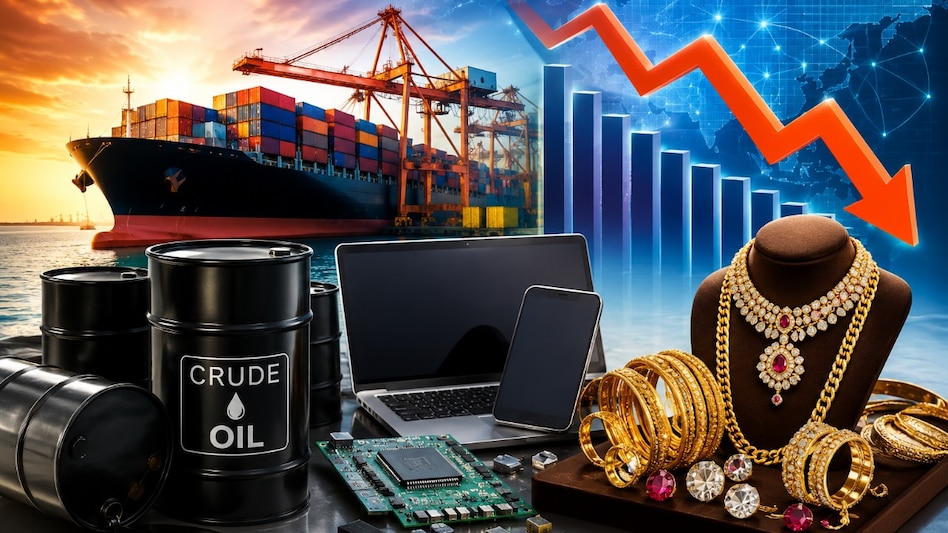
 In June itself, petroleum and crude oil imports surged 23% year on year to $19.32 billion (Pic: AI generated)
Petroleum, electronics and gems and jewellery continue to remain the three top import items that are widening India’ merchandise trade deficit with imports outpacing exports during April to June 2026.
Data from the commerce ministry revealed that the trade deficit from petroleum, electronics, and gems and jewellery stood at 65.9 billion in the first quarter of the fiscal as compared to an overall trade deficit of $37.42 billion in the same period.
Don't Miss | How India Inc's balance sheets are improving, despite moderate revenue growth

 Trump says Europe to release ‘massive’ diesel stocks as fuel prices rise
 Airport security upgrade: Why your mangalsutra or janeu won’t trigger scanner alarms anymore
 Reliance plans ₹1 lakh crore CBG investment in Andhra Pradesh, eyes 3 lakh jobs
 Rupee near 97: Rupee faces multi-front pressure; SBI Research calls for immediate protective measures
 Stock market sell-off: Nifty, Sensex log 8th straight weekly loss; key levels & top triggers now
 How Much Should You Invest In Bonds At Different Stages Of Life? 20/60 Investing Rule Explained
 Bond Investing For Beginners: How To Choose, Check Ratings, Returns & Manage Risk
 Flexi-Cap Funds: How Much Does the Fund Manager’s Strategy Really Matter?
 Diwali 2026 Gold Price Outlook | Expert Price Targets Revealed | Massive Gold Price Prediction
 Flexi Cap, Midcap Or Smallcap? Dinshaw Irani On Mutual Fund Strategy
 Stock market sell-off: Nifty, Sensex log 8th straight weekly loss; key levels & top triggers now
 IPO boom: 69 Indian companies raise Rs 90,500 crore in Q3 despite stock market sell-off; what's next
 TCS, Infosys, HCL Tech, TechM, Wipro, LTM, Coforge, HEXT: Fresh target, Q2 previews for IT stocks
 Carlsberg India IPO: SEBI approves confidential filing; beer maker moves closer to listing
 Suzlon, KPIT Tech, RIL, IRFC, HDFC Bank, Infy: 56% Nifty500 stocks in bear grip amid market sell-off
 Flydubai suspends Tel Aviv route after flight deck incident, investigation underway
 G7 agrees to coordinated refinery maintenance, 100 million-barrel oil release to ease market pressure
 NRI bought Rs 2.31 crore property, skipped ITR; why ITAT struck down tax demandTrump says Europe to release ‘massive’ diesel stocks as fuel prices rise
 CJP protest Mumbai: Bollywood celebrities gather at Shivaji Park over SIR controversy












