


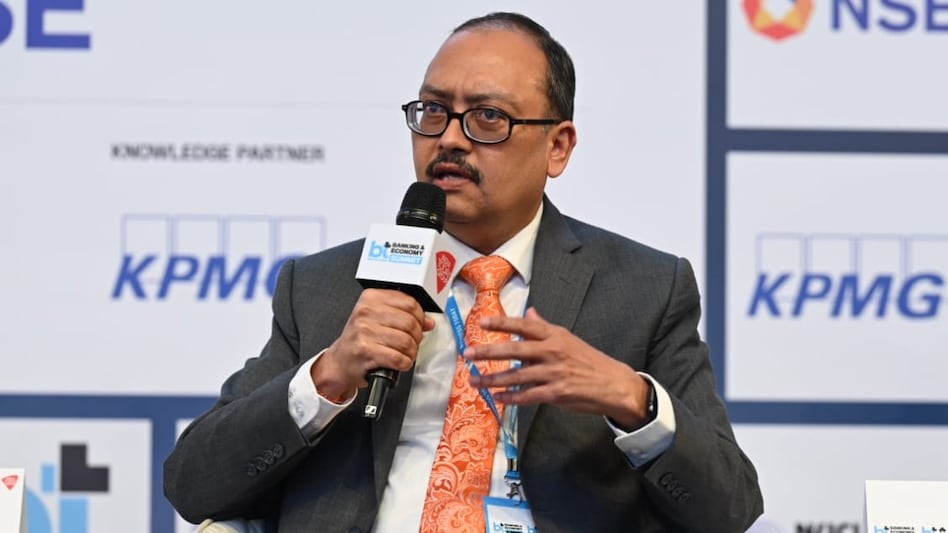
 Rajneesh Karnatak, MD & CEO, Bank of India
As the clamour for mobilizing deposits grows, the decline in CASA for all scheduled commercial banks is a structural shift that is happening as far as deposits are concerned, according to Rajneesh Karnatak, MD & CEO, Bank of India.
“If you see the data, CASA percentage has come down over the last few years. As the economy is progressing, a lot of financial literacy is happening. Customers now invest in equity markets, mutual funds, pension funds and gold, there is definitely some shift. As we develop further, this percentage will come down further,” Karnatak said at the panel discussion ‘Banking’s Next Evolution’ on the sidelines of Business Today Banking & Economy Summit.
“Banks will have to see where to fund the credit growth from. Retail term deposit and CASA will not be a thing which will last much longer. Banks will have to raise bonds. Corporates will also have to go to the bond market to raise funds,” said Karnatak.
Nidhu Saxena, the managing director and CEO of Bank of Maharashtra, said in the last 1-2 years, private banks, because of CASA, are opening branches aggressively in the rural and semi urban centres where typically PSBs (public sector banks) used to have a monopoly.
Saxena said digitization will not stop the bank’s geographic expansion. “We are aggressively expanding into new geographies and I have a robust board approved plan of opening 1,000 branches in five years,” he added.
Agreed, Dinesh Khara, former chairman of State Bank of India (SBI). “Banking is all a function of trust. Earning that trust requires the presence of brick-and-mortar also,” Khara said. “Creating a distribution network today is a huge challenge. Public sector banks have that distribution network,” he added.
On potential uses of artificial intelligence (AI) in banking, Khara said the new era for banking is going to be focused in terms of customization, which means that the data which is already there, it has to be put to use beyond the transaction process. “We started doing it during the pandemic. We had come out with algorithms. Based on that we started reaching out to those who needed credit. Those were the early days. We tried it out and it became a great success. With the new models, public sector banks will be in a position to profile their customers and hyper-personalization can become a reality,” said Khara.
Khara, however, warned that the banking industry is facing a challenge in terms of cybersecurity. “Perhaps AI can be used for is cutting costs both in terms of fraudulent activities which become a drain on the bank’s profitability and the right kind of underwriting through better risk management.”
Recalling his tenure as the chairman of India’s biggest lender, SBI, Khara said there were learnings from 2008-2014 wherein there was a challenge in terms of underwriting, there was a challenge in terms of resolving the stressed assets. “But the ecosystem got evolved. The IBC, which was never heard of in the country, came into existence. It actually demonstrated its teeth. That is one of the reasons as to why there were more responsible borrowings as far as corporates are concerned,” he stated.
Zarin Daruwala, Group CEO, PL Capital, said AI can help manage some risks in the banking sector. “Annually, there are about 14 lakh cyberattacks that happen. A lot of it is financial sector. On fraud detection, it is a very big area where we see AI investments happening. Bank of America uses an AI bot which does one billion customer interactions. JP Morgan Chase uses AI for fraud detection, it does 12,000 contracts in seconds. HSBC uses AIML for transaction monitoring. I am sure, Indian banks will also step up on AI investments,” Daruwala said.

 Who is Pralhad Joshi? Modi names veteran Karnataka BJP leader to lead Education Ministry after Pradhan's exit
 Third round of talks: CJP ends 49-day-long protest, says govt accepted 'key demands'
 Dharmendra Pradhan resigns, says decision taken to protect students' future amid NEET row
 All about Dharmendra Pradhan's educational qualification, wealth, assets and more
 India's first REIT mutual fund is here. Can it change how Indians invest in real estate?
  FDs vs Markets: Where Should You Keep Your Short-Term Money?
 Why Term Insurance Is Essential for Every Earning Member | Sum Assured & Coverage Explained
 Pakistan's Alleged Terror-Politics Nexus: Lashkar Links Spark Questions Over Fazlur Rehman
 Think Life Insurance Is Optional? Here's Why Every Indian Family Needs It Today
 FD Vs Arbitrage Fund: Which Is Better For High Taxpayers?
 Adani Power: 45 GW target, Rs 2 lakh crore capex plan among conference call highlights
  ITC Hotels, Chalet, Ventive, IHCL, SAMHI: Hotel stocks to buy despite travel disruptions
 ITC shares: Rs 307 a key short-term level to watch; here's target price
 Mphasis shares: FY27 guidance maintained; brokerages keep 'Buy' after Q1; check target price
 Should you buy every IPO? Research suggests patience may be the smarter strategy
 New York's $400 million climate bet: How a million trees are cooling a city the city from extreme heat Who is Pralhad Joshi? Modi names veteran Karnataka BJP leader to lead Education Ministry after Pradhan's exit
 Houthis target Saudi Aramco sites in Jizan and Yanbu as Red Sea tensions take a new turn
  Lifestyle inflation, delayed investing, high-interest debt: 3 biggest money mistakes young professionals makeThird round of talks: CJP ends 49-day-long protest, says govt accepted 'key demands'









