


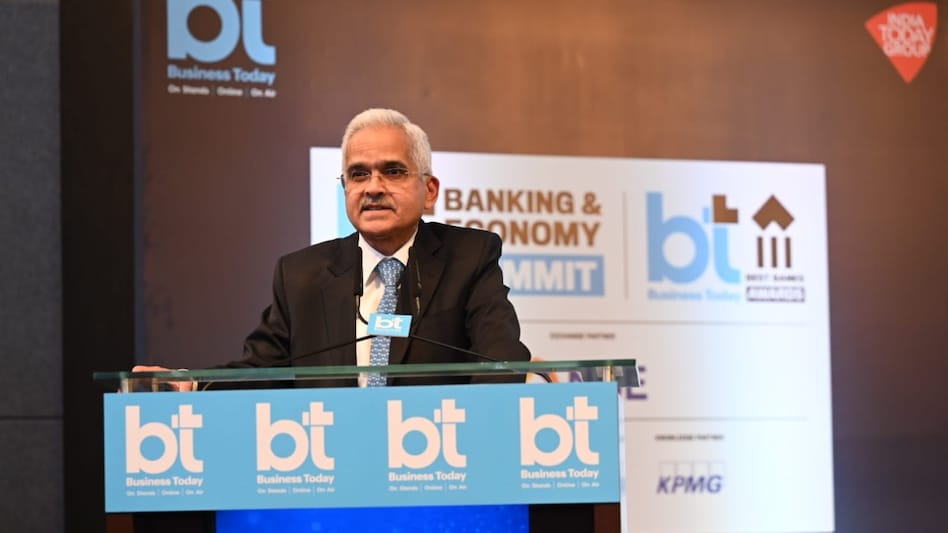
 Referring to the recent US and Israel attacks on Iran, Shaktikanta Das noted we are living in an era of geopolitical shifts, rapid economic change, technological disruption and evolving expectations.
The global economic order is shifting under the weight of volatility and is facing several challenges but the Indian economy presents a picture of resilience and stability, said Shaktikanta Das, Principal Secretary to the Prime Minister and former Governor of the Reserve Bank of India. “Today India is not just reacting to the world, we are influencing its future direction and shape,” Das said in his keynote address at the Business Today Banking and Economy Summit on Saturday.
“The world is coming to us because India is one of the largest and exciting markets with its democratic strength, technological momentum, startup, IT and AI ecosystem, stable, macroeconomics framework and rising competitiveness,” he said, adding that the coming decade will not be one where India simply participates in global growth but shapes it.
Referring to the US and Israel attacks on Iran that started on Saturday morning, Das noted we are living in an era of geopolitical shifts, rapid economic change, technological disruption and evolving expectations.
“The global economy is currently navigating and unusually turbulent and uncertain phase shaped by persistent geo political fragmentation supply chain realignments and uneven economic momentum across regions,” he further said, adding that the International Monetary Fund underscores this fragility noting that risks to global growth outlook remain firmly tilted to the downside.
“Compounding this challenge is a possible tightening of financial conditions led by high public debt and widening, fiscal deficits across several major economies,” he further said.
He pointed out that in this context, the Indian economy’s current stability and resilience has not happened by chance but by ‘surgically precise interventions’ by the Government of India and the Reserve Bank of India right in the aftermath of the Covid-19 pandemic when measures for
calibrated fiscal and monetary the expansion were undertaken and then rolled back in time. This ensured that undesirable cholesterol was not built up in our economic and financial systems and was something unique among countries.
“As a result, Indian economy has emerged much stronger after the pandemic,” Das said, adding that in the post pandemic period, nearly one sixth of global real GDP growth has come from India, thus establishing, India firmly, as one of the primary engines of global economic expansion.
He also highlighted nine building blocks that define the Indian economy and have fostered credibility in it. These include structural reforms and institutional strength, fiscal prudence and capital expenditure push, a resurgence in manufacturing activities and policy measures for it,
Resurgence in manufacturing and the resilience in the services sector that have led to a rise in global capability centres and the strategy Artificial Intelligence.
Other building blocks include external sector and trade integration, strong balance sheets of corporates, banks and households, Digital Public Infrastructure and the India Stack and India’s demographics human capital and jobs with India entering its prime with over 68% population in the working age group. Lastly, Das highlighted India’s efforts at energy transition and green energy as the ninth building block noting that ambition is no longer the headline but execution of the strategy is.
“Driven by the nine solid building blocks, India is mapping a future that is already arising today,” he said, adding that there are several other building blocks as well like agriculture, tourism, healthcare which are also witnessing rapid strides.

 Sugar price surge: Govt allows 1 million tonne duty free imports ahead of festive season
 PM Modi pushes bureaucracy to break data silos, use AI and take long-term policy view
 Merck, Moderna cancer vaccine clears Phase 3 milestone in melanoma
 SEBI allows FPIs to use digitally signed power of attorney for faster onboarding; check details
 'AI Jobocalypse': Raghuram Rajan proposes AI token tax to curb job losses, boost govt coffers
 Sugar Prices Surge Ahead Of Diwali: Is India’s Ethanol Push Creating A Food-Versus-Fuel Crisis?
 Sugar, Internet, Pharma Shares Rise In Strong Trade
 ₹30,000 Monthly SIP? 5 Funds Suggested For A 20-Year Wealth Creation Strategy
 Is ₹20,000 SIP Enough To Build Wealth? The 15–20 Year Investment Math Explained
 Starlink Renews India Push With 30,000-Satellite Plan Amid Regulatory Clearance Hurdles
 SEBI allows FPIs to use digitally signed power of attorney for faster onboarding; check details
 Rays of Belief, parent of Mom's Belief, to launch IPO on September 1
 Large cap stocks may lead market recovery; Anand Rathi analyst cites key factors
  Sensex, Nifty rebound sharply; can the recovery sustain?
 Hold ITC, avoid averaging despite underperformance, says Ruchit Jain of MOFSL
 GST 2.0 made two-wheelers and cars the biggest winners on price relief: Report
 DoT’s New SIM Rule: 9 Connections Means No More Numbers From August 24
 Why Is The Govt Pushing Indians From LPG Cylinders To PNG? The Real Reason ExplainedPM Modi pushes bureaucracy to break data silos, use AI and take long-term policy view
 Google Pixel 11 Unboxing On The Tech Gear Show On Business Today












