












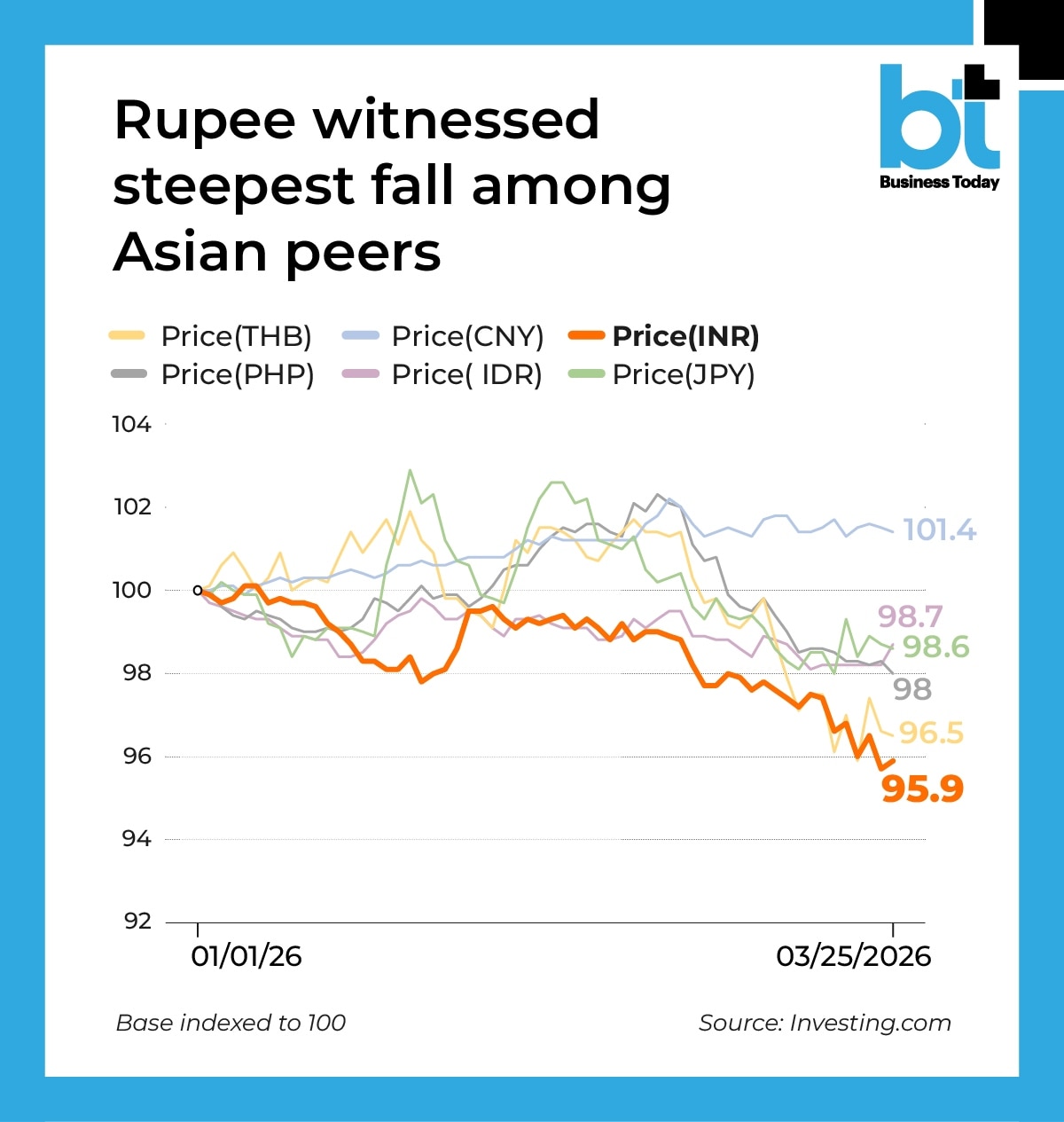


 The depreciation in the INR is followed by the Thai baht, which has declined 3.5% against the US dollar.
The Indian rupee (INR) is currently at an all-time low, breaching the ₹90–93 per dollar mark, and has become Asia’s worst-performing currency, depreciating 4.1% against the US dollar (USD) since January 1, 2026.
While most Asian currencies have been under pressure, the Chinese yuan (CNY) has managed a marginal 1.4% appreciation against the US dollar, making it the best performer among its Asian peers.
 NSE IPO day 1 update : Issue subscribed 31% so far; NIIs, employees lead bidding | Key details
 MDR on UPI: Will examine concerns raised by stockbrokers, says SEBI chief
 Diwali demand lifts Indian food exports as global buyers seek sweets, snacks and ready-to-eat foods
 NSE IPO: SGX, LSEG, ICE and CME Group - how NSE compares with global peers
  US tariff clouds loom again: India awaiting more clarity on Russia sanctions bill
 PM Modi’s 76th Birthday: From Sardar Sarovar To Cheetahs, His Birthday Milestones Over The Years
  Café Mondegar Shut: FDA Suspends Licence Over Alleged Food Safety, Hygiene Lapses
 NSE IPO Opens Today: ₹22,568 Crore Mega Issue, Valuation, Growth Outlook & Sona Select IPO
 Gold Finance & Jewellery Stocks: Expert Outlook Ahead of Festive Season | Sky Gold in Focus
 Best Stocks To Buy Now? Power, Hotels, Auto & Pharma Stocks For Long-Term Investors
 NSE vs BSE valuation: Does NSE’s larger scale give it an edge?
 Kanohar Electricals stock: Two-day rally takes gain from IPO price to 40%, here's why
  NSE IPO: CBDO Sriram Krishnan on retail growth, product diversification, new opportunitiesNSE IPO day 1 update : Issue subscribed 31% so far; NIIs, employees lead bidding | Key details
 Alembic Pharma shares rise 4% on receiving USFDA EIR for Vadodara facility
 From China to Japan, births are plunging across major economies. Sanjeev Sanyal shares data
 India Wants To Build Chips For The World: Applied Materials On Semiconductor Mission 2.0
 ISM 2.0: India Eyes Full Semiconductor Ecosystem As 5 Units Enter Production
 PM Modi Highlights Power Needs Of AI, Semiconductor Ecosystem
 Who let the dogs out? Yuva Sena's unique protest in Niphad Panchayat office goes viral


