


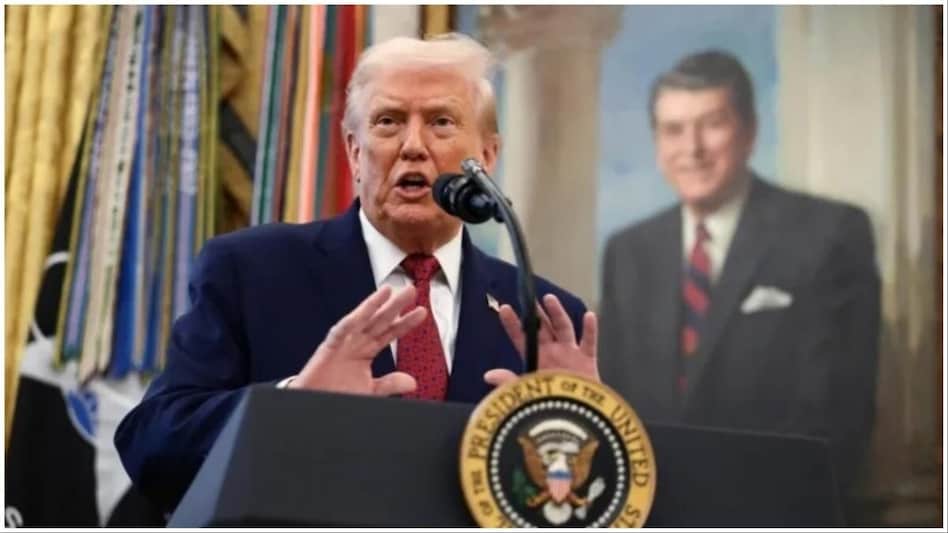
 The probe by the US has been launched soon after the US Supreme Court struck down Trump's reciprocal tariffs
With the US launching an unfair trade negotiation against India and 15 other countries, there are rising concerns over further trade and tariff policies of the Donald Trump administration and their impact on the domestic industry.
Also read: 'LPG production increased by 28%, delivery cycle unchanged': Hardeep Puri tells Lok Sabha amid Hormuz blockade
United States Trade Representative Jamieson Greer on March 11 announced the initiation of investigations regarding the acts, policies, and practices of various economies under Section 301(b) of the Trade Act of 1974 relating to structural excess capacity and production in manufacturing sectors. The investigations are focussed on China, the European Union, Singapore, Switzerland, Norway, Indonesia, Malaysia, Cambodia, Thailand, Korea, Vietnam, Taiwan, Bangladesh, Mexico, Japan, and India.
Also read: First crude shipment reaches Mumbai port following tense Strait of Hormuz passage
Greer has warned that the investigation could lead to new tariffs being imposed against these countries.
The probe by the US has been launched soon after the US Supreme Court struck down the reciprocal tariffs, putting a question mark over the future of the trade deals negotiated by the US. US President Donald Trump has since then imposed a 10% tariff for 150 days under Section 122 of the Trade Act of 1974 and has said it will soon be replaced by a 15% tariff.
A report by the Global Trade Research Initiative said that while Section 301 remains an important US trade tool, it is slower and more legally constrained than the reciprocal tariff system invalidated by the Supreme Court. Section 301 investigations require evidence of harm and must be tied to specific trade practices.
“The United States may also consider tariffs under Section 232 of the Trade Expansion Act of 1962, which allows trade restrictions on national-security grounds. The provision has already been used to impose high duties on steel and aluminium and could potentially be extended to additional sectors,” said Ajay Srivastava, Founder, GTRI, adding that the revival of Section 301 investigations signals that US trade policy is entering a new phase following the court ruling that curtailed Washington’s tariff powers.
The Confederation of Indian Textile Industry said that it is awaiting more clarity on this development, and it adds further uncertainty to the textiles and apparel sector, which is already under stress due to the West Asia crisis. “However, CITI remains hopeful that the Indian government will do all it can to safeguard the interests of the textiles and apparel sector, one of the country's major exporters and the nation's second-biggest employer,” it said.
Amit Maheshwari, Managing Partner, AKM Global, however, said that India's inclusion in this 16-nation investigation should not be viewed through the same lens as other countries. “While it seems this USTR probe could significantly affect China, given its well-documented domestic surplus capacity and record trade surpluses, India’s economic realities are fundamentally different,” he pointed out.
Indian manufacturing is primarily driven by its massive domestic demand, and this investigation is unlikely to have any significant adverse effect on the Indian economy, provided these facts are appropriately placed on record before the US authorities, he said.
India has previously faced this instrument during 2020–2021, when the USTR investigated India’s Equalisation Levy on the grounds that it discriminated against American technology companies. This ultimately led to the abolition of the levy in Budget 2024, illustrating that Section 301 proceedings can lead to tangible policy outcomes, Maheshwari pointed out.

 Exam reforms: Tech titan Nandan Nilekani picked by PM Modi to fix national public examination system
  'Tax officers struggled for own land': Nirmala Sitharaman slams laidback attitude of govt depts
 CBDT issues new crypto reporting guidance: No new tax, but exchanges must track and report all transactions
 Did Cockroach Janta Party's 'Chalo Sansad' 2.0 threat trigger Dharmendra Pradhan's resignation? What we know so far
 'Will discharge my responsibilities with complete humility': Pralhad Joshi after being appointed Education Minister
 AI Data Centers, Aerospace & Gas Turbines: What's Powering Indo-MIM's Future Growth?
 Best Healthcare Stocks: Gaurang Shah's Outlook On Apollo Hospitals, Fortis & The Manipal Health IPO
 Is Indo-MIM's IPO Valuation Justified? Here's Why The Company Sees Strong Growth Ahead
 Treasury Bills Explained: Why T-Bills Are One Of The Safest Short-Term Investment Options
 FDs vs Markets: Where Should You Keep Your Short-Term Money?
 Gland Pharma stock: Price target of Rs 3,250 likely in medium term, says analyst
  Metal recycling stocks to buy: Gravita, Pondy Oxides, Jain Resource among top picks
 TRIL shares: Should you average the falling stock? Here's 'fixed and final' stop loss
 Adani Power: 45 GW target, Rs 2 lakh crore capex plan among conference call highlights
  ITC Hotels, Chalet, Ventive, IHCL, SAMHI: Hotel stocks to buy despite travel disruptions
 Beyond mutual funds: Why analysts see SBI Funds' alternative asset business as a long-term growth engine
 'Ashamed of it...': Manoj Muntashir calls Adipurush his biggest mistake, seeks country's forgiveness Exam reforms: Tech titan Nandan Nilekani picked by PM Modi to fix national public examination system 'Tax officers struggled for own land': Nirmala Sitharaman slams laidback attitude of govt depts
 Delhi targets traffic bottlenecks on Aruna Asaf Ali Marg with ₹1.97 crore elevated road study









