








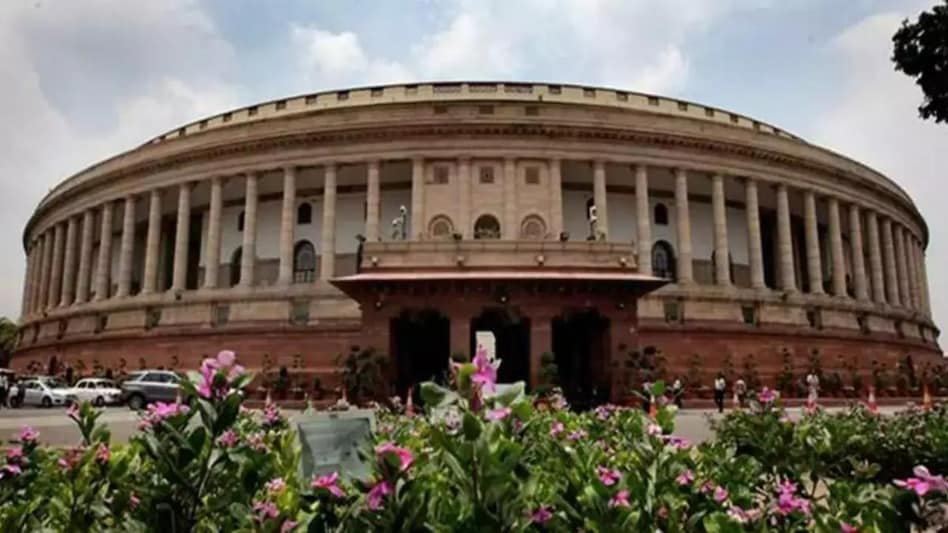
 The no-confidence motion signifies that one or more members of parliament have lost confidence in the appointed government.
 The no-confidence motion signifies that one or more members of parliament have lost confidence in the appointed government.
Lok Sabha speaker Om Birla on July 26 admitted a no-confidence motion moved by Congress MP Gaurav Gogoi against the Narendra Modi government, after a head count of over 50 MPs was attained, as required under the rules.
MPs belonging to the opposition bloc INDIA, including Congress parliamentary party chief Sonia Gandhi, National Conference president Farooq Abdullah, DMK's T R Baalu and NCP leader Supriya Sule, stood up for the headcount. Birla then admitted the motion of no-confidence.
Opposition MPs from 13 parties, including the Congress, Trinamool Congress, DMK, CPI, CPI(M), Shiv Sena (Uddhav Thackeray faction), JD(U), and AAP also stood up for the headcount.
It may be noted that this is the second time that the Modi government is facing a no-confidence motion since it came to power in 2014. The first no-trust motion against the Modi government in Lok Sabha was moved on July 20, 2018. The National Democratic Alliance (NDA) scored a thumping win with 325 MPs voting against the motion and only 126 supporting it.
What is a no-confidence motion?
The no-confidence motion signifies that one or more members of parliament have lost confidence in the appointed government. It allows the opposition to challenge the government's majority and ability to govern, and if passed, the government must resign.
It can be moved by any member of the Lok Sabha. Rule 198 of the Rules of Procedure and Conduct of Lok Sabha specifies the procedure for moving a no-confidence motion. A minimum of 50 members have to support the motion and the Speaker will accordingly announce the date for discussion for the motion. The allotted date has to be within 10 days from the day the motion is accepted.
Prime Ministers who faced no-confidence motion
The first no-confidence motion was moved against the Jawaharlal Nehru government by Acharya JB Kripalani in 1963. A year later, the next no-confidence motion was passed against Prime Minister Lal Bahadur Shastri.
A total of 15 no-confidence motions were moved against Indira Gandhi during her 16-year tenure as Prime Minister, which is the maximum so far for any Prime Minister.
Both Lal Bahadur Shastri and PV Narasimha Rao faced three motions each while Morarji Desai and Atal Bihari Vajpayee faced two motions each. Rajiv Gandhi and Jawaharlal Nehru faced one motion each.
However, so far, the passing of only one of these motions led to the fall of a government. That motion was moved against Prime Minister Morarji Desai by YB Chavan of the Congress in 1979. After the discussion around the motion remained inconclusive, Desai tendered his resignation.
No-confidence motion against PM Modi
The decision to move the motion in Lok Sabha was taken in a meeting attended by opposition MPs in Parliament on Tuesday morning. At the meeting of the opposition leaders, it was decided after weighing various options that this would be an effective way to compel the government to initiate a discussion on the Manipur issue, one of the alliance leaders said.
The opposition has been demanding that Modi make a statement on the Manipur issue in Parliament before a debate on the matter can be taken up, a demand not accepted by the government.
With the opposition and treasury bench members not relenting, a logjam has been prevailing in both Houses since the start of the Monsoon session on July 20.
More than 160 people have lost their lives and several hundreds have been injured since ethnic violence broke out in Manipur on May 3.
Also Read: Monsoon session 2023: Lok Sabha adjourned as Opposition raises Manipur issue
 Union Budget 2026: Can India put its AI ambitions on fast track?
 Visa curbs: US to pause visa processing for applicants from 75 countries as screening rules tighten
 US troops pulled from Qatar base amid escalating Iran standoff: Report
 State Street to acquire 23% stake in Groww AMC to expand India-focused investment offerings
 Infosys ADRs rise 2% in pre-market session as FY26 guidance raised
 Fake Silver In Memento For Retired Railway Employees Triggers Probe
 Rajnath Singh Salutes Armed Forces Veterans, Calls Them India’s Greatest Strength
 Silver Rally Turns Explosive: $100 Crossed, $115 Next?
 Denmark Backs Aravalli Restoration Study, Calls Land Degradation A Global Climate Challenge
 Tata Elxsi Q3 Results: Profit Slides, Stock Under Pressure Despite Margin Recovery
 FirstCry shares hit 52-week low; down nearly 30% in six months; what's next?
 Groww stock rises despite Q3 profit drop; analysts share outlook
 RBI gives nod to Japan's SMBC to set up subsidiary in India; what it means for YES BankInfosys ADRs rise 2% in pre-market session as FY26 guidance raised
 Labour Codes impact: Infosys Q3 provisions at Rs 1,289 cr; top 3 IT firms at Rs 4,373 cr