








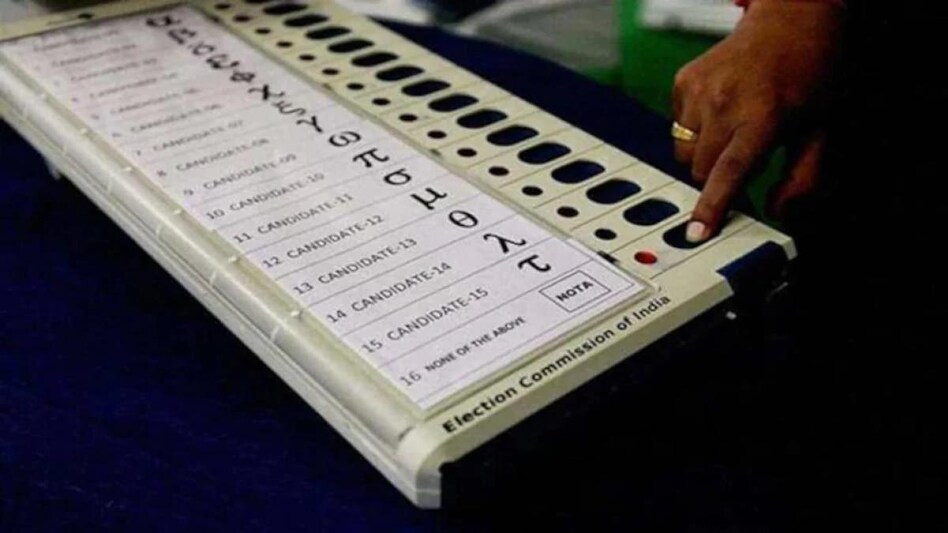
 Election Commission is ready to test remote EVM prototype
 Election Commission is ready to test remote EVM prototype
The Election Commission (EC) on Thursday said it is ready to pilot a remote voting facility for domestic migrants to ensure voters who are away from their homes constituencies get to vote from their current place.
The move is aimed at increasing voter turnout in assembly and general elections, which many voters miss due to a combination of factors like work, marriage, and education.
The commission said while voter participation in the Lok Sabha elections has risen, nearly 30 per cent of people are still not voting and voter participation has stagnated.
In the 2014 Lok Sabha polls, the voter turnout was 66.44 per cent while it increased marginally to 67.40 per cent in 2019.
In effect, one-third of the voters do not vote. And approximately one out of every three voters does not participate in the direct electoral process of exercising his or her vote. This translates to a high figure of about 30 crore voters.
Concerned with the low and stagnating turnout, the commission has now explored the option of using a modified version of the existing EVMs to enable voting at remote polling stations (polling stations outside the home constituency) for domestic migrants.
So far, the facility of voting from remote places through ballot paper is available to only a few categories like service voters, special office holders, persons on election duty, and persons under preventive detention.
Remote EVM prototype
The EC said it has been working with Bharat Electronic Limited (BEL) and Electronics Corporation of India Limited (ECIL) - manufacturers of existing EVMs - to develop a robust, failproof, and efficient stand-alone system for remote voting based on the existing electronic voting machines.
The ECIL, which comes under the Department of Atomic Energy, has developed a prototype of Multi-Constituency Remote EVM (RVM), a modified form of EVM that could handle a maximum of 72 constituencies in a single remote polling booth.
The proposed RVM system would enable domestic migrants to participate in elections in their home constituencies, from their remote locations, i.e. the places of their work.
With the new system, an individual would have the facility to vote for his/her home constituency from whichever state he/she is from special remote voting booths in the current state itself. These remote voting booths would also cater to voters of multiple constituencies of the state going to the polls.
Remote polling booths may as a pilot be set up within the state in an election to the state legislature to tackle the issue of migrant voters within the state. Once the system is in place, the migrant voter will not have to travel back to his/her home state or district to exercise his/her franchise of voting.
RVM voting method
A remote voter will have to pre-register for the remote voting facility by applying online or offline within a pre-notified time before elections.
Voter details will be verified at the home constituency and the voter's request for remote voting will be approved after successful verification.
Special multi-constituency remote voting polling stations will be set up in the places of their current residence.
RVM features
A remote voting machine is a standalone, non-networked system having the same security features as the existing EVMs. It provides the same voting experience to the voter as EVM. The RVM system is essentially a modified version of the existing EVM system.
RVM will be used in multi-constituency polling stations set up in remote locations. A single Ballot Unit (BU) can cater to multiple assemblies and parliamentary constituencies at a single polling station by using a dynamic ballot display instead of the usual printed paper ballot sheet on BU.
 Adani Ports, HAL, M&M, LG India among top picks post Budget for upto 40% upside potential
 18% excise duty on unmanufactured tobacco withdrawn; will tobacco stocks be impacted?
 Hyundai Motor Q3 results: Profit up 6% at Rs 1,234 crore; revenue climbs 8%
 BEL, GRSE, RVNL among key Budget beneficiaries; ICICI Bank, Belrise among top picks
  'STT hike won't do anything...': STT revision on derivatives sparks debate as Zerodha’s Nithin Kamath flags unintended risks
 Unpublished Ladakh Memoir Triggers Rahul–Rajnath Showdown In Parliament
 Budget 2026: Exclusive Live Market Masterclass With Raamdeo Agrawal
 Daily Calls LIVE: Ask Your STOCK MARKET TODAY QUERIES | Market Update LIVE | Share Market News Today
 Exclusive: Naina Lal Kidwai Breaks Down Budget 2026 And Its Impact On Business And Economy
 Budget 2026 Backs Wellness & Wanderlust: Ayurveda, Mental Health And Tourism Get Big Push
 NSE IPO: Unlisted shares hold firm despite STT hike in budget as issue timeline clears
 'Indian markets are still domestically focused': Navam Capital MD calls for opening up for global listings
 Bajaj Housing Finance Q3 earnings: Net profit rises 21%, AUMs at Rs 1.33 lakh crore Hyundai Motor Q3 results: Profit up 6% at Rs 1,234 crore; revenue climbs 8%'STT hike won't do anything...': STT revision on derivatives sparks debate as Zerodha’s Nithin Kamath flags unintended risks