









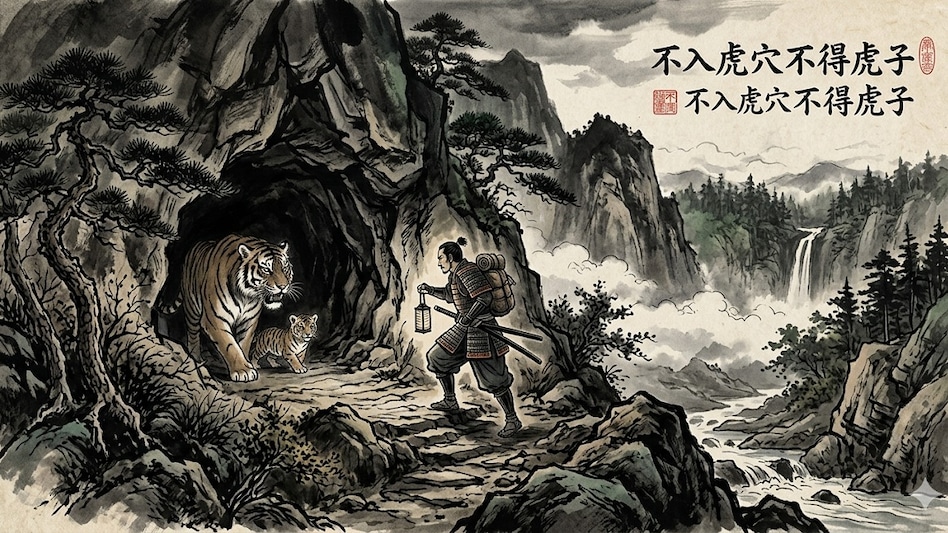
 Humans are evolutionarily wired to prefer avoiding losses over acquiring equivalent gains. We want the cub, but our instinct is to stay away from the cave.

 Humans are evolutionarily wired to prefer avoiding losses over acquiring equivalent gains. We want the cub, but our instinct is to stay away from the cave.
"If you do not enter the tiger’s cave, you will not catch its cub (koketsu ni irazunba koji o ezu)." — a classic Japanese proverb. This classic Japanese proverb highlights the fundamental relationship between risk and reward, emphasizing that you cannot achieve anything valuable without stepping out of your comfort zone.
What the proverb means
At its core, "koketsu ni irazunba koji o ezu" (虎穴に入らずんば虎子を得ず) means that immense value cannot be obtained without exposing yourself to danger or discomfort.
The imagery is visceral: a tiger's cub is highly valuable, but it is fiercely guarded inside a dark, unpredictable cave. To get the prize, you must willingly walk into the threat. In Western culture, this directly mirrors the phrase, "Nothing ventured, nothing gained," or "Fortune favors the bold." It acknowledges that safety and high achievement are inherently mutually exclusive.
How the proverb applies for businesses today
In today’s fast-paced corporate landscape, the "tiger's cave" isn't a physical place — it is modern market uncertainty, disruptive tech, and unmapped consumer territory.
Why it remains timeless
This phrase remains deeply relevant across centuries because it addresses a fundamental flaw in human psychology: loss aversion.
Humans are evolutionarily wired to prefer avoiding losses over acquiring equivalent gains. We want the cub, but our instinct is to stay away from the cave. The proverb acts as a timeless psychological correction.
It reminds us that across history — whether navigating ancient wilderness, launching voyages during the Age of Discovery, or founding tech startups in 2026 — the architecture of success has never changed. Comfort and growth cannot coexist.
 HDFC Bank review finds no basis for concerns flagged in Atanu Chakraborty’s resignation
 AMFI to renew push for higher overseas investment cap for mutual funds
 Where are the clouds? Latest satellite imagery shows vanishing monsoon over India
 Much of India’s technology stack is built on technologies developed elsewhere
 Volkswagen layoffs: German auto giant to axe 100,000 jobs, shut down four plants
 India's First Hydrogen Train Hits 120 kmph | No Diesel, No Wires, Only Water Vapour
 Rajan Bharti Mittal Touted India's $10 Tn Growth Story At UK-India Week
 Tech Gear Show | Latest Tech News, G-Shock, Redmi Turbo 5, HP EliteBook X G2a | EP 8 | Business
 Yogi Adityanath Alleges ₹4,600 Crore Purvanchal Expressway Tender Scam By SP
 NSE CEO Ashishkumar Chauhan Explains Why Every Entrepreneur Should Consider Listing
 Adani Enterprises, Adani Power, Adani Ports rally up to 61% in three months; is more upside left?
 TMPV or TMCV shares: Which Tata Motors stock has higher upside potential?
 'Those sectors that were new in 1990s...': Samir Arora says history is repeating
 NSE chief urges startups, MSMEs to view listing as a tool for scale
  Indian equities third-biggest losers after Indonesia, Hong Kong in 2026