


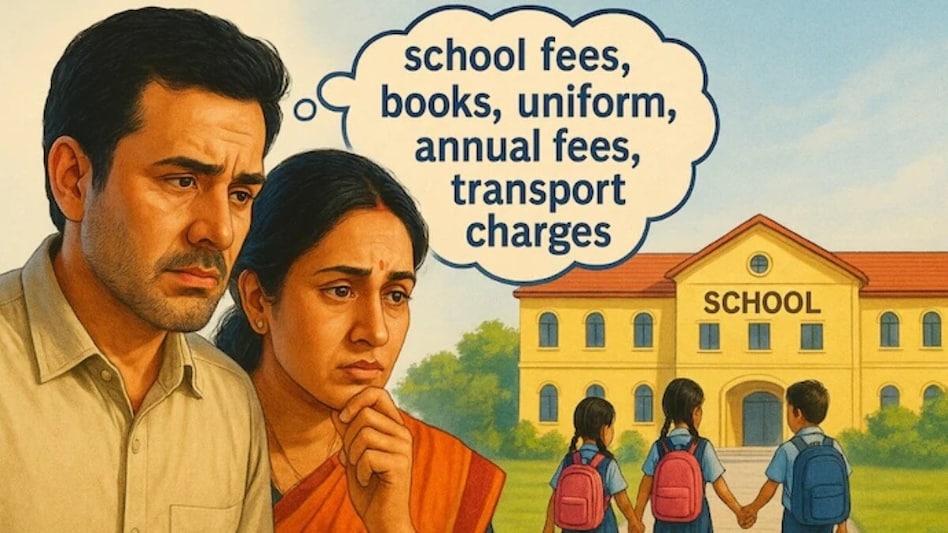
 A one-time admission fee of ₹1 lakh is charged separately.
Financial planner D Muthukrishnan on Sunday flagged the steep fee structure of a Bengaluru school, calling it unaffordable even for well-paid professionals.

 90% EVs exported out of India are from Maruti Suzuki: MD & CEO Hisashi Takeuchi
 India's $30 trillion goal needs 8-10% growth, $400 billion more annual investment: Jayant Sinha
 1.1 billion barrels gone: IMF warns that global oil market is running out of safety cushions
 From Devbhoomi to industrial destination: Uttarakhand’s manufacturing moment
 India’s deep-tech startups face a new test: Crossing the valley of death
 #IndiaAt100 : Adipen Bose Nandhiji On Conscious Capitalism- Can Profit & Purpose Coexist?
 #IndiaAt100 : Hisashi Takeuchi On Driving India’s Manufacturing Revolution
 #IndiaAt100 : Manufacturing For Viksit Bharat | Can Industry Power India’s $30-Trillion Dream?
 #IndiaAt100 : Tarun Garg On Hyundai & India’s Manufacturing Powerhouse Ambition
 #IndiaAt100 : CM Pushkar Singh Dhami On Uttarakhand’s Industrial Growth & India’s Next Leap
 Cupid, NTPC Green, NTPC, Raymond Realty, HAL shares: Key technical levels to watch
 Defence stock with Rs 2,654-crore order book hits record high; here's why
  GACM Technologies: FII holding jumps to 29%; penny stock in focus
 Puravankara shares rise 5% on fresh order win
  20 high-conviction ideas for up to 95% upside | stocks to buy
  India Inc’s $150 billion capex dwarfed by Microsoft-sized AI spend: Jayant Sinha flags investment gap
 Iran vows devastating response as US warns Tehran's commercial allies: Who are its trading partners?
 iQOO Z11 launch: The new smartphone packing a 7,050mAh battery and curved display
 Beyond Bollywood glamour: Inside the lavish menu of Arpita Khan’s Mercii
 Anil Kapoor’s first television payment was ₹250—five verified milestones from his early struggle to global recognition












