


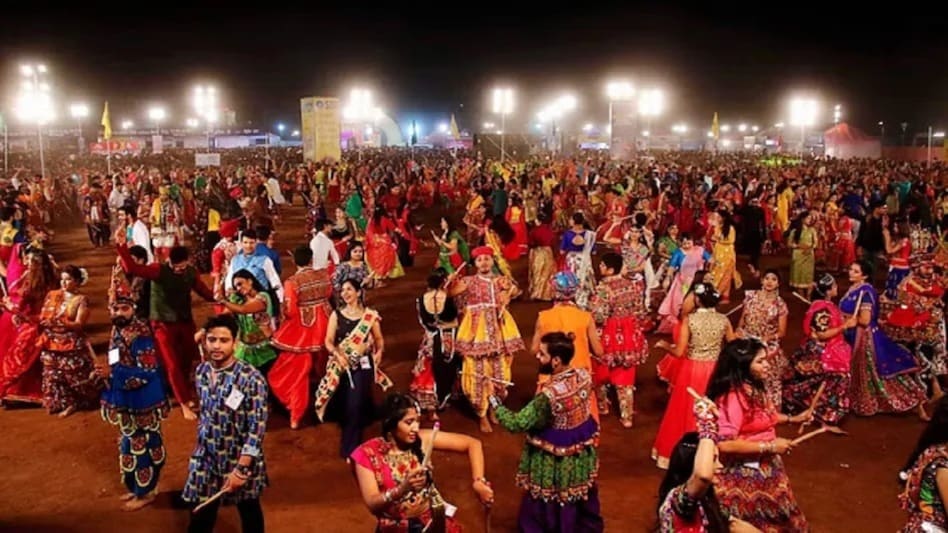
As the Navratri celebrations kick off across the nation on Thursday, October 3, a remarkable tradition in the heart of Ahmedabad's old city has captivated mass attention. In Sadu Mata Ni Pol, a 200-year-old ritual unfolds each year on the eighth night of Navratri, where men from the Barot community wear sarees and perform Garba to honour an ancient curse.
According to local lore, the custom originated over 200 years ago when a woman named Saduben sought protection from the men of the Barot community against a Mughal nobleman who demanded her as a concubine. Tragically, the men failed to defend her, resulting in the loss of her child. In her grief, Saduben cursed the men, proclaiming that their descendants would suffer as cowards before committing 'sati.'

 90% EVs exported out of India are from Maruti Suzuki: MD & CEO Hisashi Takeuchi
 India's $30 trillion goal needs 8-10% growth, $400 billion more annual investment: Jayant Sinha
 1.1 billion barrels gone: IMF warns that global oil market is running out of safety cushions
 From Devbhoomi to industrial destination: Uttarakhand’s manufacturing moment
 India’s deep-tech startups face a new test: Crossing the valley of death
 #IndiaAt100 : Adipen Bose Nandhiji On Conscious Capitalism- Can Profit & Purpose Coexist?
 #IndiaAt100 : Hisashi Takeuchi On Driving India’s Manufacturing Revolution
 #IndiaAt100 : Manufacturing For Viksit Bharat | Can Industry Power India’s $30-Trillion Dream?
 #IndiaAt100 : Tarun Garg On Hyundai & India’s Manufacturing Powerhouse Ambition
 #IndiaAt100 : CM Pushkar Singh Dhami On Uttarakhand’s Industrial Growth & India’s Next Leap
 Cupid, NTPC Green, NTPC, Raymond Realty, HAL shares: Key technical levels to watch
 Defence stock with Rs 2,654-crore order book hits record high; here's why
  GACM Technologies: FII holding jumps to 29%; penny stock in focus
 Puravankara shares rise 5% on fresh order win
  20 high-conviction ideas for up to 95% upside | stocks to buy
  India Inc’s $150 billion capex dwarfed by Microsoft-sized AI spend: Jayant Sinha flags investment gap
 Iran vows devastating response as US warns Tehran's commercial allies: Who are its trading partners?
 iQOO Z11 launch: The new smartphone packing a 7,050mAh battery and curved display
 Beyond Bollywood glamour: Inside the lavish menu of Arpita Khan’s Mercii
 Anil Kapoor’s first television payment was ₹250—five verified milestones from his early struggle to global recognition












