












 (Image for representation)
 (Image for representation)
On Tuesday, the Supreme Court directed five states, including Delhi, Punjab, Haryana, Uttar Pradesh and Rajasthan, to file affidavits stating measures taken by them to control the problem of air pollution.
A three-judge bench headed by Justice SK Kaul and comprising Justices Sudhanshu Dhulia and P K Mishra, directed the states to file an affidavit within a week. The next hearing on this matter is scheduled for November 7.
The Court observed that the impact of air pollution on future generations will be huge. It also noted that the pollution has made it increasingly difficult to step outside, particularly during what used to be considered the best time of the day in Delhi, India Today reported.
Highlighting the recurring nature of this issue, the Court noted that it happens year after year. The bench also said crop burning is one of the main reasons for air pollution in Delhi.
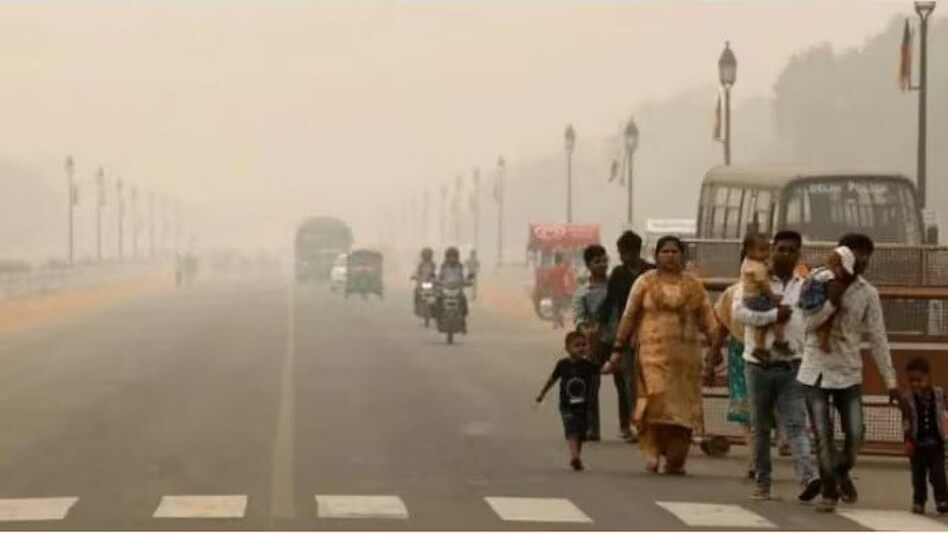
This comes as haze enveloped the national capital and its suburbs on Tuesday, with the city recording its air quality in the very poor category for the fourth day on the trot.
According to a numerical model-based system developed by the Indian Institute of Tropical Meteorology in Pune, vehicular emissions (11 percent to 15 percent) and stubble burning (seven percent to 15 percent) currently stand as the two major contributors to the city's very poor air quality, news agency PTI reported.
It also shows that pollution sources in Gautam Buddha Nagar, Uttar Pradesh, are responsible for up to 14 percent of the air pollution in the capital.
The city's average AQI was recorded at 350 at 10 am, the highest this season so far. The 24-hour average AQI was 347 on Monday, 325 on Sunday, 304 on Saturday and 261 (poor) on Friday, 256 on Thursday, 243 on Wednesday and 220 on Tuesday.
An AQI between zero and 50 is considered good, 51 and 100 satisfactory, 101 and 200 moderate, 201 and 300 poor, 301 and 400 very poor, and 401 and 500 severe.
Also Read: Israel-Hamas war: World Bank warns of 'dual shock' to global commodity markets
 RBI MPC April policy: Hold, cut or hike? 7 key signals to watch today
 'Agreed to open Stair of Hormuz': Trump announces two-week ceasefire with Iran, drops threat to end a 'whole civilisation'
 Travelling to UK gets costlier: ETA fee jumps above Rs 2400 from April 8; What Indians must know
 Trump, Iran ceasefire: Gift Nifty up 3%; Sensex, Nifty eye gap-up start as oil tanks 10%
 RBI MPC April meet: Your home loan EMIs may not fall before Diwali — what it means for you
 Aludecor – Powering India’s Modern Facades
 "Pakistan Ke Kitne Tukde Honge": Rajnath Singh’s Big Warning Amid Bengal Political Battle | Exclusive
 "Pakistan Ke Kitne Tukde Honge": Rajnath Singh’s Big Warning Amid Bengal Political Battle | Exclusive
 Tata Trusts Row Deepens After Venu Srinivasan Exit, Legal Battle Intensifies
 Fresh Row At Tata Trusts Over Non-Parsi Trustees | Matter Headed For Courts?
 LTIMindTree, MTAR Tech, Natco: 3 stocks to buy; check target prices, stop loss & moreTrump, Iran ceasefire: Gift Nifty up 3%; Sensex, Nifty eye gap-up start as oil tanks 10%
 Top stocks in news: Infosys, GAIL, Auro Pharma, AB Capital, Biocon, CleanMax, Muthoot, SRF
 Sebi extends IPO approval validity till Sept 30 amid West Asia tensions, weak sentiment
  Major US-Iran war impact: $900 mn loss hits this energy firm's quarterly results – Here is how