GM: The stories of India are great. India is one of the only countries that has documented its stories of the past well through our Puranas, Vedas and historical documents. Our history is very well documented, and there are a multitude of stories.
If any brand from India wants to come up with something original, it can bring out the stories and culture of India through its products. For me, Indian luxury is about celebrating that.
Q: What has changed over the years for Jaipur Watch Company, and how have you built the market for the company?
GM: When we started in 2013, for the first nine to ten years, we did not see any success. We were the first entrant in the market and the first microbrand. There was no concept of a microbrand in India. Today, there are more than 50 microbrands in India.
We have worked hard to develop an industry on our own. India has really changed in the last three or four years, and that is evident not just through our numbers but also in how consumers’ perceptions towards Indian products have changed. Premiumisation of Indian products is happening. When I started, people would not accept Indian products at a premium price point. Now, that has completely changed. This generation has accepted that Indian products can be fantastic.
Q: When it comes to watches, there are dominant legacy players in the market. How does an Indian brand break through that barrier and become a go-to timepiece rather than just a souvenir?
GM: We don’t want to be a souvenir company. We want to make serious watches, and we are making serious watches.
This market is dominated by foreign brands that have been around for hundreds of years. We are going to break through in our own way and find our own place. We are not competing with any international brands. We have found our own niche and clientele.
Jaipur Watch Company is planning to launch two international stores in Dubai and in Sri Lanka. We currently have 15 stores, and soon, we will have 19 stores live. It is also not just the Indian diaspora ordering our watches. Japan has really surprised us. We are getting single orders for eight or nine watches from Japanese people in Japan. People are ordering from Japan to buy from India, and that is a great feeling.
Q: Many brands use Indian heritage as inspiration. How do you ensure authenticity in the stories behind the latest collection?
GM: Our watches are very much about the stories of India. We have not copied Western designs. We are original in our design and come from a school of maximalism, which is something very Indian. We launched the collection at Rambagh Palace, which is itself very opulent and maximalistic. That is the DNA of the brand.
With Gates of India, we have used two beautiful gates from Pritam Niwas Chowk on the watch, along with other iconic gates of India, ranging from India Gate, Red Fort, to Charminar and Gateway of India, on the other side of the watch.
Baagh has been an iconic collection and our bestseller since 2022. When Prime Minister Narendra Modi wore our Roman Baagh watch, it was an absolute honour and brought the product a lot of attention. There are currently more than a thousand people on the waitlist, so we wanted to pay homage to that collection through Premium Baagh. The baagh is shown walking in the desert against a turquoise wall, and there is a khadi dial inside the watch. What could be more Indian than that?
Q: How do you work with your team when developing a new collection?
GM: My biggest inspiration comes from Jaipur. It is a beautiful city with so much history and so many design elements.
When we get an idea, I discuss it with my team. They put it on a screen or in sketch form. Once I am satisfied that it represents the idea in my mind, we start working on it. It takes almost eight to nine months to go from the idea to the product level. The final assembly happens in Jaipur.
Q: What changes are you seeing among Indian consumers?
GM: They are doing a lot of research and finding out the stories behind products before buying them. Who would have imagined five years ago that an Indian T-shirt would sell at a ₹30,000 price point or even ₹1 lakh?
These things have changed drastically because of this generation. Gen Z and millennials are also educating their parents and peers. Indian luxury has just arrived, and I think it will become a giant in the coming few years.
Q: How would you introduce the brand to someone in markets such as Japan or Switzerland?
GM: The brand is about the stories of India, putting them together in a miniature version and using world-class materials comparable with those used by international brands.
The Premium Baagh watches are made using 904L stainless steel, which is used by uber-luxury brands. No brand in India has ever used 904L stainless steel. We use crystals, automatic movements and top-of-the-line materials comparable with those used by any international brand. You are buying stories along with a premium watch. That is how I would describe the brand to someone who is not aware of it.
Q: How do you think brands such as yours will take India’s story to the world?
GM: We are a very old-school brand in terms of our philosophy. We have been a little shy of funding and fundraising because I have always believed that I am building a legacy brand. I am building a brand that will last for more than 200 years and beyond my lifetime. It will be managed by professionals and continue with the DNA we have built.
We have grown substantially. We did ₹10 crore, then ₹25 crore, and now we are on track to do ₹80 crore this financial year. The idea is to open 100 stores over the next three years.
Q: Do you think consolidation will happen in the Indian luxury watch market?
GM: Consolidation in luxury has already started globally. I do not foresee it happening in Indian watchmaking right now because the industry is at a very nascent stage. Until you see numbers crossing ₹150 crore or ₹200 crore, consolidation will not happen.
In another five years, international watch brands or Indian business houses may start picking up Indian watch brands. Right now, the industry needs to wait and watch. In the last year, 30 or 40 brands have opened in India, so people need to see whether it is a bubble or a sustainable business.
Q: Do newer brands make you rethink your approach?
GM: I enjoy seeing newer brands using the stories of India in their products and building that narrative. I was vocal about it for decades, but no one understood or accepted it. Now even bigger watch brands have launched hand-painted watches, which I launched in 2017.
For me, it is a moment of recognition, irrespective of whether they acknowledge it. These brands’ marketing efforts also help the whole industry. People start searching for microbrands in India, and someone else’s marketing effort eventually helps other brands too.
Q: Are local artisans employed in making the watches?
GM: Hand-painted watches are made by local artisans. We also use a lot of gemstones. In 2024, we launched the Brides of Jaipur collection, where we incorporated jewellery styles into our watches.
My vision for the next three years is to bring these crafts together under one roof and provide artisans with world-class equipment so that they can make better-finished products. Their tools and equipment are currently a little outdated, and the environments they work in can have dust. I want to give them a place where they can create fantastically finished products.
Q: Is there also a sustainability aspect to the brand?
GM: We are trying to work with alternative leathers such as cactus and apple leather, and we have developed straps using them. However, a watch touches your skin every day, and we have not yet found a product that can sustain itself for a very long period.
Materials such as cork and fabric can be upcycled into straps, but longevity remains an issue. Recycling metal for watches is also difficult because you do not get the required grade of steel that works on CNC machines. I am sure we will find materials that can be used. As of today, we are limited to dials using khadi and recycled matchboxes.
Q: What would be your advice to entrepreneurs trying to bring Indian elements and stories into their products?
GM: Be honest and sincere about what you have promised the client. Do not overcommit or make false commitments. If it is machine-made, say it is machine-made. If it is handmade, say it is handmade. If you are honest and persistent, you will achieve your end goal. The Indian population is there to support you. A population of almost 150 crore people does not mean that it is a problem. For watches, I feel that we have almost 150 crore wrists to target.



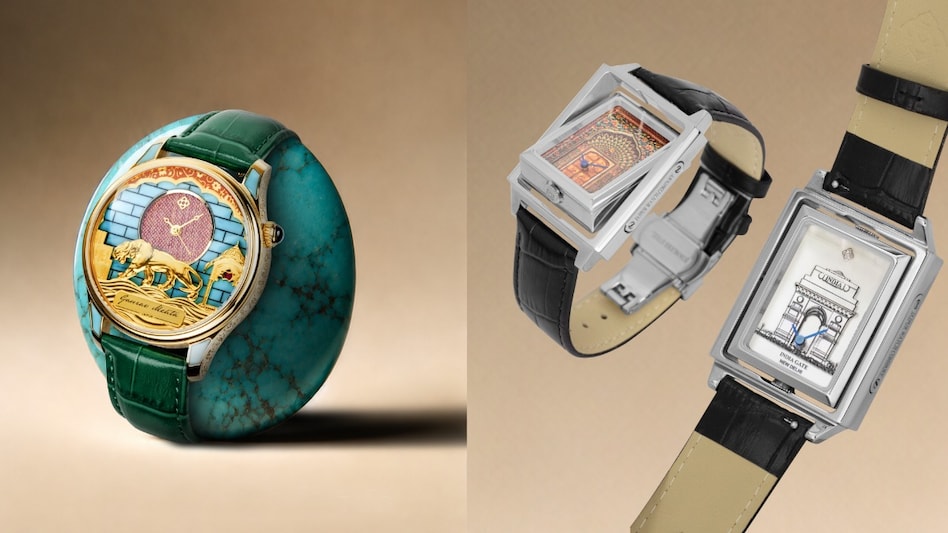 The Turquoise from the Premium Baagh collection is priced at ₹1,75,000 while the Gates of India collection is priced at ₹50,000.
 India is an important US ally, can't pivot from Russian oil overnight: Marco Rubio ahead of Mumbai visit
 Noel Tata evokes founding principles to guide Tata Trusts' new strategic shift
  No data needed? Airtel rolls out 3 new prepaid voice and SMS packs after TRAI directive
  'More patients than we want to count. It's a disaster': Canada military base fire overwhelms hospitals
 From storage to transport, FSSAI tightens checks on how paneer, meat, fish and khoa reach consumers
 Gold Vs Silver: Which Could Deliver Better Returns Over The Next 3–5 Years? Expert Shares Targets
 Gold, Silver ETF Purchases Halted: Why Mutual Funds Have Restricted Fresh Investments Before Diwali
 SIR Explained: Forms 6, 7 And 8—What Voters Must Know | Akshita Nandagopal Explains
 Gold Investment Options: ETFs, EGR And MCX Explained | How To Invest In Gold Beyond Physical Buying
 Redmi Note 17 Pro Max Review , Vivo V80, Vivo Vision | Tech Gear EP 20 | Business Today
 Markets Next Week: Jio Platforms IPO, high crude oil prices and Q2 earnings in focus
 10 investing mistakes retail investors should avoid, from overpaying to panic selling
 YES Bank Q2 profit rises 65% to Rs 1,080 cr; proforma impact of restatement of AT-I bonds revealed
 ICICI Bank Q2 results: Net profit jumps 20% to Rs 14,843 crore; NIM contracts
 IDBI Bank Q2 net profit falls 39% to Rs 2,205 crore on year-ago's one-off gain
  Advertising veteran blasts LIC's cancer insurance ad: 'Most horrific thing I've seen'
 'I hope Rishikesh holds on to its soul': Anand Mahindra reacts to spiritual town's makeover
 'A boon for people like me': LLB student turns Blinkit delivery partner, shares first-day earnings












