












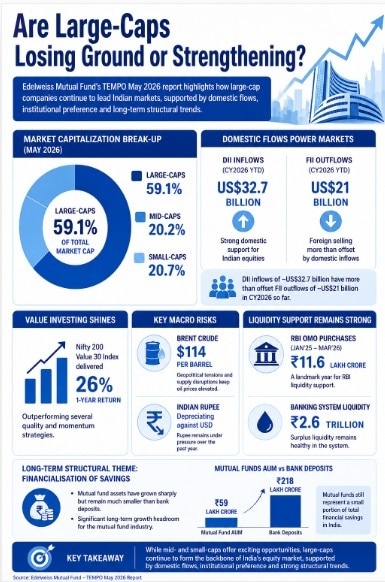



 While large-caps still dominate by size, investor preferences are shifting, with value strategies outperforming as the Nifty 200 Value 30 Index delivered nearly 26% one-year returns.
Despite growing investor enthusiasm for mid- and small-cap stocks, large-cap companies continue to dominate India’s equity landscape. Edelweiss Mutual Fund’s latest TEMPO report suggests that structural factors, domestic flows and institutional preference continue to reinforce large-caps’ market leadership.
India’s equity market has evolved significantly over the past decade. Mid-cap and small-cap stocks have increasingly captured investor attention, delivering strong returns during various market cycles and attracting retail participation through SIPs and mutual funds. Yet beneath this broader market participation, one reality remains unchanged: large-cap companies still dominate India’s stock market.

 BT India@100: Amitabh Kant says this one ‘neglected but important’ sector is the biggest driver of jobs
 India Inc’s $150 billion capex dwarfed by Microsoft-sized AI spend: Jayant Sinha flags investment gap
 90% EVs exported out of India are from Maruti Suzuki: MD & CEO Hisashi Takeuchi
 The $1.8 trillion space economy: Who will capture value as the final frontier goes commercial?
 More homes to get piped gas? Centre unveils incentive scheme to boost domestic PNG connections
 #IndiaAt100 : Adipen Bose Nandhiji On Conscious Capitalism- Can Profit & Purpose Coexist?
 #IndiaAt100 : Hisashi Takeuchi On Driving India’s Manufacturing Revolution
 #IndiaAt100 : Manufacturing For Viksit Bharat | Can Industry Power India’s $30-Trillion Dream?
 #IndiaAt100 : Tarun Garg On Hyundai & India’s Manufacturing Powerhouse Ambition
 #IndiaAt100 : CM Pushkar Singh Dhami On Uttarakhand’s Industrial Growth & India’s Next Leap
 Cupid, NTPC Green, NTPC, Raymond Realty, HAL shares: Key technical levels to watch
 Defence stock with Rs 2,654-crore order book hits record high; here's why
  GACM Technologies: FII holding jumps to 29%; penny stock in focus
 Puravankara shares rise 5% on fresh order win
  20 high-conviction ideas for up to 95% upside | stocks to buy The $1.8 trillion space economy: Who will capture value as the final frontier goes commercial?
 ‘Your blood will spill’: Maharashtra FDA commissioner Tukaram Mundhe recalls first-ever threat he received in 2007
 Anthropic's Claude has some tricks ChatGPT doesn’t: Key features explained
 US Navy P-8A Poseidon transits Taiwan Strait as China tracks aircraft: Report
 SBI FD rates vs Bank of Baroda vs Canara Bank: Which bank offers higher returns in 2026?


