









 India spends thousands of crores annually on CSR activities. By allowing a portion of these funds to flow through the Social Stock Exchange, policymakers aim to build a more structured social financing ecosystem.

 India spends thousands of crores annually on CSR activities. By allowing a portion of these funds to flow through the Social Stock Exchange, policymakers aim to build a more structured social financing ecosystem.
India's Social Stock Exchange (SSE) has received a major policy boost after the Ministry of Corporate Affairs (MCA) allowed companies to deploy a portion of their Corporate Social Responsibility (CSR) spending through the platform. The move is expected to increase funding opportunities for non-profit organisations while bringing greater transparency and accountability to social impact projects.
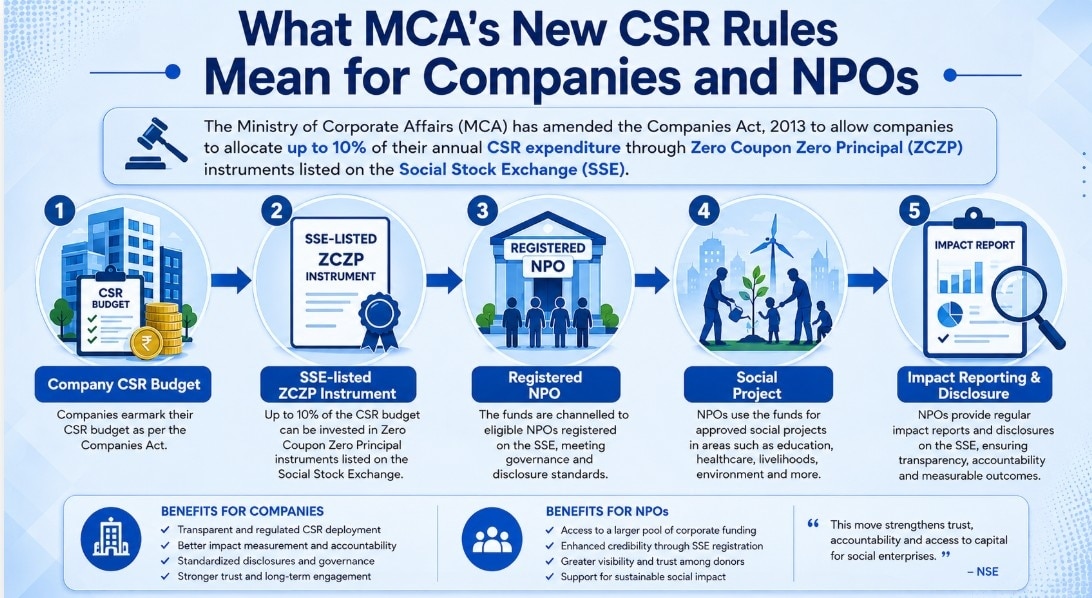
The MCA has amended Schedule VII of the Companies Act, 2013 to include subscriptions to Zero Coupon Zero Principal (ZCZP) instruments listed on the Social Stock Exchange as an eligible CSR activity. Under the new rules, companies can allocate up to 10% of their annual CSR budget through these instruments.
What is the Social Stock Exchange?
The Social Stock Exchange is a dedicated platform that connects social enterprises and non-profit organisations (NPOs) with donors, investors and funding providers. Unlike traditional stock exchanges where investors buy shares of companies for financial returns, the SSE focuses on generating measurable social impact.
The concept was first proposed by Finance Minister Nirmala Sitharaman in the Union Budget 2019 with the objective of leveraging capital market mechanisms to support social welfare initiatives and financial inclusion. Today, the NSE Social Stock Exchange operates as a regulated platform under the Securities and Exchange Board of India (SEBI).
MUST READ: BEL, HAL, Data Patterns, Apollo Micro, Zen Tech: Fresh target prices post Q4
How does the Social Stock Exchange work?
Eligible non-profit organisations can register and list on the Social Stock Exchange after meeting prescribed disclosure and governance standards.
One of the primary fundraising instruments available to NPOs is the Zero Coupon Zero Principal (ZCZP) instrument.
Unlike conventional bonds:
No interest (coupon) is paid
No principal amount is repaid
Contributions function as grants for social projects
Investors or donors support specific social causes rather than seeking financial returns
The platform requires periodic disclosures, impact reporting and compliance standards, helping donors and corporates track the utilisation of funds.
How CSR funding through SSE will work
Companies can allocate up to 10% of their annual CSR budget to subscribe to SSE-listed Zero Coupon Zero Principal (ZCZP) instruments issued by eligible non-profit organisations. The funds are then used for approved social projects, with regular impact reporting and disclosures ensuring transparency, accountability, and measurable outcomes.
What has changed now?
Previously, corporate CSR spending was typically routed directly to implementing agencies, foundations, trusts or NGOs.
Following the MCA notification dated May 27, 2026, companies can now use up to 10% of their annual CSR expenditure to subscribe to ZCZP instruments issued by eligible NPOs listed on the SSE.
This effectively creates a regulated and disclosure-based channel for CSR deployment.
Why is this important?
The amendment is expected to benefit both corporates and social enterprises.
For companies
Greater transparency in CSR spending
Standardized disclosures and reporting
Better impact measurement
Improved governance and accountability
For NPOs
Access to a larger pool of corporate funding
Enhanced credibility through SSE registration
Greater visibility among donors and institutions
Long-term funding opportunities
What could be the impact?
India spends thousands of crores annually on CSR activities. By allowing a portion of these funds to flow through the Social Stock Exchange, policymakers aim to build a more structured social financing ecosystem.
NSE believes the move will strengthen trust, accountability and access to capital for social enterprises while encouraging outcome-driven philanthropy.
As corporate India increasingly focuses on measurable social impact, the Social Stock Exchange could emerge as an important bridge between capital and social development, helping channel resources toward education, healthcare, livelihood generation, environmental sustainability and other public welfare initiatives.
 HDFC Bank review finds no basis for concerns flagged in Atanu Chakraborty’s resignation
 AMFI to renew push for higher overseas investment cap for mutual funds
 Where are the clouds? Latest satellite imagery shows vanishing monsoon over India
 Much of India’s technology stack is built on technologies developed elsewhere
 Volkswagen layoffs: German auto giant to axe 100,000 jobs, shut down four plants
 India's First Hydrogen Train Hits 120 kmph | No Diesel, No Wires, Only Water Vapour
 Rajan Bharti Mittal Touted India's $10 Tn Growth Story At UK-India Week
 Tech Gear Show | Latest Tech News, G-Shock, Redmi Turbo 5, HP EliteBook X G2a | EP 8 | Business
 Yogi Adityanath Alleges ₹4,600 Crore Purvanchal Expressway Tender Scam By SP
 NSE CEO Ashishkumar Chauhan Explains Why Every Entrepreneur Should Consider Listing
 Adani Enterprises, Adani Power, Adani Ports rally up to 61% in three months; is more upside left?
 TMPV or TMCV shares: Which Tata Motors stock has higher upside potential?
 'Those sectors that were new in 1990s...': Samir Arora says history is repeating
 NSE chief urges startups, MSMEs to view listing as a tool for scale
  Indian equities third-biggest losers after Indonesia, Hong Kong in 2026