




Search
Advertisement
South Korea crashed 15.57%, China fell 7.17% in October: Are emerging-market funds getting riskier?

South Korea crashed 15.57%, China fell 7.17% in October: Are emerging-market funds getting riskier?

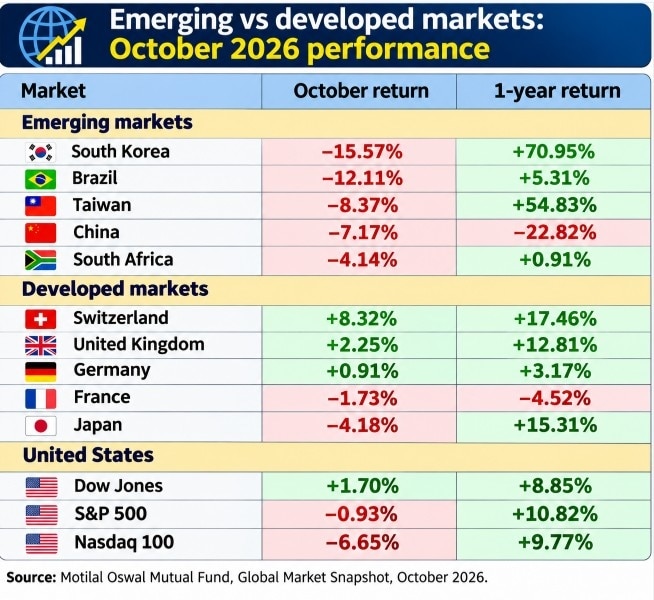
Emerging markets suffered sharp losses in October, with South Korea plunging 15.57% and China falling 7.17%, according to Motilal Oswal Mutual Fund. A fresh technology-led selloff in South Korea has intensified concerns over whether investors should rethink their exposure to emerging-market funds.

Business Today Desk
Business Today Desk
  • Updated Nov 7, 2026 5:31 PM IST
South Korea crashed 15.57%, China fell 7.17% in October: Are emerging-market funds getting riskier?The selloff intensified in November as South Korea's benchmark KOSPI plunged more than 8% in early trading, triggering a circuit breaker and temporarily halting stock and derivatives trading.

Emerging-market equities faced a sharp selloff in October 2026, with South Korea, Brazil, Taiwan and China recording substantial losses. The correction has raised questions about whether investors should reconsider exposure to emerging-market funds, particularly those concentrated in Asian economies.

According to Motilal Oswal Mutual Fund's Global Market Snapshot – October 2026, South Korea recorded the steepest monthly decline of 15.57%, followed by Brazil at 12.11%, Taiwan at 8.37%, China at 7.17% and South Africa at 4.14%.

Advertisement

The figures, based on MSCI country indices measured in US dollars, indicate broad-based weakness across emerging markets.

South Korea's sharp fall masks strong annual gains

Despite October's correction, South Korea remained among the strongest performers over the preceding year, delivering a return of 70.95%.

Taiwan also recorded a substantial one-year gain of 54.83%, despite falling 8.37% in October.

China presented a different picture. Its index declined 7.17% during October and remained down 22.82% over one year, highlighting persistent weakness.

Brazil fell 12.11% in October but retained a positive annual return of 5.31%.

MUST READ: Wall Street bleeds: Trump blames Democrats for $1-trillion stock rout post midterm shake up

KOSPI crashes 8.6%, triggers circuit breaker

Advertisement

The selloff intensified on Friday as South Korea's benchmark KOSPI plunged more than 8% in early trading, triggering a circuit breaker and temporarily halting stock and derivatives trading.

The Korea Exchange activated the 20-minute trading halt at 9:03 a.m. The index subsequently traded around 4,923.47, down approximately 500 points, or 8.6%, slipping below the 5,000 mark.

Technology stocks led the decline, with Samsung Electronics tumbling 10% and SK Hynix losing 13%. Hyundai Motor declined 6.9%, while LG Energy Solution and Kia fell 4% each.

MUST READ: Nifty 50 gains 1.91%, microcaps crash nearly 9% in October: Should investors shift SIPs to large caps?

The rout followed a sharp selloff in US technology stocks amid uncertainty over artificial intelligence and data-centre policies following Democratic gains in the US midterm elections.

Advertisement

"It is time for correction, but we feel that there may be some overreaction to the outcome of the midterm election," said Jun Kwang-woo, chairman of Seoul-based Institute for Global Economics.

Jun, a former chairman of South Korea's National Pension Service, also cautioned that AI infrastructure expansion could slow amid concerns surrounding data-centre development.

How did developed markets perform?

Developed markets showed mixed performance in October. Switzerland gained 8.32%, followed by the United Kingdom at 2.25%, while Japan declined 4.18%.

In the US, the Nasdaq 100 dropped 6.65%, the S&P 500 declined 0.93%, and the Dow Jones gained 1.70%.

The figures indicate that technology-led weakness extended beyond emerging economies.

ALSO READ: BT Explainer: Why stock markets are falling; behind AI rout & likely impact on India

Should investors reduce emerging-market exposure?

Emerging-market funds offer access to high-growth economies but carry currency, geopolitical and concentration risks.

For Indian investors, country-specific funds can experience sharper fluctuations than geographically diversified portfolios.

October's correction highlights why investors should examine a fund's country and sector exposure rather than relying solely on its emerging-market classification.

Developed-market funds can provide diversification, although they remain vulnerable to global corrections.

Advertisement

The bottom line: South Korea's 15.57% October decline, despite a 70.95% annual gain, illustrates the volatility of emerging-market investing. Investors should review geographic concentration and investment horizons before making allocation changes.

DO READ: US stocks or US ETFs: Should Indian investors buy NVIDIA directly or invest through Nasdaq 100 funds?

Disclaimer: Business Today provides stock market news for informational purposes only and should not be construed as investment advice. Readers are encouraged to consult with a qualified financial advisor before making any investment decisions.

ABOUT THE AUTHOR

Business Today Desk
Business Today Desk

Business Today brings you the latest news, views and analysis from the world of finance, economy, markets, corporates, startups, tech, and the digital economy. You can find everything from breaking news to deep dives to immersive essays and more on a variety of subjects across all formats - online, magazine, television, data visualisation, et al.

Published on: Nov 7, 2026 5:17 PM IST