











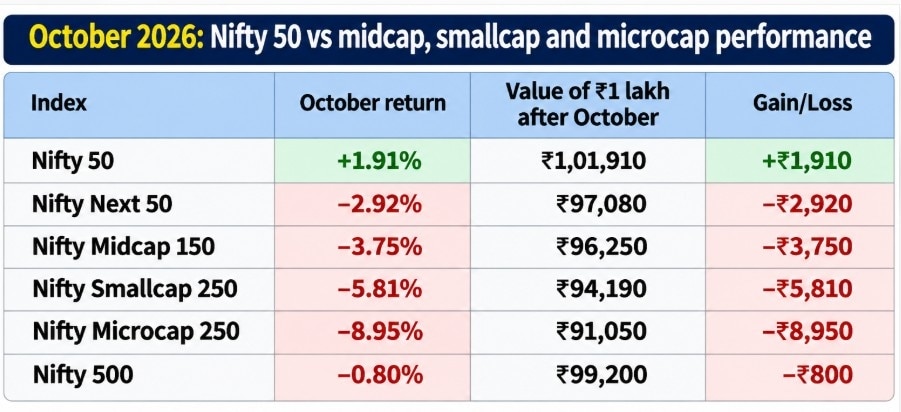



 October's nearly 11-percentage-point gap between Nifty 50 and microcaps highlights the need for diversification. Investors should review portfolio concentration and rebalance if needed rather than abruptly stopping SIPs.
Indian equity markets witnessed a sharp divergence in October 2026, with large-cap stocks outperforming while mid-, small- and microcap indices suffered significant losses. The contrasting performance has raised a crucial question for mutual fund investors: Is it time to redirect SIPs towards large-cap funds or continue investing in smaller companies despite the correction?
According to Motilal Oswal Mutual Fund's Global Market Snapshot – October 2026, the Nifty 50 gained 1.91% during the month, while the Nifty Microcap 250 plunged 8.95%. The Nifty Smallcap 250 declined 5.81%, Nifty Midcap 150 fell 3.75%, and Nifty Next 50 lost 2.92%. The broader Nifty 500 also slipped 0.80%.

 SEBI's new settlement rules effective November 7: Online applications, revised fees, fast-track process explained
 India loses $13 billion worth of food annually: How climate change is worsening the crisis
 India sent $29 billion abroad, but LRS isn't the forex problem, says Capitalmind's Deepak Shenoy
 Can you convert NSE's Electronic Gold Receipts into jewellery or physical gold? Here's how redemption works
 Videocon promoter Venugopal Dhoot declared bankrupt as NCLT accepts SBI plea over Rs 12,668 cr dues
 Gold Prices Down 30%: Why Ajay Kedia Sees A New Bull Run Ahead | Gold & Silver Outlook
 Samvat 2083 Outlook: Why Investors Should Focus on the Next 10 Years, Not 6 Months
 Nilesh Shah On Why Earnings Growth Matters More Than FII Flows For India's New-Age Stocks
 5 Must-Have Asset Classes for a Diversified Mutual Fund Portfolio
 Samvat 2083: Which Sectors Could Create The Biggest Wealth As India's Economy Moves Towards $7T?
 SEBI's new settlement rules effective November 7: Online applications, revised fees, fast-track process explained
 Zerodha Fund House becomes Zerodha CASE Funds as investor base crosses 12 lakh in three years
 Gold, silver or stocks this Dhanteras? Nifty 500 won 9 years, gold 7 and silver 5 since 2006
 Bharti Airtel shares: Citi remains bullish after strong Q2 despite elevated churn; Rs 299 plan restored
 Vijay Kedia shares formula on how to pick stocks during correction Gold Prices Down 30%: Why Ajay Kedia Sees A New Bull Run Ahead | Gold & Silver Outlook
 Canada Express Entry changes: High-wage workers to get up to 100 additional CRS points
 Donald Trump celebrates Diwali at White House, receives Hanuman Chalisa as gift
 Dhanteras 2026: NSE gold receipts hit record trading volume of 2.27 lakh units as demand surges
 India's extreme poverty fell to 2.3% from 21.9% in 12 years, says recent paper co-authored by Panagariya


