


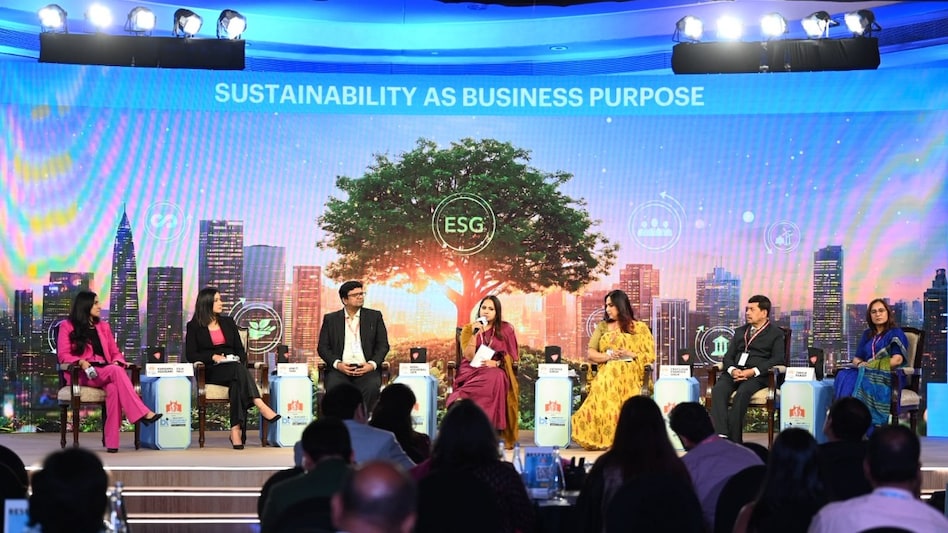
 Speakers at a session titled 'Sustainability as a Business Purpose' at BT India's Most Sustainable Companies Summit and Awards.
Sustainability is increasingly becoming a core business imperative rather than a compliance requirement, with companies and governments embedding climate action, resilience and community development into long-term growth strategies, speakers said at a session titled 'Sustainability as a Business Purpose' at BT India's Most Sustainable Companies Summit and Awards.
Ankit Todi, Chief Sustainability Officer at Mahindra Group, said the conglomerate has redefined its long-term vision around becoming a "planet positive" company through a multi-pronged strategy that integrates sustainability into business operations and future growth plans.

 Nepal flash floods: Infosys subsidiary chief Lax Gopisetty not reachable. Read full company statement here
 West Asia conflict: Delhi CNG price to rise by ₹3.89 per kg; check latest CNG rates here
 Mahindra takes battery-as-a-service to entire electric SUV line-up
 ITR-3 vs ITR-4: Which income tax return form should freelancers, traders and business owners use?
 After 2024 bleaching: Super El Niño likely to push coral reefs closer to the brink
 CMF Buds Neo Review | Tech Gear | Business Today
 Gen Z Is Changing Politics? D.K. Shivakumar On Youth Power & Rahul Gandhi’s Outreach
 Babita Singh Reporting, Part-Timers, Bandar & More: 5 OTT Releases To Watch This Weekend
 Using AI To Write? You Could Be Caught! Anthropic's Invisible Watermark Explained
 Shah Rukh, Salman & Madhuri-Backed Pernia’s Pop-Up Shop Parent Eyes ₹680 Cr IPO
 Jio Platforms IPO gets SEBI nod: Rs 27,500 crore debt repayment plan, $100 billion valuation in focus
 Closing Auction Session: Why the system expected to reduce volatility is still seeing occasional wild swings
 RIL-backed penny stock hits 52-week low; firm clarifies on high trading volume
 Happiest Minds shares slip despite IT stocks surge; here's what is weighing on the stock
 BEL, Solar Industries shares remain Nuvama's top defence picks; here's what it said on BDL, Data Patterns, HALNepal flash floods: Infosys subsidiary chief Lax Gopisetty not reachable. Read full company statement here
 JEE rank at 17, career at 40: Indian professional asks why we still care about an exam taken in adolescence
 Quote of the Day by Deepinder Goyal: ‘The goal is not to be the best company in the world, but the best company for the world’
  How India’s deep-tech ecosystem is at an inflection pointWest Asia conflict: Delhi CNG price to rise by ₹3.89 per kg; check latest CNG rates here
FAQs
Why is sustainability being treated as a business purpose rather than only a compliance requirement?
Sustainability is now seen as a driver of long-term growth, resilience and value creation. Companies are integrating climate action, resource efficiency and community impact into core business strategy to stay competitive and future-ready.
How is Mahindra Group building a planet positive business strategy?
Mahindra is focusing on reducing environmental impact across energy, water, waste and materials, while also expanding green businesses. This includes electric vehicles, green buildings, sustainable resorts and a strong renewable energy portfolio.
Why does PepsiCo India consider sustainability important for competitiveness?
PepsiCo depends heavily on agriculture for raw materials such as potatoes, millets and rice. By supporting regenerative agriculture, micro-irrigation, soil health and farmer resilience, the company aims to reduce supply-chain risks and strengthen long-term competitiveness.
What sustainable tourism approach is Maharashtra promoting?
Maharashtra is promoting responsible tourism that balances economic growth with conservation and community well-being. The state is developing homestays, eco-tourism and agro-tourism in smaller districts to create local livelihoods and reduce pressure on popular destinations.
What role can AI play in sustainability and business models?
According to the discussion, AI can improve predictability, connect ecosystems and support more sustainable business models. It can also help with cost optimisation, operational longevity and better coordination across stakeholders.













