Speaking on the launch, Sankaran Naren, Executive Director and Chief Investment Officer at ICICI Prudential AMC, said the balanced allocation is designed for the current market environment.
"ICICI Prudential Balanced Hybrid Fund is designed to strike a suitable balance between equity and debt allocation, with each receiving an allocation of 40-60% of the portfolio, basis prevailing market conditions. We believe this balanced approach is well placed to navigate the current environment while supporting both income generation and long-term wealth creation for investors," he said.
MUST READ: Why silver emerged as the biggest common bet for top multi-asset funds in May
Why balance matters now
Aggressive hybrid funds typically invest 65-80% of their assets in equities and 20-35% in debt. Balanced hybrid funds, on the other hand, maintain a more even allocation of 40-60% in both asset classes, offering greater flexibility to increase debt exposure when equity valuations appear expensive or market risks rise.
MUST READ: Stop chasing returns: These 10 mutual fund ratios matter more than 5-year CAGR
That distinction becomes particularly relevant in an environment marked by geopolitical tensions, uncertain global growth, changing interest rate expectations and elevated domestic equity valuations.
According to ICICI Prudential, equity remains the primary driver of long-term wealth creation but is inherently volatile. Debt, meanwhile, provides relatively stable returns and can cushion portfolios during periods of market correction. Combining the two asset classes allows investors to benefit from their different market cycles rather than relying solely on one source of returns.
The fund house has also highlighted historical data showing that a hypothetical 50:50 equity-debt portfolio experienced smaller losses during major equity market declines while delivering higher long-term returns than debt alone in normal market conditions. While past performance is no guarantee of future returns, the data underscores the diversification benefit of maintaining balanced exposure across asset classes.
MUST READ: Why Jio BlackRock feels hybrid long-short is the perfect fund to launch now as it enters the SIF space
Should investors switch?
Whether investors should move from aggressive hybrid funds to balanced hybrid funds depends largely on their financial goals and risk appetite rather than market timing alone.
Investors with long investment horizons and the ability to tolerate significant volatility may still prefer aggressive hybrid funds because of their higher equity allocation. However, those approaching financial goals, seeking more stable portfolio behaviour or concerned about sharp market corrections may find balanced hybrid funds more suitable.
ICICI Prudential Balanced Hybrid Fund: Key Details
| Particulars |
Details |
|---|
| Fund name |
ICICI Prudential Balanced Hybrid Fund |
| Fund type |
Open-ended Balanced Hybrid Scheme |
| NFO opens |
June 30, 2026 |
| NFO closes |
July 14, 2026 |
| Investment objective |
Capital appreciation and income through investments in equity and debt instruments |
| Equity allocation |
40%–60% |
| Debt & money market allocation |
40%–60% |
| Arbitrage exposure |
Not permitted |
| Equity strategy |
Active investing across market capitalisations and sectors |
| Debt strategy |
Invests across duration, AAA-rated bonds, government securities (G-Secs) and credit opportunities |
| Portfolio review |
Periodically based on valuations, earnings outlook and bond yields |
| Minimum investment |
₹500 (and multiples of Re. 1 thereafter) |
| Plans available |
Direct Plan and Regular Plan |
| Benchmark |
CRISIL Hybrid 50+50 – Moderate Index |
| Fund managers |
Roshan Chutkey, Manish Banthia and Akhil Kakkar |
| Suitable for |
Investors seeking a balance between long-term capital growth and relatively lower portfolio volatility |
MUST READ: How your investments are taxed in 2026-27: ITR filing guide for stocks, FDs, gold, mutual funds
The new ICICI Prudential scheme will actively invest across market capitalisations and sectors on the equity side, while the debt portfolio will span government securities, AAA-rated bonds, duration opportunities and credit instruments. Allocation between equity and debt will be reviewed periodically based on prevailing market conditions rather than maintained at a fixed ratio.
For investors who are uncomfortable taking an all-equity approach but still want long-term capital appreciation, balanced hybrid funds could offer a middle path—one that aims to participate in market gains while reducing the impact of volatility through disciplined diversification.
Balanced Hybrid Fund vs Aggressive Hybrid Fund
| Feature |
Balanced Hybrid Fund |
Aggressive Hybrid Fund |
|---|
| Equity allocation |
40%–60% |
65%–80% |
| Debt allocation |
40%–60% |
20%–35% |
| Risk level |
Moderate |
Moderately High to High |
| Return potential |
Moderate to High |
Higher over the long term |
| Downside protection |
Better due to higher debt allocation |
Lower during sharp market corrections |
| Suitable for |
Investors seeking a balance between growth and stability |
Investors with higher risk appetite and longer investment horizon |
| Portfolio strategy |
Dynamic allocation between equity and debt based on market conditions |
Equity-focused with limited debt allocation |
| Volatility |
Lower than aggressive hybrid funds |
Higher because of greater equity exposure |
| Ideal investment horizon |
3–5 years or more |
5 years or more |
| Best suited for |
Conservative to moderate investors and those nearing financial goals |
Long-term wealth creators comfortable with market volatility |
MUST READ: Edelweiss Mutual Fund launches India’s first hybrid index fund combining equities, G-Secs; should do you get it?













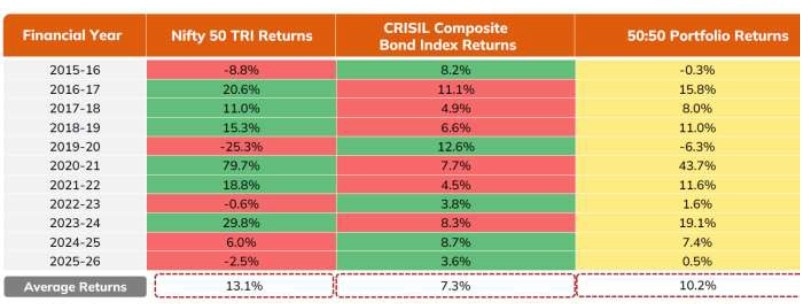



 According to ICICI Prudential, combining equity's long-term growth potential with debt's relative stability can help investors navigate market volatility while reducing downside risk.
 'RBI letter does not mention listing': Noel Tata seeks full briefing on Tata Sons-RBI talks
 Tata Trusts asks Tata Sons to explore options other than listing, says ‘Tata Model has to be saved’
 Tata Trusts proposes ₹25,000 crore plan for SP Group, says Tata Sons listing is not an option
 Chandrasekaran had assured all necessary steps were being taken to remain private: Noel Tata
 'We cannot put the cart before...': Noel Tata's argument against N Chandrasekaran's reappointment
 How India Changed In 12 Years: PM Modi’s Journey From Economic Reforms To Viksit Bharat
 Modi @76: From Twitter To Instagram, How His Digital Outreach Has Evolved
 Stock Picks To Watch: Shibani Kurian Reveals Kotak AMC’s Market Bets
 Gold ETF vs Physical Gold: Know the Tax Rules, Charges and Key Differences
  PPF vs NPS: Tax Benefits, Returns and Lock-in Period Explained for Retirement Planning
 Hero Motors IPO subscribed 3.37 times on Day 2; retail portion subscribed over 5 times
 NSE IPO: India's largest exchange gets 43% subscription on Day 1; NIIs, retail see strong demand
 Rentomojo shares settle maiden trade nearly 32% above IPO price; what should investors do now?
 Sensex slips, Nifty settles higher; Tata stocks gain after N Chandrasekaran reappointment
 Cochin Shipyard, KRBL, RITES, Ramky Infrastructure among stocks to turn ex-dividend on September 18
 Noida Airport commuters can drive through toll plaza without stopping, here’s how it will work
 OTT releases this week (Sept 14- Sept 20): 'Irumudi', 'Thudakkam', 'Lee Cronin's The Mummy' and more to watch this weekend
 NMDC's Panna mine unearths 27.29-carat diamond, second-largest discovery so far
 Flexicap funds: 90.6% large caps vs 55.2% small caps — 10 biggest portfolio differences
 Who is Sethuraman Panchanathan? Chennai-born scientist honoured with NAE’s prestigious Bueche Award


