












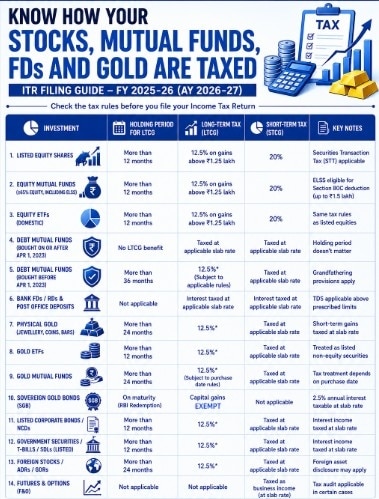



 Financial planners say investors should focus on post-tax returns, not just headline yields, as taxes, exemptions and TDS can significantly affect actual gains.
Choosing the right investment is no longer just about earning higher returns. Taxation has become an equally important factor, as different financial products—from stocks and mutual funds to fixed deposits, gold and government securities—are subject to different tax rules depending on the holding period and nature of income.
A tax reckoner for FY2025-26 (Assessment Year 2026-27) outlines the latest tax treatment across popular investment options, helping investors understand how capital gains and income from various asset classes are taxed.

 State finances are turning into a matter of concern. Here’s why
 GE HealthCare targets 2X+ exports from India by 2030
 Hisar to Sohna-Palwal: Haryana approves ₹9,700 crore for five major bypass projects
 ‘No amount of US pressure should justify recklessness’: Sam Altman backs 'slow' frontier AI pace
 NSE IPO: Nithin Kamath recalls how NSE supported Zerodha in its early years
 Amit Shah Hails India’s Rise From Fragile Five To Top Five, Politics Of Performance Since 2014
 MEA Details BRICS Summit Outcomes as India Pushes Practical and People-Centric Cooperation
 Modi@25: Amit Shah Highlights 25 Years Of Leadership, Governance And 2047 Vision
 “Development And Environment Are Complementary”: PM Modi On Sustainability At BRICS
 Modi@25: Amit Shah Announces Seva Sankalp Campaign From Sept 17 To Mark Modi’s 25 Years Of Service
 Solar Industries to acquire South African firm Omnia Holdings for Rs 12,951 crore
  Tata Sons: A look at net worth of the holding company as IPO buzz gains traction NSE IPO: Nithin Kamath recalls how NSE supported Zerodha in its early years
 Tata Sons listing: Tata Steel, TMPV, Tata Chemicals among stocks that could benefit; here's why
 KEC International wins new orders worth Rs 1,303 crore across T&D, cables businesses
 iPhone 18 Pro effectively around ₹70,000: Here's how you get discounts
 'It is my vehicle, I was at work': Gurugram car owner says friend was driving during woman biker crashSolar Industries to acquire South African firm Omnia Holdings for Rs 12,951 crore
  Gen Z drives 79% of new formal job accounts in India in FY26: Quess reportTata Sons: A look at net worth of the holding company as IPO buzz gains traction


