












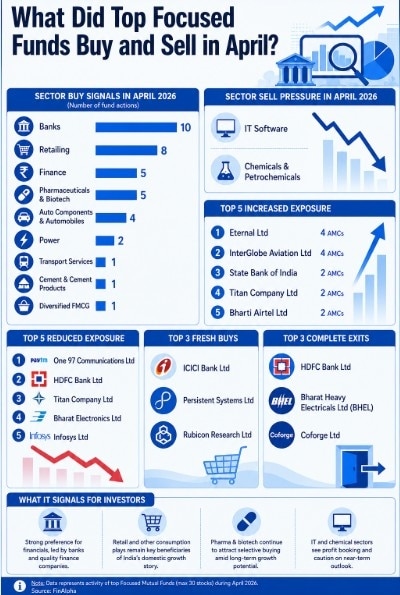



 Focused funds favored domestic themes, with banks (10), retail (8), and finance/pharma (5 each) leading buys.
Focused mutual funds, known for making concentrated, high-conviction bets, appear to be turning increasingly optimistic on banks, retail businesses, and select financial stocks. Portfolio changes in April indicate that fund managers are shifting allocations toward sectors linked to domestic consumption and financial growth, while reducing exposure to segments such as IT software and chemicals.
According to portfolio data compiled by FinAlpha, banks emerged as the strongest sectoral preference among focused equity funds during April, followed by retailing and finance. The latest buying patterns offer insights into where fund managers see opportunities amid evolving market conditions.

 GST Council October 8 meeting: What’s likely to be on the table
  SRIT India, Shah Investor's Home make positive D-st debut; both stocks list at premium
 BT BIG STORY | Market meltdown: Is it time to buy the dip?
 'Airspace restrictions have resulted in...': Airlines seek 25% landing parking charge relief for airlines amid West Asia conflict
 Ola, Uber, Rapido must transition to 100% EV fleets by July 2027 in Maharashtra
 Varmora Granito IPO: How Management Plans To Reduce Morbi Concentration Risk
 Value Buying, Short Covering Pushes Stocks Higher; BSE, ITC Shine
 Future Of MBA: ISB Dean Madan Pillutla On AI, Skills, Careers And Lifelong Learning
 How Amaravati Plans To Become A Quantum Hub
 MBA In The AI Era:IIM Ahmedabad Director On The Changes In Management Education
 Rentomojo shares rise 10% after Q1 revenue jumps 51%
 Will largecap de-rating prove cyclical? Morgan Stanley identifies what may lift share prices
 Top smallcap stocks to buy: Monarch Networth sees up to 51% upside; check targets
 Balaji Amines, Alkyl Amines, Deepak Nitrite, Aarti Ind: Why chemical stocks rallied up to 20% today; targets
 Gold, silver outlook: Key support, resistance levels; triggers to watch Rentomojo shares rise 10% after Q1 revenue jumps 51%Will largecap de-rating prove cyclical? Morgan Stanley identifies what may lift share prices
 PM Modi’s diplomatic feast: What was on the menu at PM Modi’s lunch for the Swiss president?
 Apple’s next iPads could get slimmer bezels with major display upgrades: What’s comingTop smallcap stocks to buy: Monarch Networth sees up to 51% upside; check targets


