












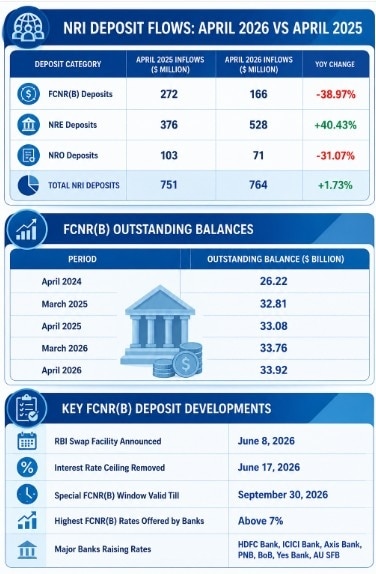



 Even though fresh inflows weakened, outstanding FCNR(B) balances rose from $33.08 billion in April 2025 to $33.92 billion in April 2026.
The Reserve Bank of India's (RBI) latest measures to attract foreign currency deposits from non-resident Indians (NRIs) have triggered a sharp increase in FCNR(B) deposit rates, with several banks now offering returns of 6% to over 7% on US dollar deposits. However, the move comes against the backdrop of weakening inflows into these accounts, with April data showing that NRI dollar deposit momentum had slowed significantly even before the RBI stepped in.
Annual FCNR(B), deposits

 HDFC Bank fast-tracks CEO search: Who could succeed Jagdishan as more names crop up?
 ‘We do not need lower standards but wider lenses’: Gautam Adani calls for new credit framework
 'Thank you for being a constant source of inspiration': Tim Cook bids farewell to Apple as CEO
 ‘I have nothing left to give’: Lionel Messi bids emotional farewell to Argentina after 20 years
 BT Explainer: What are EREVs? Why JSW MG Motor may bring this tech to India next
 Indian Markets Outlook: Is Bear Phase Ending? Maneesh Dangi Sees Better Next 6-12 Months
 This ₹5 Lakh AI Gym Wants To Replace Your Gym
 Nepal Flood Horror: Sadhguru, Manisha Koirala Stand In Solidarity As Rescue Efforts Continue
 Nepal Flood Horror: Children Found Alive After Days Under Debris, Hope Emerges From Devastation
 India’s 6% Growth Trap: Why Manufacturing Still Struggles To Beat China
 Priority Jewels IPO subscribed 21.23 times on Day 2; check latest GMP, other key details
 Ola Electric shares jump 5%; still down 34% in a year; what's ahead?
 Sensex falls 307 points, Nifty settles below 24,100; what happened today
 Market veteran Ajay Bagga on top sectoral picks; impact of oil prices, monsoon on economy
  Nifty Bank jumps over 600 points in last five minutes; CAS in focus
 India’s hidden stimulus: How a ₹33-lakh-crore gold stockpile could boost consumption
 Property vs mutual funds: Where should your first ₹50 lakh of wealth go?
 Save for 5 kg gold in 10 years? How Axis MF’s gram-based Shagun SIP works
 Julie Andrews at 90: 'The Sound of Music' star reveals why she still feels much younger than her age
 UTI Mutual Fund, Bank of India MF launch new equity schemes; NFOs close on September 11


