The answer, experts say, is no longer straightforward.
The era of blind prestige is fading
Experts say students can no longer evaluate universities purely through global rankings or aspirational branding.
“Students today need to evaluate a foreign degree through three lenses: career outcome, financial sustainability, and policy stability," Saurabh Arora, Founder & CEO of University Living, told Business Today.
He added that employability now matters far more than university prestige alone.
“Students should not evaluate universities only through rankings anymore. They need to look at what graduates from that specific course are actually doing after graduation. Internship access, industry exposure, local hiring demand, alumni outcomes, salary range, and employer networks matter far more today than a broad university brand alone.”
Ritika Gupta, CEO of Global Education Mentor, AAera, echoed a similar view, saying the actual course and job market often matter more than the country itself.
“The university and country students attend are not as important as the actual course and the job market in determining ROI.”
Experts say students now need to evaluate:
-
Internship opportunities
-
Post-study work visas
-
Employability outcomes
-
Industry demand
-
Expected salary after graduation
-
Recovery timeline for education loans
-
Accommodation and living costs
Immigration uncertainty has changed the equation
One of the biggest shifts over the past few years has been the tightening of immigration systems across traditional study destinations like the US, UK, Canada, and Australia.
“The UK has tightened migration policies, Canada has reduced study permit volumes, and Australia has increased visa scrutiny, making students far more conscious about long-term work opportunities and career pathways after graduation,” Arora said.
While overseas education continues to attract Indian students, experts say the assumption that a foreign degree automatically guarantees global career success is fading.
“I would not say the return on investment from overseas education has declined universally. What has changed is the way students define and evaluate ROI today,” Arora added.
Students are now approaching overseas education more cautiously because of layoffs, inflation, visa restrictions and rising living expenses.
Gupta pointed out that ROI calculations today must include economic uncertainty and changing visa systems.
“Some of these factors include numerous changes to the visa processes (among others), the numerous layoffs occurring within virtually all sectors of the economy due to those layoffs, and the continuing inflation and rising costs of living.”
The hidden cost problem
Experts say many families still underestimate the true cost of overseas education.
Tuition is only one part of the financial burden. Accommodation, healthcare, insurance, transport, deposits, visa fees, flights and currency depreciation can significantly inflate costs over two to three years.
“Rupee depreciation alone has added ₹5–8 lakh per year to the cost of an overseas degree for Indian families,” Arora said.
He added that between 2021 and 2025, fees and living expenses across major destinations, including the US, UK, Canada, Australia, Germany and France, collectively rose by 35–40%.
This is particularly important because a growing number of Indian students now depend on education loans.
“Recent industry reports suggest that nearly 1 in 3 Indian students studying abroad now depend on education loans,” Arora said.
Both experts stressed that students should rethink overseas education if the financial plan depends entirely on securing a high-paying foreign job immediately after graduation.
“I would advise students to rethink the investment if the loan size becomes disproportionate to the family’s financial capacity, if major family assets are being heavily leveraged without backup liquidity, or if the chosen programme does not have strong employability visibility in the destination market,” Arora said.
Gupta offered a similar warning.
“Moreover, you should NEVER go to school just to get an international qualification to be eligible for migration.”
So who still benefits the most?
Experts believe overseas education still delivers strong long-term value, but mostly for students entering specialised and globally relevant sectors.
Programs linked to AI, cybersecurity, engineering, healthcare, finance, climate tech and advanced research continue to see strong global demand.
“Students pursuing specialised programs linked to sectors like AI, cybersecurity, healthcare, engineering, finance, climate tech, data science, and advanced research are generally seeing stronger long-term global demand and better ROI potential,” Arora said.
Gupta added that international education continues to offer benefits that go beyond immediate salary gains.
“Global learning has opportunities to understand different business cultures as well as to have access to a broader range of contacts and global networks.”
She said students also gain exposure to multinational work environments and international research ecosystems that may compound professionally over time.
Can Indian degrees now offer better value?
India’s rapidly expanding startup ecosystem, digital economy and corporate hiring landscape have also changed the conversation.
Arora noted that top Indian institutions continue to offer excellent returns at significantly lower costs.
“A quality Indian degree still delivers exceptional ROI in many cases, especially for students entering India's rapidly growing sectors like technology, consulting, finance, entrepreneurship, and digital businesses.”
Gupta also said that for many students, staying in India and investing the remaining money elsewhere may provide greater financial security.
“For many of you, gaining a high-quality degree from India and using the balance of your funds to create a strategic investment in your future may provide you with a more secure financial base and provide you with similar opportunities for advancement in an expanding Indian economy.”
At the same time, both experts agreed that comparing Indian and foreign degrees purely on salary misses the bigger picture.
Students studying abroad often gain access to global labour markets, multinational employers, international peer networks and multicultural work exposure much earlier in their careers.
“Students studying abroad are not just earning a degree. They are spending years inside global economies, international classrooms, multicultural work environments, and industry ecosystems,” Arora said.
The answer now depends on alignment
Experts say the biggest shift in 2026 is that overseas education is increasingly being treated like a long-term investment decision rather than an aspirational milestone.
“The real question today is not whether a foreign degree is worth it or not. The real question is whether the student has chosen the right course, in the right country, at the right cost, with a realistic strategy to convert that experience into long-term career value,” Arora said.
Gupta summed up the debate more directly: “The response to your question would depend on what type of career you intend to pursue.”
For students seeking global careers, international research exposure and multinational opportunities, the investment may still pay off over time.
But for others, especially those entering sectors growing rapidly inside India itself, a quality domestic degree paired with strategic investments, upskilling or entrepreneurship may now deliver equally strong, and sometimes safer, long-term returns.



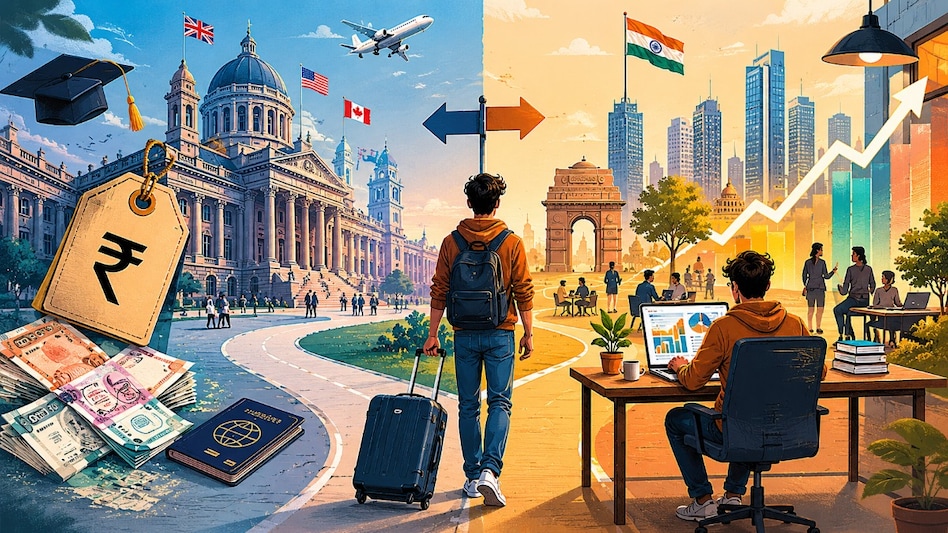 ROI, rupee depreciation and reality checks: A frank look at whether overseas education pays off in 2026
 'We do not censor content': MeitY Secretary S Krishnan breaks down India's social media blocking framework
 Elon Musk says Starlink can help India’s rural users as satellite internet launch plans resurface
 Tata Motors PV to hike car prices by ₹25,000 from next month
 India targets 35-40% domestic value addition in mobile phones, says MeitY Secretary S Krishnan
 H1N1 surge in Delhi: Cases jump six-fold year-on-year to 1,449 as hospital doctors test positive
 Smartphone Price Hikes Hit India: Will Diwali Discounts Offset Rising Costs?
 Sugar Prices Surge Ahead Of Diwali: Is India’s Ethanol Push Creating A Food-Versus-Fuel Crisis?
 Sugar, Internet, Pharma Shares Rise In Strong Trade
 ₹30,000 Monthly SIP? 5 Funds Suggested For A 20-Year Wealth Creation Strategy
 Is ₹20,000 SIP Enough To Build Wealth? The 15–20 Year Investment Math Explained
 BHEL, CG Power, L&T, Siemens Energy, Voltamp: Buy, hold or sell? Target prices
 Lumino Industries IPO opens on August 27: Check price band, issue size, order book & key details
  Shankesh Jewellers IPO: How to check your application status, odds of allotment, latest GMP & more
 Sunshine Pictures IPO: How to check you application status, odds of allotment, latest GMP & more
 ICICI Bank board approves $5 billion overseas borrowing limit
 Nothing OS 5.0 is coming next week with Android 17: Top features to expect












