

 Low volatility stocks tend to do very well during turbulent markets when investors seek relatively safer investments.
Most investors look forward to having a portfolio that is steady in its performance and does not fluctuate wildly with market movements, especially on the downside. To cater to this need, a smart-beta or factor-based investing style with low volatility as the focus is available for investors. Factor or rule-based investing combines the best of passive and active styles of investing and low volatility indices offer the opportunity for investors to build a portfolio that does not gyrate sharply.
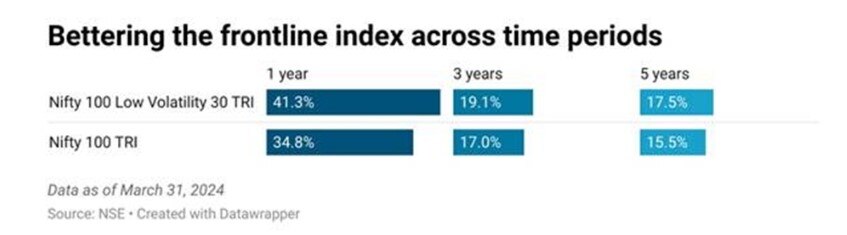
Broadly, as a factor, low-volatility investing means that an index falls less than broader markets during periods of corrections, while ensuring reasonable participation during rallies. The Nifty 100 Low Volatility 30 Index is a benchmark index available for investors. There are multi-factor indices available as well which has low volatility as a key ingredient. For example: The Nifty Alpha Low Volatility 30 Index.
Lower Volatility for Reduced Risk
Essentially, a low volatility strategy means buying stocks or an index of such stocks that have a fair degree of stability in their price movements. Lower volatility means lower fluctuations, lower uncertainty and lower risks compared to the broader markets. Statistical measures such as beta and standard deviation among a few other metrics are commonly used to gauge risks and fluctuations.
Usually, low volatility stocks tend to do very well during turbulent markets when investors seek relatively safer investments. The strategy works due to three key market factors that come into play.
Many investors irrationally prefer to invest in highly volatile stocks hoping they would turn into multi-baggers and even pay high valuations while buying them. They tend to ignore low volatility stocks or underpay for them. This is called the lottery effect.
Overconfidence effect results from investors having too much (often misplaced) confidence in their ability to forecast earnings for the future of companies that are highly volatility. They end up painting highly optimistic scenarios for high volatility stocks, which may end in disappointment.
The third and most important factor at play is the prospect of asymmetric returns. Low volatility stocks and indices fall a lot less than the broader markets during declines. These lower falls tend to substantially compensate for the relative underperformance during market rallies. Thus, the overall returns are robust on a risk-adjusted basis.
There are two kinds of shocks that cause market volatility – endogenous and exogenous.
When a turmoil or recession or tough macro environment is due to factors that are intrinsic to the economy then it is termed as endogenous shock. Examples may be the global financial crisis, demonetization, sovereign defaults, trade wars etc.
Exogenous shocks come from factors outside a country. Russia-Ukraine war, Israel-Hamas tensions, COVID-19, SARS, oil price spike are some of the examples.
A low volatility strategy would look to help in weathering exogenous challenges, while hedging the portfolio reasonably due to endogenous factors.
Playing Low Volatility Via ETFs
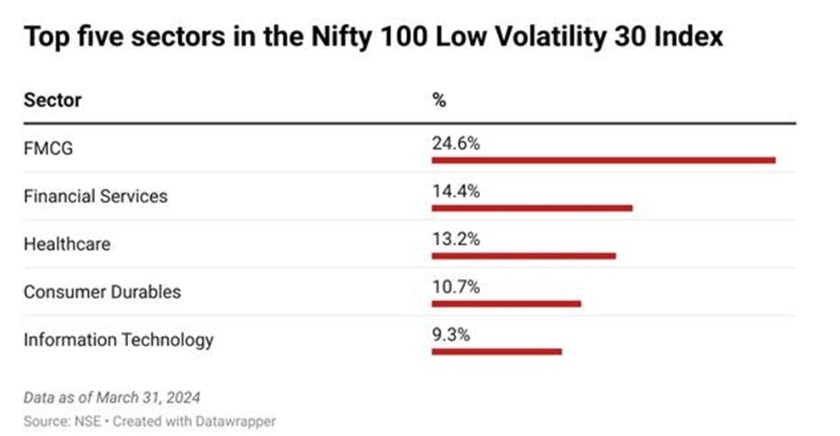
For an investor, the addition of an investment in an index like the Nifty 100 Low Volatility 30 offers an opportunity to limit the impact of market volatility on the overall portfolio. Through this investment, one gets exposure to the least volatile stocks from the large-cap pack.
 How Indian investment overseas is gathering momentum
 Indian-origin CEO Shailesh Jejurikar appointed Chairman of P&G Board
 To stay ahead, Indian manufacturers are embracing AI
 Dabur India Q1 results: Profit up 15% at Rs 591 crore YoY; revenue climbs 11%
 10-year jail, ₹50 lakh fine: Lok Sabha approves anti-paper leak bill; key details inside
 LIVE Daily Calls: Ask Your STOCK MARKET TODAY QUERIES | Market Update LIVE | Share Market News Today
 Why Are Markets Rallying? Ajay Bagga Explains | Fed, Oil Prices & FII Flows
 Strong Q1 Helps Paradeep Phos Clock 17.3 Cr Shares In Trade
 Mumbai Elite Clubs Face FDA Action | Food Licences Suspended Over Hygiene Violations
 10 Tax Jargons Every First-Time Taxpayer Must Know | Tax Guide | Personal Finance | Money Today
 Dabur India Q1 results: Profit up 15% at Rs 591 crore YoY; revenue climbs 11%
 FIIs could return to market in six months, says Ajay Bagga
  Sensex, Nifty climb over 1% each; investors add Rs 4 lakh crore in wealth
 Banks, IT, defence, power stocks likely to lead FY27 earnings upgrades, says Ajay Bagga
 Vedanta Oil and Gas Q1 earnings: Net profit at Rs 945 crore, revenue rises 9%
  India now has 3,040 individuals with a combined wealth of Rs 104 lakh crore, but wealth still remains concentrated among few families: ReportTo stay ahead, Indian manufacturers are embracing AILIVE Daily Calls: Ask Your STOCK MARKET TODAY QUERIES | Market Update LIVE | Share Market News TodayIndian-origin CEO Shailesh Jejurikar appointed Chairman of P&G BoardWhy Are Markets Rallying? Ajay Bagga Explains | Fed, Oil Prices & FII Flows