












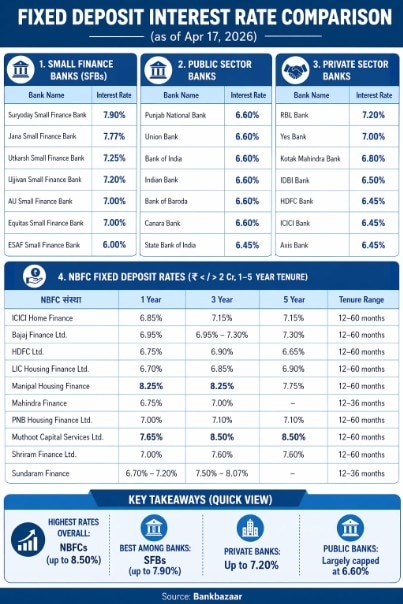



 Among all banking categories, Small Finance Banks are currently leading the interest rate spectrum.
Fixed deposit (FD) rates across India are witnessing a clear divergence, with Small Finance Banks (SFBs) offering the most attractive returns, followed by select private banks and NBFCs. Recent data as of April 17, 2026, indicates that SFBs have emerged as the top yield providers, while public sector banks continue to offer relatively lower but stable rates.
SFB FD rates

 Pezeshkian rejects US nuclear charge, says ‘enrichment’ was an alibi to attack Iran
 RBI rejects Tata Sons’ CIC deregistration bid, makes stock market listing mandatory: Report
 PM Modi, Xi Jinping stress on ‘strategic and long-term’ India-China ties at BRICS Summit
 BRICS New Delhi Declaration calls for dialogue and multilateralism: All that it says
 HDFC Bank submits two names for MD & CEO post as Sashidhar Jagdishan’s term ends
 BRICS Summit 2026: Mega VIP Move! Ministers, CMs Travel Together In Bus
 PM Modi Proposes BRICS Reform Roadmap, Calls For Global Governance Reset
 PM Modi Proposes 10-Point BRICS Reform Roadmap For Global Governance
 PM Modi, Xi Jinping, Vladimir Putin & BRICS Leaders Explore Bharat Innovates Exhibition In Delhi
 PM Modi, Xi Jinping & Putin Together At BRICS Summit In Delhi
 SEBI’s CAS proposals: Expert weighs in on new expiry-day settlement price methodology
 Large caps stocks under pressure as rising US bond yields, crude prices weigh on foreign flows
  SEBI proposes bringing unexecuted Iceberg orders into closing auction
 SEBI proposes new expiry-day settlement formula for derivatives after CAS concerns
 Silver may climb to Rs 3.25 lakh, but January peak looks distant: Navneet Damani
 HDFC Bank appoints Jimmy Tata as Executive Director: Who is he?
 Pezeshkian’s nuclear message to the world: Iran wants talks, but within NPT rules
 After 50-minute Modi-Xi meet, BRICS leaders head to Bharat Mandapam PM's gala dinner
 Putin Arrives At Bharat Mandapam For PM Modi’s BRICS Gala DinnerPezeshkian rejects US nuclear charge, says ‘enrichment’ was an alibi to attack Iran


