












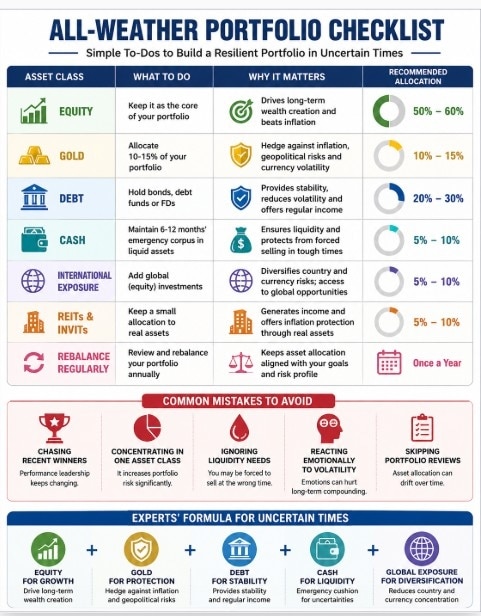



 Experts say an "all-weather portfolio" — one designed to perform reasonably well across varying economic conditions — can help investors navigate uncertainty while staying focused on long-term goals.
As investors grapple with geopolitical tensions, sticky inflation, shifting interest-rate cycles and concerns over global growth, wealth advisors are increasingly emphasizing the importance of building portfolios that can withstand multiple market environments rather than trying to predict the next crisis.
Experts say an "all-weather portfolio" — one designed to perform reasonably well across varying economic conditions — can help investors navigate uncertainty while staying focused on long-term goals.

 Crude oil could crash to $40 after Iran war ends, says US Treasury Secretary Scott Bessent
 Tata Sons chairman race heats up: T V Narendran, Saurabh Agrawal, NSE's Ashish Chauhan in contention
 We have been overestimating GDP growth...: Former Chief Statistician Pronab Sen
 Festive season revival? Indian airlines' capacity continues to shrink
 Monsoon update: These Delhi-NCR areas to see heavy rainfall today. Check latest details
 Parag Parikh Flexi Cap Fund Underperformance: Is Fund Size Becoming A Major Challenge For Investors?
 Midcap, Smallcap Funds: Strong Profit Growth Could Keep Investor Flows Robust, But Valuations Matter
 Travel Insurance Guide: Where To Buy, How Much Cover You Need & When To Get It
 MINI Countryman C Tech Overview | Tech Gear EP 17 | ASUS Jelly75 Keyboard | Business Today
 From LIC At 70 To 100: CEO Doraiswamy’s Big Promise To Policyholders & Shareholders
 Tata Power stock: Choice Broking expects recovery, assigns two price targets
  IPO rush next week: 11 issues eye to raise Rs 7,055 crore; 6 IPOs to open on same day, check details
 600% dividend stock: Check dividend per share, record date, payment date and other key details
 56% rally in TBZ stock: Upper circuit led to record high today; here's why
  Sensex, Nifty snap four sessions of losing streak; RIL, Tata Steel, Bajaj Finance boost sentiment Tata Power stock: Choice Broking expects recovery, assigns two price targets Parag Parikh Flexi Cap Fund Underperformance: Is Fund Size Becoming A Major Challenge For Investors?
 3.7 million followers, 20% engagement: Why Tukaram Mundhe is beating Fadnavis, Shinde on Instagram?Tata Sons chairman race heats up: T V Narendran, Saurabh Agrawal, NSE's Ashish Chauhan in contentionFestive season revival? Indian airlines' capacity continues to shrink


