










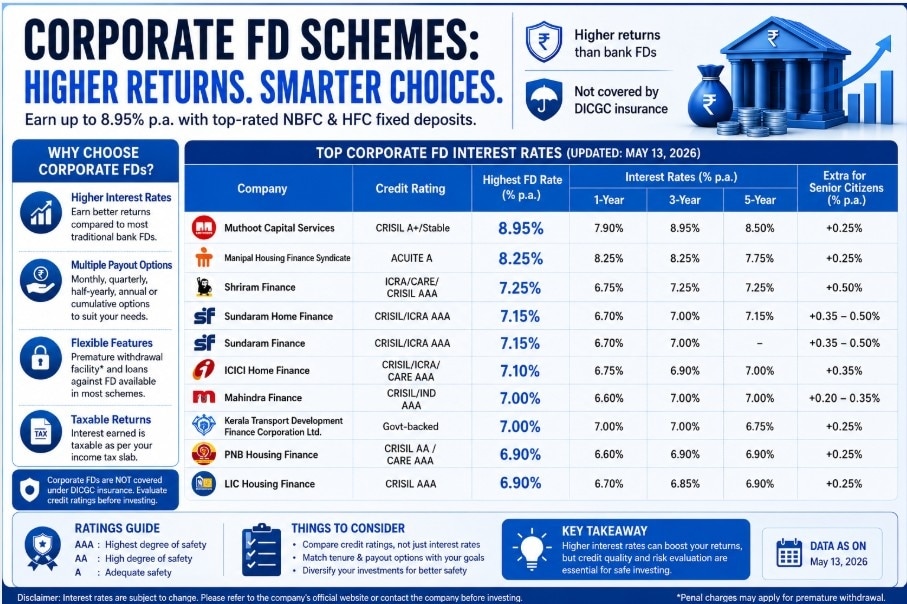
 Several major NBFCs and HFCs currently carry high investment-grade ratings.
 Several major NBFCs and HFCs currently carry high investment-grade ratings.
Corporate fixed deposits (FDs) offered by Non-Banking Financial Companies (NBFCs) and Housing Finance Companies (HFCs) are increasingly attracting investors searching for better returns than traditional bank deposits. With some corporate FD schemes offering interest rates as high as 8.95% annually, they stand out in a market where many public and large private sector bank fixed deposits continue to offer lower returns. However, while the higher rates may appear attractive, investors may need to evaluate the risk side before making a decision.
One of the biggest differences between bank FDs and corporate FDs lies in safety. Unlike fixed deposits placed with scheduled banks, corporate FDs are not covered under the Deposit Insurance and Credit Guarantee Corporation (DICGC) insurance framework, which protects bank deposits up to Rs 5 lakh in case of a bank failure. This means repayment security depends heavily on the financial health of the issuing company.
Because of this, credit ratings become a critical factor while evaluating corporate deposits. Agencies such as CRISIL, CARE and ICRA assign ratings after assessing a company's repayment capacity and financial strength. Higher ratings generally indicate stronger safety and lower chances of default in principal and interest repayments.
MUST READ: Special FDs vs regular fixed deposits: Which option makes more sense for investors?
Several major NBFCs and HFCs currently carry high investment-grade ratings. Companies such as Shriram Finance, Mahindra Finance, Sundaram Home Finance and ICICI Home Finance have received top-tier AAA ratings from leading agencies, indicating relatively stronger credit quality.
Among the available options, Muthoot Capital Services currently offers one of the highest rates in the segment. The company provides returns of up to 8.95% annually, particularly for select medium-term tenures. Manipal Housing Finance Syndicate offers rates of up to 8.25%, while Shriram Finance offers up to 7.25%, along with additional benefits for renewals and women depositors.
Other prominent issuers include Mahindra Finance, offering rates up to 7%, and Sundaram Home Finance and ICICI Home Finance, which provide rates in the 7.10%-7.15% range depending on tenure. Senior citizens generally receive an additional interest benefit ranging from 0.25% to 0.50%, enhancing effective yields further.
MUST READ: Foreign Bank FD rates in India: How do they stack up against public and private banks?
Corporate FDs also come with multiple payout structures. Investors can choose monthly, quarterly, half-yearly or annual interest payouts, depending on their income needs. They may alternatively opt for cumulative deposits where interest gets reinvested, allowing returns to compound over time.
Several issuers additionally provide premature withdrawal facilities and loans against deposits. However, early withdrawals may attract penalties of up to 2%, and some schemes may impose lock-in periods. Interest earned from corporate deposits is also taxed according to the investor’s applicable income tax slab.
MUST READ: What are India’s HNIs buying now -- equities, gold or alternative assets?
Financial planners often caution investors against selecting products purely on the basis of headline interest rates. Higher returns can compensate for higher risk, but choosing deposits from stronger-rated institutions and diversifying exposure may help balance the risk-reward equation. For conservative investors, the focus may need to remain on credit quality and capital protection rather than simply chasing the highest available yield.
 Oil at $110, global panic rising: Now NATO may step into the Hormuz crisis
 Has EPFO cleared a minimum EPS-95 pension hike to Rs 7,500? Here's what pensioners need to know
 Bear attack on India markets: No Indian company in world's top 100 listed firms by market cap, says report
 'Indian economy is in trouble': Ex-IMF economist Surjit Bhalla on what went wrong
 'Never seen so much pessimism regarding India': Fund manager rejects slowdown fears
 Narendra Taneja Explains Why UAE’s OPEC Exit Could Be Big News For India
 RBI Dividend Bonanza Incoming? | Govt Set For Massive Cash Support
 Pankaj Murarka Reveals Why Growth Stocks Still Offer Massive Wealth Potential
 Why Petrol & Diesel Prices Are Rising Again? IOC Warns Of More Pain Ahead
 Boeing 787 Under Fresh Scrutiny | DGCA To Inspect Fuel Switch System
 Tata Motors (TMCV), BPCL, Dr Reddy's shares: Check strategy, outlook
 SEBI proposes scrapping centralised STP hub, plans API-based framework for faster trade processing
 BEL Q4 PAT up 5% at Rs 2,230 crore; here's how the stock may reactBear attack on India markets: No Indian company in world's top 100 listed firms by market cap, says report
 ITC share price target: Will cigarette price hike affect the FMCG stock?