












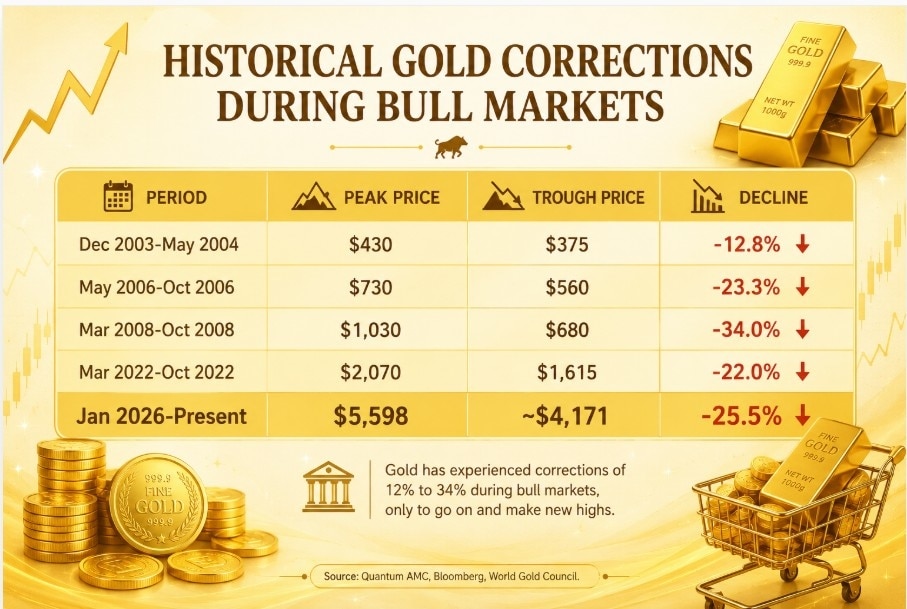



 Gold has fallen around 25.5% from its all-time high of $5,598 an ounce reached in January and recently slipped to around $4,171 an ounce.
Gold prices have corrected sharply from their January 2026 record highs, leaving many investors wondering whether the rally has finally run out of steam or whether the recent decline presents a fresh opportunity to accumulate the precious metal.
According to Chirag Mehta, Chief Investment Officer at Quantum AMC, the current selloff should be viewed as a temporary correction rather than the end of gold's long-term bull market.
FAQs
Why have gold prices fallen sharply from their January 2026 highs?
Gold prices have corrected due to stronger-than-expected US economic data, rising bond yields, expectations of higher interest rates, and the impact of the ongoing Middle East conflict. These factors have pressured gold in the short term.
Does the recent fall in gold prices mean the long-term rally is over?
According to Quantum AMC CIO Chirag Mehta, the current decline looks like a temporary correction rather than the end of gold’s long-term bull market. He says the structural drivers supporting gold are still in place.
What long-term factors continue to support gold prices?
Key long-term supports include rising US debt, persistent inflation, fiscal deficit concerns, and central banks diversifying away from US Treasuries. Strong central bank buying of gold also adds support to the broader outlook.
What does history suggest about sharp corrections in gold bull markets?
History shows that 25 to 35 percent corrections are common during major gold bull markets. Quantum AMC noted that after a 33 percent fall during the 2008 financial crisis, gold later rallied strongly and reached fresh record highs.
Is the current correction a good buying opportunity for gold investors?
Mehta believes the present weakness may offer long-term investors a good chance to accumulate gold. He highlighted the $4,098 to $4,200 range as an important accumulation zone, suggesting the fall may provide a better entry point rather than signal a broken investment thesis.

 RBI's forex swap facility draws massive $127 billion through FCNR(B) deposits
 'No mechanical boost to GDP numbers': MoSPI's detailed clarification on 7.8% growth
 The GDP conundrum: Economists split over India's faster-than-expected 7.8% GDP growth rate
 Subhash Chandra insolvency case: 'I've been vilified across country over ₹6.5 crore repayment plan,' says media baron
 Mukesh Ambani's ₹10 power play: From Campa Cola to ice cream, why Reliance is betting big on India’s middle class
 U.S. May Tighten Child Passport Checks Under Trump, Indians And Birth Tourism Families Face Scrutiny
 Market Commentary | Deven Choksey On Buying Opportunities & Market Trends
 “India Is Certainly Not In Crisis”: Arvind Panagariya On Growth, Investment And Reforms
 Daily Calls: Ask Your STOCK MARKET TODAY QUERIES | Market Update | Share Market News Today
 What’s Hot: Stocks, Gold & Big Money Moves | Daily Markets Show | September 02 | Business Today
 RIL-backed Alok Industries shares hit fresh 52-week low, end slightly higher
 Milky Mist shares surge 10% after Q1 results; brokerage sees more upside potential
 Hero MotoCorp, Eicher Motors shares slide up to 5%; analyst flags key support levels
 Man Infraconstruction shares fall; Rs 169 crore buyback approval in focus
 Brigade Enterprises shares: Analyst on when to exit the real estate counter
  Uber cuts 3,300 jobs: CEO Dara Khosrowshahi reveals reason behind massive layoffsRBI's forex swap facility draws massive $127 billion through FCNR(B) deposits
 ₹90 crore for 15 episodes? What reports claim about Ajay Devgn’s Crime Patrol hosting fee
 Indian Railways approves ₹170 crore for Kavach 4.0 across 712 route km in Moradabad Division
 Rhetan TMT plans bigger expansion with ₹300 crore borrowing limit


