












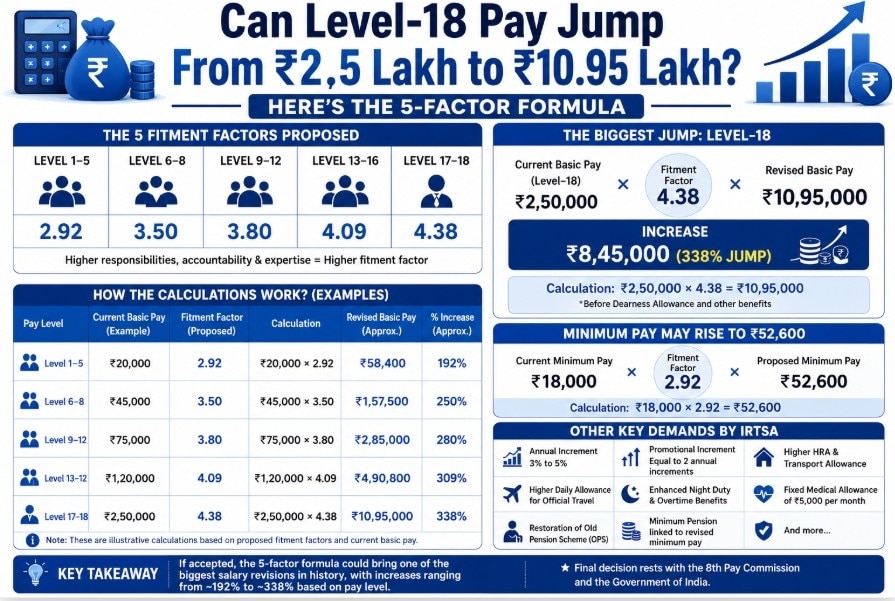



 A proposed fitment factor of 4.38 could increase Level-18 officers' basic pay from ₹2.5 lakh to about ₹10.95 lakh per month.
The 8th Pay Commission has begun consultations with employee unions and staff associations, and one proposal is already attracting attention for its potential impact on government salaries. The Indian Railway Technical Supervisors' Association (IRTSA) has proposed a new five-tier fitment factor structure that, if accepted, could result in salary increases ranging from nearly 192% to as much as 338% depending on an employee's pay level.
The proposal differs significantly from previous pay commissions, which largely relied on a common fitment factor for all employees. Instead, IRTSA has recommended separate fitment factors for different pay levels, arguing that higher responsibilities, technical expertise and supervisory roles should be rewarded with higher multipliers.

 BT India@100: ‘India has not lost the AI race,’ says Amitabh Kant, highlights the country’s biggest advantage
 Will Tukaram Mundhe enter politics? Here's what the Maharashtra FDA commissioner said
 Sensex CAS manipulation: Thin liquidity exposes vulnerability; what's ahead?
  Apple vs OpenAI: Legal battle escalates as iPhone maker rejects dismissal plea
 Housing prices rise 6% YoY despite sales dip; Gurugram, Noida lead Delhi-NCR real estate growth
 #IndiaAt100 | Amitabh Kant On The Future Of ‘Make In India’: Can India Become A Global Factory?
 #IndiaAt100 | Manufacturing Jobs In The AI Age: What Will The Future Workforce Look Like?
 #IndiaAt100 | Manufacturing: The Engine That Could Power India’s 2047 ‘Viksit Bharat’ Dream
 #IndiaAt100 | Swapan Dasgupta On West Bengal’s Growth Story: Can It Power India’s Next Leap?
 #IndiaAt100: MeitY Secretary S. Krishnan On Building Bharat’s Aatmanirbhar Tech Stack
 Sensex CAS manipulation: Thin liquidity exposes vulnerability; what's ahead?
  Renewable stock to buy: Recent debutant in bear grip after multibagger rise; Ventura sees 55% rally
 STT now accounts for 27% of retail derivatives costs, up from 13% in FY22
 Nobel Hygiene files IPO draft papers with Sebi; plans Rs 150 crore fresh issue, OFS
 HDFC Bank shares to see 57% upside? Bernstein targets for ICICI, Axis, KMB, SBI, IIBWill Tukaram Mundhe enter politics? Here's what the Maharashtra FDA commissioner saidApple vs OpenAI: Legal battle escalates as iPhone maker rejects dismissal pleaHousing prices rise 6% YoY despite sales dip; Gurugram, Noida lead Delhi-NCR real estate growth
 Qualcomm confirms two Snapdragon 8 Elite chips: How big could the upgrade be?Sensex CAS manipulation: Thin liquidity exposes vulnerability; what's ahead?


