















 The policy shift could have a notable impact on Indian investors, who remain one of Dubai’s largest overseas buyer groups.
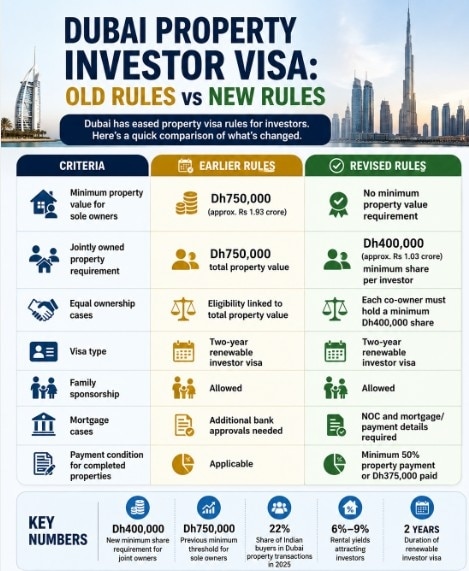
 Dubai has introduced a major change to its property-linked residency rules by easing eligibility norms for its two-year real estate investor visa. The revised framework removes the minimum property value requirement for sole owners, a move expected to widen access for foreign investors and further strengthen the emirate’s appeal as a global real estate destination.
The updated guidelines, issued by the Dubai Land Department (DLD) through its Cube platform, eliminate the earlier requirement that sole property owners hold assets worth at least Dh750,000 (approximately Rs 1.93 crore) to qualify for a two-year residency visa. Under the revised rules, only jointly owned properties will continue to carry a minimum threshold, with each investor required to hold a share worth at least Dh400,000 (around Rs 1.03 crore).

 IDBI Bank sale: Timing of Fairfax deal announcement being worked out, say government sources
  AEL, Adani Power, Adani Ports, Adani Energy: Why Adani stocks are rising today
 BPCL, IOC, HPCL shares unfazed as Brent crude hits $100 a barrel for first time since July
 Master Blaster’s new address? Sachin Tendulkar buys ₹70 crore Lonavala land, expands his real estate empire
 Singapore Airlines may lay out this one condition for fresh funding in Air India
 Delhi PG Tragedy Ground Report: More Arrests, Demolitions And Tighter Rules For PG Operators
 CM Vijay’s Assembly Gesture Sparks Row, DMK Demands Action In Tamil Nadu House
 India IPO Boom: Why Dalal Street Liquidity Is Shifting
 Auto Ancillaries Rally: Why Are These Stocks Outperforming OEMs? Sanjay Sinha Explains
 Rupee Holds Firm Despite $100 Crude: Can $136 Billion FCNR Inflows Keep Currency Strong?
 Craftsman Automation stock offers buy-on-dips opportunity, says analyst; shares price target
  ZEE, Apex Frozen, Power Mech, TVS Srichakra among stocks to turn ex-dividend on September 10
 Quest's Rakesh Vyas prefers private defence plays over PSU majors; here's why
 Piramal Pharma likely to hit fresh highs as CDMO recovery lifts EBITDA, says Quest CIO
 PC Jeweller share price: Expert sees Rs 15.5–17 target, says Rs 200 dream too far; suggests stop loss
 Blended fuel is changing car ownership — can Zuno’s new Fuel Guard protect your engine?Craftsman Automation stock offers buy-on-dips opportunity, says analyst; shares price target
  Want to invest beyond India? Waterfield launches two GIFT City funds for global exposure
 Singapore PM Lawrence Wong to earn ₹26.9 crore after 64% salary hike: How much do Modi, Trump, Xi earn?
 Buying a Kia this September? Check the exact Carnival, Clavis, Sonet, Syros and Carens discount conditions


