












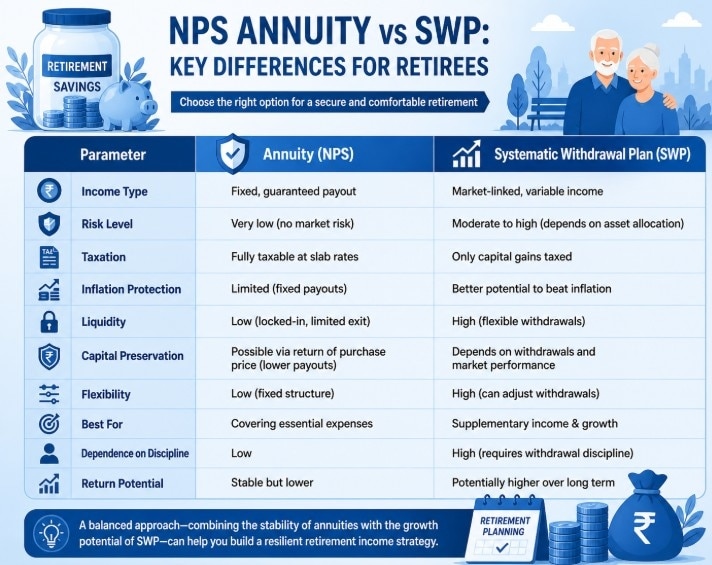



 Unlike market-linked instruments, annuities offer fixed payouts irrespective of market volatility or interest rate movements.
The National Pension System (NPS) has become more flexible in recent years, but that flexibility has shifted a greater burden of decision-making onto retirees. With mandatory annuitisation now reduced to just 20%, investors can withdraw a larger portion of their retirement corpus — but must carefully decide how much to lock into guaranteed income versus market-linked options.
At the centre of this decision lies the annuity—a product designed to provide steady, pension-like income after retirement. While often seen as conservative, annuities continue to play a crucial role in ensuring financial stability, especially for essential expenses.

 ‘Welcome the decision wholeheartedly’: Shapoorji Pallonji on RBI’s decision on Tata Sons listing; full text
 NSE IPO: India's largest exchange gets 55% subscription on Day 2 so far; NIIs, employee portions fully booked
 NSE IPO, Hero Motors IPO, SS Retail IPO, Jindal Supreme IPO: GMP of four ongoing issues rises up to 32%
 ‘An Indian consumes 1/10th of an average American’: Amb Kwatra says energy security comes first
 UPI MDR: BharatPe distances itself from Ashneer Grover's remarks, says UPI to remain free for consumers
 Midcap Stocks To Auto & Metals: Where Investors Can Find Market Opportunities Amid Earnings Growth
 What To Watch This Weekend? 5 OTT Picks From Lust Stories 3 To Zakir Khan’s Papa Yaar
 From Putin To Meloni: World Leaders Send Birthday Wishes As PM Modi Turns 76
 Tata Sons Board Votes To Bring N Chandrasekaran Back As Chairman For 5 Years
 Corporate Health Insurance Vs Retail Policy: Why You Need Personal Health Cover Too
 IndiGo shares rise 2% as Jefferies retains Buy call, sees 20% upside
 Bharat Electronics wins additional orders worth Rs 648 crore, check stock reaction NSE IPO: India's largest exchange gets 55% subscription on Day 2 so far; NIIs, employee portions fully booked
 Elevate Campuses IPO opens Sept 23: Check price band, key details, business model, risks and more
 NSE IPO: Nirmal Bang and Sparks say 'Subscribe', cites structural growth potentialIndiGo shares rise 2% as Jefferies retains Buy call, sees 20% upsideBharat Electronics wins additional orders worth Rs 648 crore, check stock reaction
  A kill switch won’t save us from rogue AI, tech leaders say amid growing concernsNSE IPO: India's largest exchange gets 55% subscription on Day 2 so far; NIIs, employee portions fully bookedElevate Campuses IPO opens Sept 23: Check price band, key details, business model, risks and more


