Niranjan Avasthi, Senior Vice President at Edelweiss Mutual Fund, emphasises that the ₹40 crore estimate is valid only under specific conditions. “The number sounds alarming, but it depends heavily on the kind of inflation and lifestyle trajectory you assume,” he said.
The math behind the ₹40 crore figure
The logic supporting a ₹40 crore corpus rests on three key variables: inflation, time horizon, and life expectancy. According to wealth manager Sandeep Jethwani, an individual currently spending ₹2 lakh per month in a metro city could see that expense rise sharply over two decades due to compounding inflation.
Urban households often experience inflation closer to 8–10%, significantly higher than headline CPI. This is driven by rising healthcare costs (12–14%), domestic wages (10–12%), and discretionary spending such as travel and education. Over 20 years, this can push a ₹2 lakh monthly expense to over ₹11 lakh per month, or roughly ₹1.3 crore annually at retirement.
Add to this a retirement period of 25–30 years, and the total corpus requirement can approach ₹35–40 crore, especially if post-retirement returns only partially offset inflation.
Inflation isn’t one number
However, experts caution against treating inflation as a single, fixed figure. Avasthi breaks it into two components: price inflation and lifestyle inflation.
Price inflation includes essentials like food, fuel, and healthcare—largely outside individual control. Lifestyle inflation, on the other hand, comes from discretionary upgrades such as bigger homes, premium schooling, travel, and consumption habits.
“In your 30s and early 40s, lifestyle inflation can push your effective inflation rate into double digits,” Avasthi explains. “That’s when retirement numbers start looking exaggerated.”
But this trend doesn’t continue forever.
MUST READ: Are you missing out on these govt pension, insurance schemes costing you under ₹500 a year?
Why the ₹40 crore target
As individuals approach retirement, lifestyle upgrades typically stabilise. Post-retirement, spending is largely limited to essential consumption and healthcare, which tends to moderate overall inflation.
Under more realistic assumptions, the required corpus drops significantly. For the same ₹2 lakh monthly expense today, a controlled lifestyle inflation scenario could result in a retirement requirement in the ₹9–15 crore range.
Experts also point out that geography plays a crucial role. While metro-based retirees may face higher costs, those in smaller cities or with more modest lifestyles may need far less. Some estimates suggest that in non-metro settings, even ₹1.5–2 crore could be sufficient, depending on spending patterns.
How retirement corpus requirements vary
As per Avasthi, retirement corpus requirements vary significantly based on inflation, age, and current expenses. For instance, a 40-year-old with monthly expenses of ₹2 lakh may need anywhere between about ₹9.4 crore and over ₹40 crore, depending on whether inflation assumptions are moderate (5% pre-retirement, 3% post-retirement) or aggressive (9% for both phases).
A similar pattern is visible across age groups—while starting earlier and having lower expenses reduces the absolute corpus needed, higher inflation can still push requirements sharply upward. The key takeaway is that inflation, particularly pre-retirement lifestyle inflation, is the most critical factor driving retirement needs. Even small changes in inflation assumptions can multiply the required corpus by three to four times, making realistic planning essential.
The role of compounding
Another critical factor often overlooked in headline numbers is compounding. While ₹40 crore sounds daunting, it is a future value. Adjusted for returns during the accumulation phase—typically assumed at around 12%—this translates to roughly ₹4–5 crore in today’s terms.
This reframes the challenge. The focus shifts from chasing a large absolute number to building a disciplined, long-term investment strategy through SIPs and asset allocation.
Moving target
The consensus among experts is clear: retirement planning is deeply personal and dynamic. A fixed corpus target can be misleading if it ignores changes in lifestyle, income, and inflation over time.
Financial planners recommend reviewing retirement goals every few years, tracking actual expenses, and keeping lifestyle inflation in check. Overestimating the corpus can lead to unnecessary stress and overly conservative decisions, while underestimating it can create financial shortfalls later.
MUST READ: NPS charge structure updated: What changes for pension subscribers from July 2026
Your takeaway
The ₹40 crore figure is not a universal requirement — it is a scenario based on aggressive assumptions around inflation and lifestyle. For many investors, especially those who manage lifestyle creep and plan systematically, the actual requirement could be far lower.
Ultimately, retirement planning is not about chasing a single headline number. It is about aligning savings, investments, and lifestyle choices with realistic assumptions — and adjusting along the way as those assumptions evolve.
MUST READ: Need ₹40 crore to retire in India? Here’s the math behind the big number













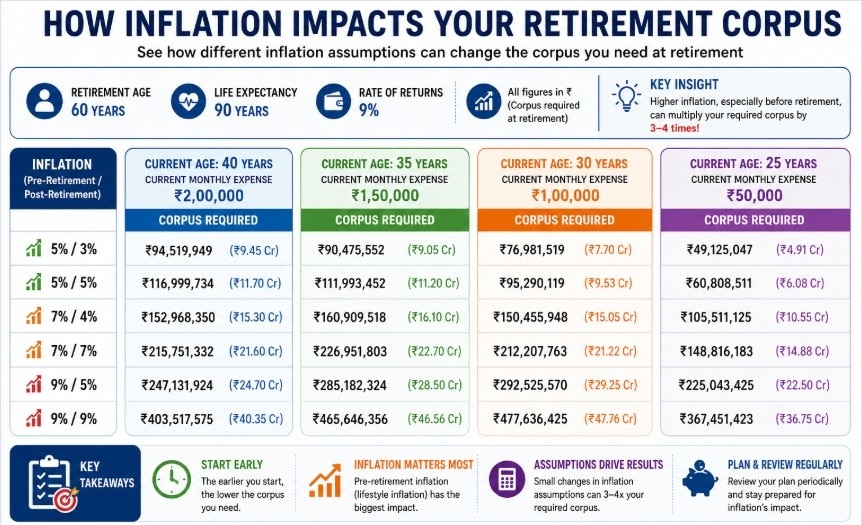



 For the same ₹2 lakh monthly expense today, a controlled lifestyle inflation scenario could result in a retirement requirement in the ₹9–15 crore range.
 India is the second-best BRICS performer, but that is not enough: Economist Surjit Bhalla
 BRICS Summit 2026: PM Modi warns against turning critical supply chains into geopolitical tools
  China will push for a 'Greater BRICS': Ex-foreign secretary decodes Delhi summit, says test will come in 2027
 'India must seriously evaluate exiting UN': Zoho's Sridhar Vembu
 'Need to reflect 2026, and no longer 1945': UN endorses PM Modi’s push for UNSC overhaul in BRICS 2026
 “BRICS’ Relevance Is Growing”: PM Modi As 18th BRICS Summit Draws To Close
 “BRICS Must Involve Citizens”: PM Modi On Expanding Friendship, Partnership And Cooperation
 Gen Z Wealth Creation: Why Patience, Long-Term Investing & Compounding Matter For Young Investors
 Mastercard’s Vision For India’s Digital Economy
 BRICS Summit 2026 LIVE | PM Modi Announces Integrated Early Warning System For Global Crises
 Avoid jewellery; stick to ETFs, bars and coins for investment this festive season: Navneet Damani
 SEBI’s CAS proposals: Expert weighs in on new expiry-day settlement price methodology
 Large caps stocks under pressure as rising US bond yields, crude prices weigh on foreign flows
  SEBI proposes bringing unexecuted Iceberg orders into closing auction
 SEBI proposes new expiry-day settlement formula for derivatives after CAS concerns
 Amit Shah Hails Modi Govt 7.8% Growth, Strong Defence & Viksit Bharat 2047
 PM Modi Meets Philippines President Marcos On Sidelines Of BRICS Summit 2026
 Russian President Vladimir Putin Departs Delhi After Participating In BRICS Summit 2026


