












 Kotak Institutional Equities indicates that any election-driven rally may be short-lived, as markets refocus on macro risks rather than political outcomes.
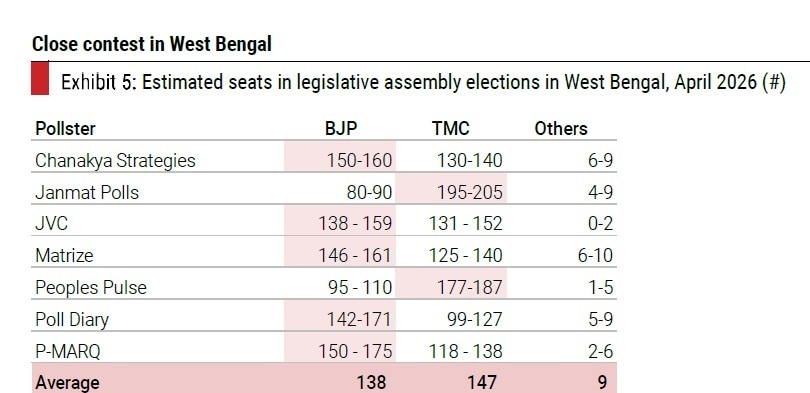
As India awaits the final results of the latest round of state elections, West Bengal has emerged as the most closely watched battleground, with exit polls indicating a tight contest and the possibility of a strong Bharatiya Janata Party (BJP) performance. While outcomes in other states appear relatively predictable, Bengal stands out due to its political weight and potential economic implications, according to a report, Election Impact Note: Markets, Macro Risks and State Outcomes (2026), by Kotak Institutional Equities.
West Bengal at the centre
Multiple exit polls suggest that while the BJP may retain power in states like Assam, West Bengal remains highly competitive. The contest between the incumbent Trinamool Congress (TMC) and the BJP is expected to go down to the wire, making it one of the most closely tracked results this election cycle.
This heightened uncertainty has drawn attention not only from political observers but also from business leaders and investors, who are increasingly viewing electoral outcomes through an economic lens.
Market sentiment
Market participants are closely tracking whether the BJP’s projected gains translate into a decisive electoral outcome in West Bengal, as this is seen as the only major swing state in an otherwise largely predictable election cycle. Exit polls indicate that incumbents are likely to retain power in most regions, with Assam and Puducherry expected to stay with the BJP and its allies, while Tamil Nadu and Kerala remain with regional parties. This makes West Bengal the key variable shaping both political narratives and market sentiment.
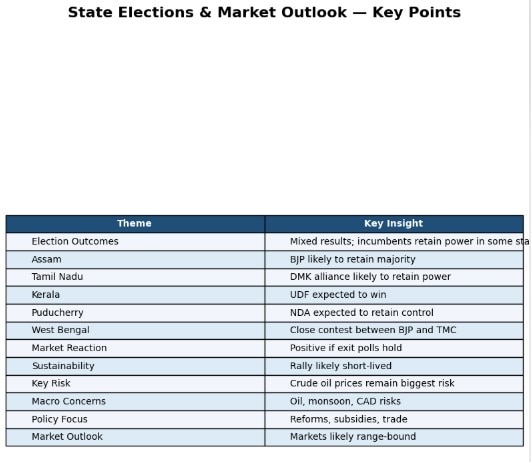
From a market perspective, a strong BJP showing—especially a breakthrough in West Bengal — could trigger a short-term positive reaction in equities. The rationale is anchored in perceived political stability and continuity at the national level, alongside the possibility of better alignment between the state and central governments. Investors typically associate such alignment with faster policy execution, smoother approvals, and a stronger push on infrastructure and investment-led growth. Historically, markets have responded favourably to outcomes that signal reform momentum and administrative efficiency.
However, the report makes it clear that any such rally is likely to be brief and sentiment-driven. The sustainability of market gains will depend far more on macroeconomic factors than on electoral outcomes alone. In particular, crude oil prices remain the single largest near-term risk, with elevated levels posing challenges for inflation, fiscal balances, and the current account deficit.
MUST READ: Up to 80% rally! Listed firms in Bengal: 3.75% of India's m-cap; ITC, Britannia among top stocks
Macro risks
Despite the potential for a short-term boost, broader macroeconomic challenges continue to dominate the outlook. Elevated global crude oil prices remain a major concern, as they can increase inflation, widen the current account deficit, and strain government finances.
Additionally, uncertainties around the monsoon could impact food prices, adding further pressure on inflation. These factors are likely to limit the extent of any market rally following the election results.
As a result, analysts expect markets to remain range-bound after any initial reaction, with investors refocusing on earnings growth and macroeconomic stability.
Policy momentum
The post-election period could provide an opportunity for policymakers to accelerate reforms. With no major elections scheduled in the near term, the government may prioritise infrastructure spending, trade agreements, and fiscal consolidation.
Such measures could have a more lasting impact on economic growth and investor confidence than electoral outcomes alone. Additionally, gains at the state level could strengthen legislative positioning, potentially easing the passage of key reforms.
MUST READ: Stock market amid Assembly elections results 2026: What investors should know, and do
Outlook for investors
For investors, the key takeaway is that while West Bengal remains a crucial political contest with potential market implications, the long-term trajectory of markets will depend on fundamentals.
Short-term gains driven by election sentiment are possible, especially if results align with expectations. However, sustained market performance will hinge on earnings growth, inflation trends, and policy execution.
In that sense, while the election outcome may influence immediate sentiment, it is unlikely to override the broader economic forces shaping India’s markets.

 US-Iran war: A second chokepoint after Hormuz opens up; concerns over oil shipping, infra
  Amazon cuts jobs in AGI team after laying off 16,000 employees
 'No one will be spared': PM Modi announces fast-track courts for paper leak cases amid CJP protests
 Who is Anurag Jain? The bureaucrat behind Jan Dhan, PM Gati Shakti taking charge as NITI Aayog CEO
 Infosys Q1 results today: Timing, earnings expectations, key things to watch
 Confused Between Old And New Tax Regime? Here's What Taxpayers Should Know
 After Vikram-1's Orbital Launch, What's Next For Skyroot?
 Can Andy Burnham Redefine India-UK Relations? New UK PM's Big India Vision Explained
 Delhi Protests Surge: PM Modi Breaks Silence In NEET Paper Leak As Opposition Rallies!
 Trump's 100% Pharma Tariff Plan: How Will Indian Drugmakers Respond To The U.S. Move?
 Pharma stocks: Sun Pharma, Biocon, Dr Reddy's, Torrent Pharma slip on Trump's generic drug tariff plan
 NTPC Green Energy shares rise 9%, trading volumes surge over 60 times; here's the trigger
  Tata Communications shares: Brokerages retain 'Buy' despite Q1 earnings miss; check revised target prices
 IndusInd Bank shares: Why this stock fell 6% despite Q1 profit beat; upside capped?
 Xtranet Technologies IPO opens today: Should you subscribe or avoid? Check all key details