











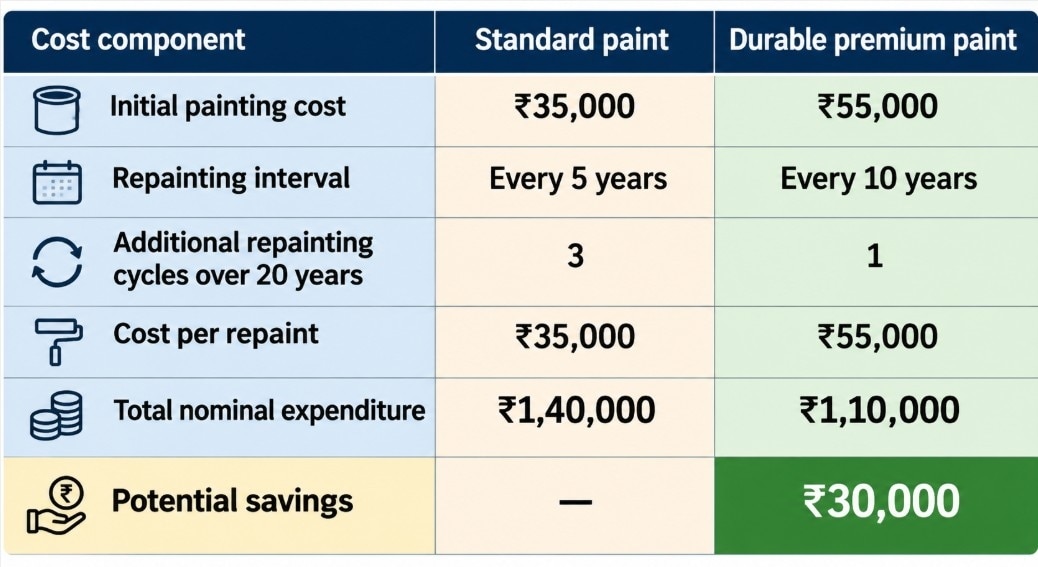



 Choosing paint based only on its upfront price could prove expensive for homeowners, as frequent repainting, labour charges and wall repairs add to long-term maintenance bills.
Many residential buildings in India reportedly require repainting or substantial touch-ups every five to six years. While homeowners often consider this routine maintenance, repeated peeling, blistering and dampness may indicate problems with coating selection, surface preparation or moisture management.
For a typical apartment, these recurring expenses can accumulate over two decades, particularly when repainting involves plaster repairs, waterproofing treatment and rising labour costs.

 Core sector growth hits 13-month high of 10.9% in October: Is India's industrial recovery gaining momentum?
 Capital markets must serve real economy, not the other way around: CEA
 From Ashton Kutcher to retired NBA star: Celebrities who could make billions from Anthropic IPO
 EPFO's new monthly withdrawal plan: Will retirees have to pay income tax on SWP payouts?
 From nearly 50 aircraft to just 5: Inside SpiceJet's dramatic fleet collapse
 Weekend OTT Releases: Dhindora 2, The Vvaan, Campus Diaries 2 & The Odyssey
 TVS Succession Battle: Kapil Sibal Vs Manu Singhvi On Lakshmi Venu's Claim To Family Wealth
 TVS Family Dispute: Abhishek Manu Singhvi Responds to Claims of an Unequal Wealth Division
 SEBI Chief Tuhin Kanta Pandey On FPI Reforms | 5-Day Onboarding, Easier KYC For Foreign Investors
 TVS Succession Battle: Why Is the 2017 Family Settlement Being Challenged Now? Singhvi Explains

 Anthropic shares tumble after record $107 billion IPO as AI valuation concerns rattle global markets: ReportCapital markets must serve real economy, not the other way around: CEA
 BT Closing Bell: Markets extend gains as Sensex jumps 898 points, Nifty reclaims 25,800
 Adani Energy, CESC, IEX, Tata Power, Waaree, Adani Power: Power stocks to buy with upto 80% uspide
 GRSE shares: Elara retains 'Reduce'; sees meaningful revenue from new Next-Gen Corvette warships only from FY29
 Want a career in luxury? The opportunities go far beyond fashion and designWeekend OTT Releases: Dhindora 2, The Vvaan, Campus Diaries 2 & The Odyssey
 Remove STT on Cash Market? Anand Rathi’s Bold Pitch at CII Summit 2026
 DFS Secretary Sanjay Lohiya Flags Rising Cyber Frauds | Banks, NBFCs Urged to Strengthen Security
 Affordable Housing Shortage in India | DFS Secretary Sanjay Lohiya Flags Growing Concern


