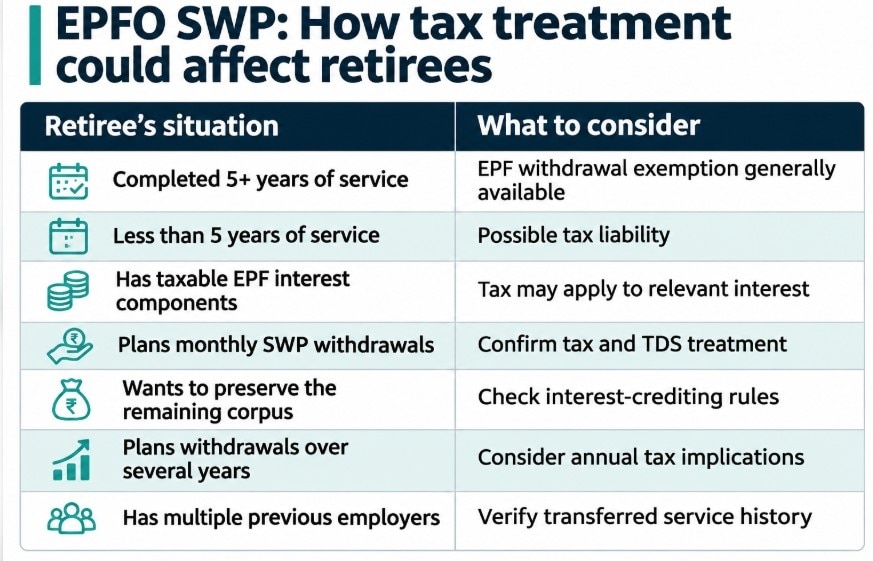









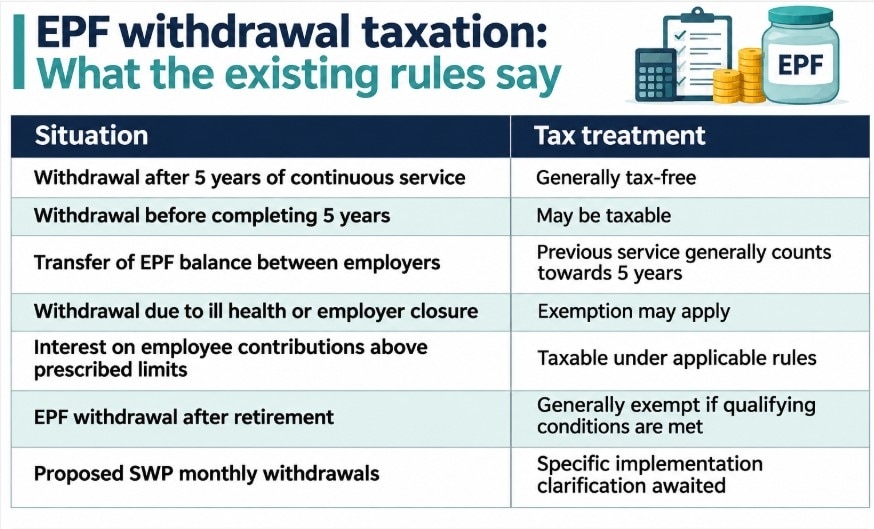



 Under existing income tax provisions, withdrawals from a recognised provident fund are generally exempt when an employee completes at least five years of continuous service.
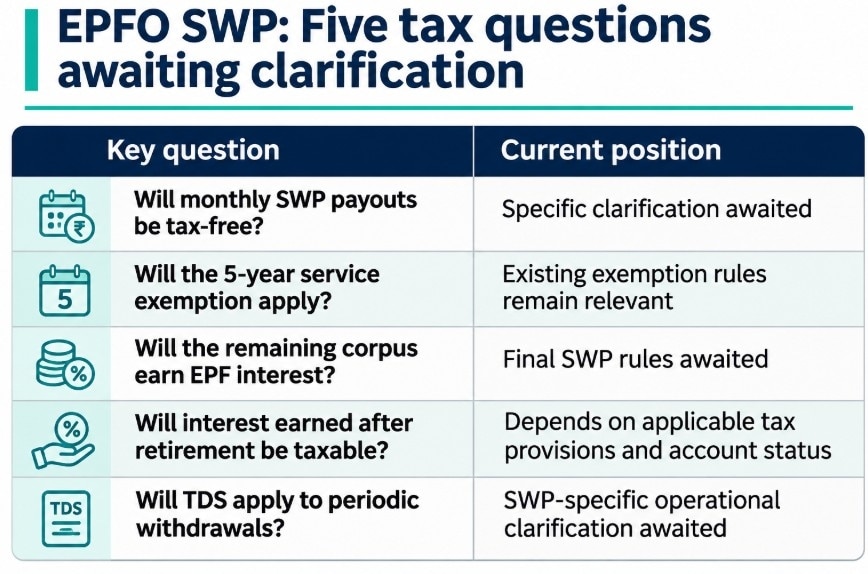
EPFO's proposed Systematic Withdrawal Plan (SWP) could allow retirees to receive monthly payouts instead of withdrawing their entire provident fund savings at once. However, uncertainty over the taxation of periodic withdrawals and interest earned on the remaining corpus could influence how attractive the facility becomes.
The Employees' Provident Fund Organisation's (EPFO) Central Board of Trustees has approved the introduction of an SWP, allowing retiring members to access their accumulated savings through periodic instalments.

 From Ashton Kutcher to retired NBA star: Celebrities who could make billions from Anthropic IPO
 BT Closing Bell: Markets extend gains as Sensex jumps 898 points, Nifty reclaims 25,800
 NSE enters top 10 m-cap club, pips LIC and Kotak Mahindra Bank; stock jumps 29% in a month
 Why the EPF’s Systematic Withdrawal Plan could be more attractive than fixed deposits, commercial annuities
 Jefferies' Chris Wood raises India weight to 15% and trims Taiwan as AI stocks stumble globally
 TVS Succession Battle: Why Is the 2017 Family Settlement Being Challenged Now? Singhvi Explains
 The Night That Changed His Career | RITES CMD Rahul Mithal's Railway Story | The Real Railway Man
 Train Derailments: Causes, Risks & Prevention | RITES CMD Rahul Mithal Explains
 Aaj Tak Masterclass | Government Jobs Vs Private Jobs | RITES CMD Rahul Mithal Shares Insights
 Trump-Xi-Putin Summit: Big Expectations, Modest Outcome | What The Joint Declaration Reveals
 BT Closing Bell: Markets extend gains as Sensex jumps 898 points, Nifty reclaims 25,800
 Adani Energy, CESC, IEX, Tata Power, Waaree, Adani Power: Power stocks to buy with upto 80% uspide
 GRSE shares: Elara retains 'Reduce'; sees meaningful revenue from new Next-Gen Corvette warships only from FY29
 Time to pick largecaps over smallcaps? SMC Global's Ajay Garg explains his investment strategy
 IndusInd Bank shares rebound 10% from day's low, top Rs 1,000 mark after 5 months; what's next?BT Closing Bell: Markets extend gains as Sensex jumps 898 points, Nifty reclaims 25,800
 'Ordered veg, got non-veg': Burger King, Swiggy told to pay Rs 72,000 after Gurugram consumer court's ruling
 One year of labour codes implementation: Some progress made, but still a long way to goTVS Succession Battle: Why Is the 2017 Family Settlement Being Challenged Now? Singhvi ExplainsThe Night That Changed His Career | RITES CMD Rahul Mithal's Railway Story | The Real Railway Man