Brokerage sentiment has also been overwhelmingly positive, with all 20 brokerages covered in a review summary recommending subscription. However, strong demand does not guarantee allotment or listing gains. For eligible RIL shareholders, understanding the reservation rules, application limits and investment risks is essential before applying.
Who is eligible for the Jio IPO shareholder quota?
Jio Platforms has reserved ₹2,500 crore worth of shares for eligible individual investors and Hindu Undivided Families (HUFs) who held RIL shares as of October 14, 2026.
Even investors holding a single Reliance Industries share on the specified date can qualify, subject to the eligibility conditions in the IPO offer documents.
The cutoff date is crucial. Investors who purchased RIL shares on October 14 or later will not qualify for the shareholder reservation. Under India's T+1 settlement system, October 13 was the last regular trading day to buy RIL shares and have the purchase settled in time for the October 14 eligibility cutoff.
Those who missed the deadline can still apply under the regular retail category, subject to the applicable IPO rules. Buying RIL shares now will not establish eligibility for the shareholder quota.
MUST READ: Jio Platforms IPO effect: Bharti Airtel, Vodafone Idea shares trade on a mixed note; RIL stock gains
How can RIL shareholders maximise their allotment chances?
1. Apply under both the shareholder and retail categories
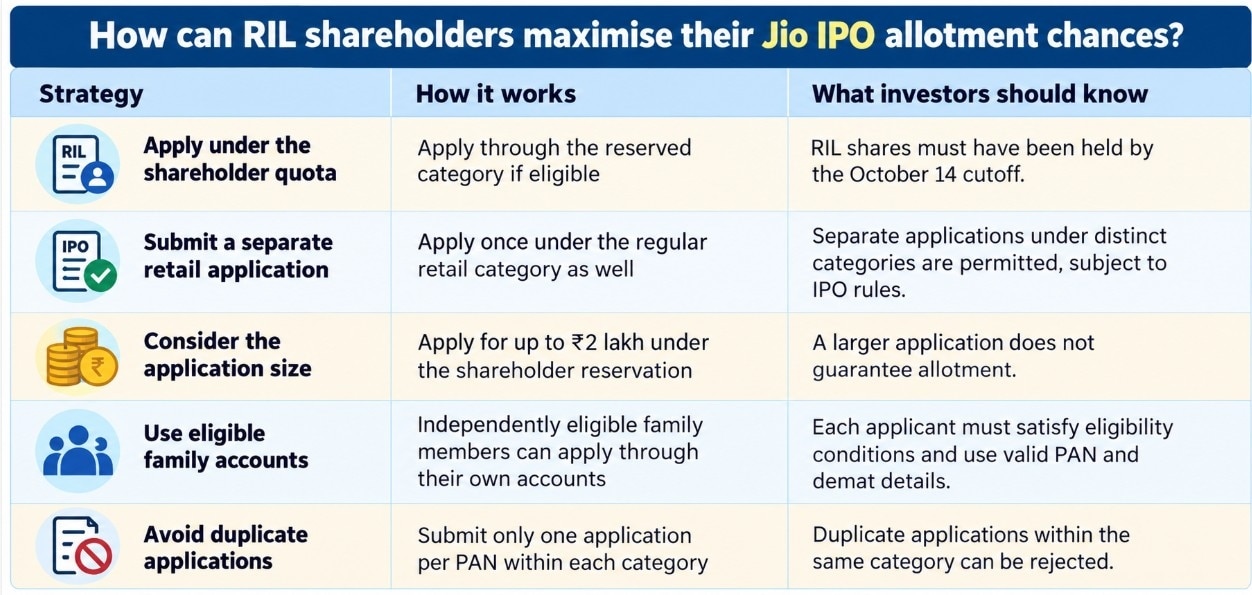
Eligible RIL shareholders can submit one application under the shareholder reservation and another under the regular retail category, provided both applications comply with the respective category requirements.
These are separate categories with distinct allotment processes. This differs from submitting multiple applications within the same category using the same PAN, which can be treated as duplicate applications and lead to rejection.
For example, an eligible shareholder could apply for one lot under the shareholder category and another under the retail category. Both applications would be considered independently, subject to the relevant allotment rules.
This approach gives investors access to two allotment pools. However, it does not guarantee that either application will receive shares, particularly if demand significantly exceeds the available allocation.
ALSO READ: Jio Platforms IPO fully subscribed within 100 minutes; QIB portion gets 3 times bids
2. Understand the shareholder quota application limit
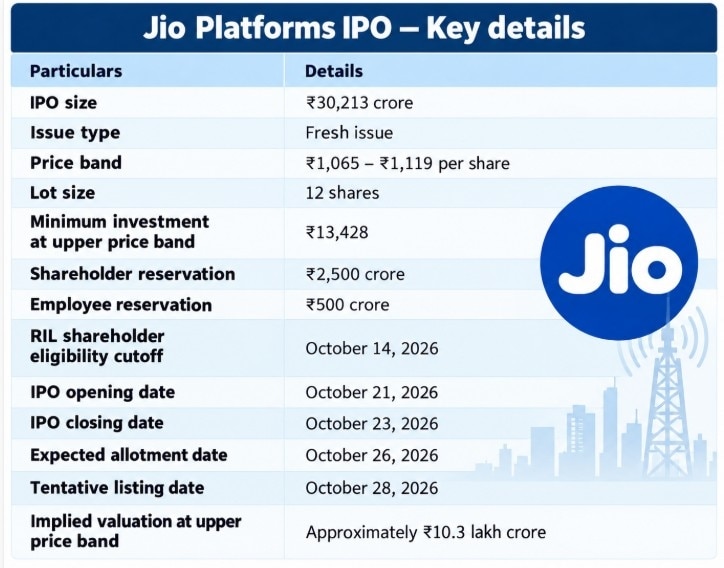
The maximum application amount under the shareholder reservation is ₹2 lakh. Jio Platforms has fixed its IPO price band at ₹1,065-₹1,119 per share, with a minimum lot size of 12 shares.
At the upper price band of ₹1,119, one lot costs ₹13,428. Eligible shareholders can apply for up to 14 lots, comprising 168 shares and requiring ₹1,87,992.
The shareholder reservation follows a proportionate allotment mechanism, subject to the applicable minimum-lot requirements and final allocation rules. Consequently, applying for a larger quantity may affect the number of shares allocated, depending on demand and the allotment process.
However, bidding for the maximum permitted quantity does not guarantee an allotment or ensure that an investor will receive all the shares applied for.
3. Eligible family members can apply separately
Families with multiple members who independently satisfy the shareholder eligibility criteria can consider applying through their respective valid PANs and demat accounts.
Each eligible investor may also submit a separate application under the regular retail category, subject to the applicable rules. Applications must represent genuine, independently eligible investors; duplicate applications under the same PAN within the same category can be rejected.
All 20 brokerages recommend subscription: What is driving optimism?
The strong investor response is accompanied by favourable brokerage sentiment. According to the brokerage review summary provided, all 20 brokerages reviewed have recommended subscribing to the Jio Platforms IPO, with no avoid or neutral calls.
Of these, nine have recommended the stock for the long term, while another nine have issued subscription recommendations without specifying an investment horizon. Two have highlighted listing gains, with Motilal Oswal identifying both listing-gain potential and a longer-term investment opportunity.
The positive outlook rests on Jio's market leadership and scale, along with growth opportunities across telecommunications and digital services. Brokerages have highlighted average revenue per user (ARPU) growth, potential tariff hikes, 5G adoption and home broadband expansion as possible drivers of revenue growth.
Opportunities in enterprise services, artificial intelligence (AI) and exports have also featured among the positives. Strong cash flow generation and lower debt are additional factors supporting the investment case.
The long-term recommendations include Mirae Asset Sharekhan, Canara Bank Securities, Anand Rathi, Choice Broking, Shriram Research, AUM Capital, Religare, KC Securities and Master Capital. Chola Securities has highlighted listing gains, while Motilal Oswal has considered both listing gains and the long-term opportunity.
However, unanimous subscription recommendations should not be interpreted as a guarantee of listing gains or future returns.
MUST READ: ‘I remember being petrified’: Nithin Kamath recalls his 2015 listing alongside Mukesh Ambani as Jio IPO takes centre stage
Valuation and risks: What should investors watch?
Despite the positive recommendations, valuation remains an important consideration. The brokerage review identifies comparisons with Bharti Airtel and Reliance Industries, forward enterprise value-to-EBITDA (EV/EBITDA) and industry multiples as key valuation measures.
EV/EBITDA compares a company's enterprise value, including debt, with earnings before interest, taxes, depreciation and amortisation. It is widely used to assess telecom companies because of their substantial infrastructure investments and depreciation costs.
Investors should also consider four key risks.
First, ARPU growth depends partly on the company's ability to increase tariffs and monetise its subscriber base. Delayed tariff hikes or weaker customer spending could affect revenue expectations.
Second, investments in 5G, broadband, enterprise services and AI need to translate into sustainable earnings. The pace of monetisation will be important.
Third, capital expenditure and leverage require monitoring because telecom infrastructure is expensive to build and maintain. Investors should assess whether cash flows can support expansion without placing excessive pressure on the balance sheet.
Finally, competitive pressure from other telecom operators and digital service providers could influence pricing, subscriber retention and profitability.
ALSO READ: Jio Platforms IPO: Should you apply? Check ratings from 20 brokerages, latest GMP and key details
Jio IPO dates, price band and listing details
The ₹30,213 crore IPO comprises 27 crore fresh equity shares. At the upper price band of ₹1,119, the issue implies a valuation of approximately ₹10.3 lakh crore.
The subscription window runs from October 21 to October 23, 2026. The basis of allotment is expected to be finalised on October 26, with listing scheduled on the BSE and NSE on October 28.
Jio Platforms plans to use approximately ₹27,500 crore of the net IPO proceeds to repay or prepay borrowings at Reliance Jio Infocomm, with the remaining funds earmarked for general corporate purposes. The company has also reserved ₹500 crore for eligible employees, who will receive a discount of ₹54 per share.
Ahead of the IPO opening, Jio Platforms shares were reportedly commanding a grey market premium (GMP) of around ₹245 on October 20. This implied an indicative listing price of approximately ₹1,364 at the upper issue price. However, GMP is unofficial, fluctuates with market sentiment and does not guarantee listing performance.
For eligible RIL shareholders, applying through both permitted categories offers an additional opportunity to seek an allotment. The final outcome will depend on demand, category-specific allocation rules and the basis of allotment. Investors should evaluate Jio Platforms' valuation, growth prospects and risks rather than relying solely on brokerage recommendations or anticipated listing gains.
Disclaimer: This article is for informational purposes only and does not constitute investment advice. Investors should review the IPO offer documents and assess their risk tolerance before investing.
ALSO READ: Jio Platforms IPO: From 14th spot to telecom leader, how Jio transformed India’s digital landscape
















 Jio’s QIB portion was fully subscribed within 10 minutes, while its anchor book attracted nearly ₹2.5 lakh crore in demand against an allocation of ₹8,110 crore.

 Jio Platforms IPO becomes fastest subscribed mega-IPO, QIBs lead demand; brokerages remain bullish
 3.75 lakh records, 3,897 customers: SBI says address, mobile numbers, email ID leaked in data breach
 Marco Rubio arrives in Jamnagar to visit Reliance refinery as India-US trade deal moves closer to final agreement
 RIL Shareholders Alert! Want to apply in Jio IPO? How can you maximise your allotment chances
 BT BIG STORY | No jobs, no security: The crisis facing India's educated youth
 “Nation First”: PM Modi Calls For Unity, Says All Parties Must Unite In National Interest
 Jio IPO Allotment: Missed Out? Sneha Poddar On Opportunities After Listing For Retail Investors 2026
 Bharti Airtel Vs Jio Platforms: Why Bharti Airtel Is The Preferred Telecom Stock For Investors
 RSS Chief Mohan Bhagwat Hails Captain Smit Machchhar, Says Hanuman Chalisa Reflects Hindu Values
 Reliance Industries Vs Jio Platforms: Which Is The Better Investment Bet For Investors?

 Jio IPO: Listing day gains ahead? What Sneha Poddar of MOFSL says
 PI Industries shares fall 5% as Morgan Stanley double downgrades stock
 IREDA selloff: Stock hits 52-week low on Q2 earnings, analysts weigh in