












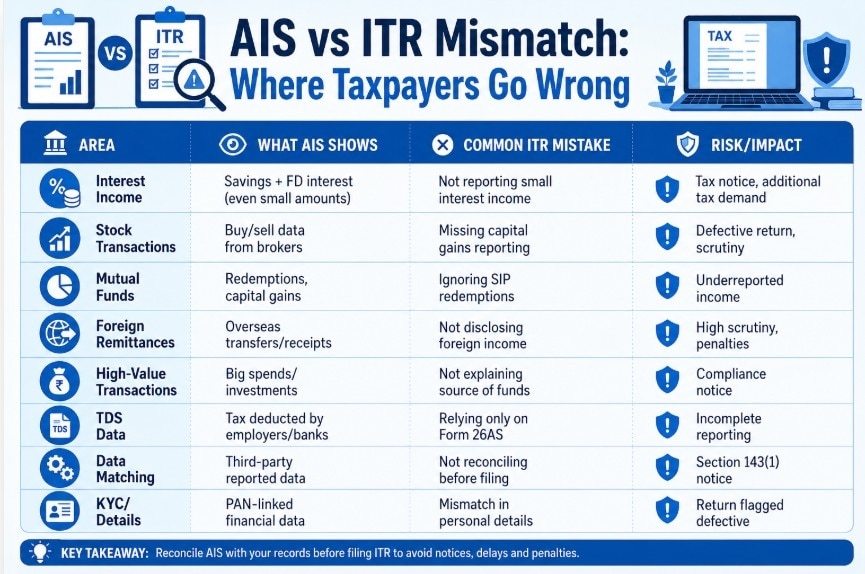



 Tax professionals recommend that taxpayers should carefully review AIS before filing returns, identify mismatches, and either correct their ITR or document valid reasons for differences.
As the Income Tax Department sharpens its data analytics capabilities, a new compliance risk is emerging for taxpayers —a mismatch between the Annual Information Statement (AIS) and Income Tax Returns (ITR). Experts warn that what was once a routine filing exercise has now evolved into a data-matching process, where even minor discrepancies can trigger automated notices.
Chartered accountants highlight that many taxpayers still operate under the outdated assumption that filing an ITR is only about declaring income correctly. However, with AIS becoming a central verification tool, that approach is increasingly risky.

 90% EVs exported out of India are from Maruti Suzuki: MD & CEO Hisashi Takeuchi
 India's $30 trillion goal needs 8-10% growth, $400 billion more annual investment: Jayant Sinha
 1.1 billion barrels gone: IMF warns that global oil market is running out of safety cushions
 From Devbhoomi to industrial destination: Uttarakhand’s manufacturing moment
 India’s deep-tech startups face a new test: Crossing the valley of death
 #IndiaAt100 : Adipen Bose Nandhiji On Conscious Capitalism- Can Profit & Purpose Coexist?
 #IndiaAt100 : Hisashi Takeuchi On Driving India’s Manufacturing Revolution
 #IndiaAt100 : Manufacturing For Viksit Bharat | Can Industry Power India’s $30-Trillion Dream?
 #IndiaAt100 : Tarun Garg On Hyundai & India’s Manufacturing Powerhouse Ambition
 #IndiaAt100 : CM Pushkar Singh Dhami On Uttarakhand’s Industrial Growth & India’s Next Leap
 Cupid, NTPC Green, NTPC, Raymond Realty, HAL shares: Key technical levels to watch
 Defence stock with Rs 2,654-crore order book hits record high; here's why
  GACM Technologies: FII holding jumps to 29%; penny stock in focus
 Puravankara shares rise 5% on fresh order win
  20 high-conviction ideas for up to 95% upside | stocks to buy
  iQOO Z11 launch: The new smartphone packing a 7,050mAh battery and curved display
 Beyond Bollywood glamour: Inside the lavish menu of Arpita Khan’s Mercii
 Anil Kapoor’s first television payment was ₹250—five verified milestones from his early struggle to global recognition
 Delhi and New Delhi are not the same administrative unit—here is the accurate and updated difference
 BT India@100: Amitabh Kant says this one ‘neglected but important’ sector is the biggest driver of jobs


