















 Financial securities such as equity shares, bonds, debentures and mutual funds represent ownership in assets, not consumption goods or services.
As participation in India’s equity markets deepens, clarity around taxation remains critical for investors and traders. One of the most commonly misunderstood areas is the applicability of Goods and Services Tax (GST) on stock market transactions.
At its core, GST is an indirect tax on consumption, applied to goods and services consumed within the economy. This has led to a recurring question among market participants: can equity investments be treated as “consumption” and therefore taxed under GST? The answer is no.
FAQs
Is GST applicable on buying and selling shares in the Indian stock market?
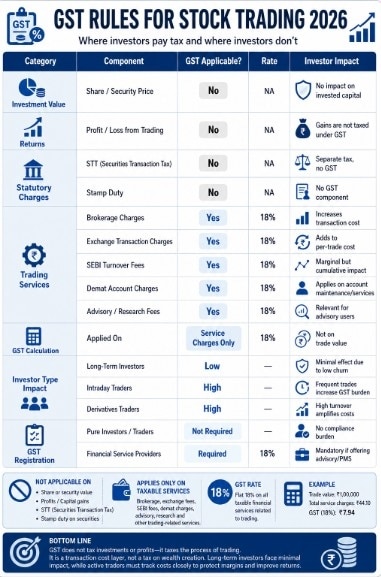
No, GST is not charged on the value of shares or securities traded in the stock market. Equity shares, bonds, debentures and mutual funds are treated as securities, which are kept outside the GST framework in India.
What parts of stock market transactions attract 18% GST?
GST at 18% applies only to service-related charges linked to trading and investing. These include brokerage fees, exchange transaction charges, SEBI turnover fees, demat account charges, auto square-off charges, delayed payment charges and research or advisory fees.
Is GST charged on capital gains, trading profits, STT or stamp duty?
No, GST is not applicable on capital gains, trading profits, Securities Transaction Tax or stamp duty on securities. It applies only to the services that support the trading process, not to investment returns or statutory levies.
How is GST calculated on stock trading charges?
GST is calculated only on the total service cost, not on the full trade value. For example, if brokerage, exchange charges and SEBI fees together come to ₹44.10 on a trade of ₹1,00,000, GST at 18% will be ₹7.94.
Do retail investors need GST registration for stock market trading?
Most retail investors and traders who only buy and sell securities do not need GST registration. Registration is generally required only if a person is providing taxable services such as investment advisory, portfolio management, financial consultancy or research services.

 NDA explores holding joint polls in 22 states, UTs in 2029: Report
 ABH Healthcare IPO: Check key dates, price band, issue size, latest GMP, listing details & more
 Cargo vessel with 20 Chinese crew sinks near Odisha; Coast Guard deploys 3 ships for rescue ops
 'Asked too much, offered too little': Carney on why Canada suspended US trade talks
 Trump doubles down on Hormuz claim, shares map calling strait 'NEW US Territory'
 Motor Insurance Add-Ons You Actually Need Explained: Zero Depreciation, RSA & Return-To-Invoice
 No Claim Bonus Explained: When Should You Claim Or Pay For Repairs Yourself?
 Motor Insurance Premium: What Factors Determine How Much You Pay?
 How Is Retirement Income Taxed For Senior Citizens? Key Rules Explained
 Rental Income Tax: 3 Key Deductions Every Senior Citizen and Property Owner Should Know
 ABH Healthcare IPO: Check key dates, price band, issue size, latest GMP, listing details & more
 India stocks lag global markets in 2026: BofA data shows 9.1% decline in USD terms
 'FOMO, fixed return': SEBI proposes revamped ad code for bond portals from misleading investors
 Crompton Greaves says no plan to sell stake, expects revenue to double by FY31
 Gaja Alternative Assets IPO: 3 ways to check application status; allotment odds, GMP, listing dateMotor Insurance Add-Ons You Actually Need Explained: Zero Depreciation, RSA & Return-To-Invoice
 ‘F&O trading is bad for almost 99% of retail traders’: Nikhil Kamath draws ITC parallel, says brokers need to diversify
 'My friends ended up seeing psychiatrists': Rajnish Kumar on ixigo's near-death moments and a deal he walked away from
 'IAF is not against theaterisation': Air Force chief AP Singh cautions against copying foreign models
 Gold, silver prices today (August 23): Check latest rates in Delhi, Mumbai, Kolkata, other cities


