












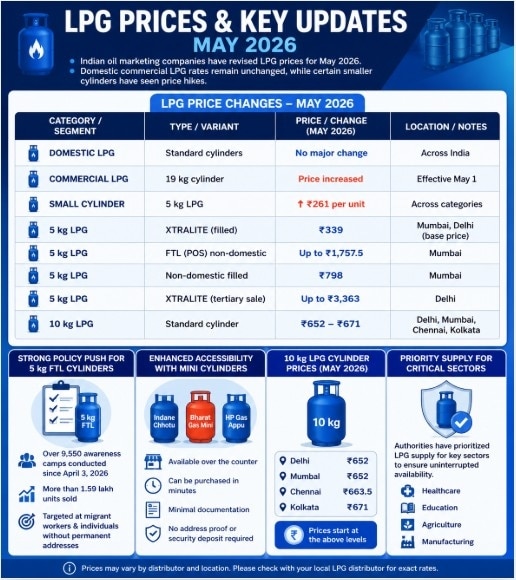



 Indian oil marketing companies have revised LPG prices for May 2026, with a mixed impact across categories.
A fresh set of financial changes comes into effect from May 1, impacting banking, digital payments, credit cards, taxation, and the broader investment ecosystem. These updates are part of a wider regulatory push aimed at improving transparency, strengthening compliance, and reducing misuse or excessive risk-taking across financial markets.
LPG prices for May 2026
FAQs
What are the key LPG price changes effective from May 1, 2026?
From May 1, 2026, the biggest change is in the 5 kg LPG cylinder segment, where prices have gone up by ₹261 per unit. In cities like Mumbai and Delhi, the 5 kg cylinder starts at ₹339, while some non-domestic and tertiary sale categories are priced much higher.
Why is the government promoting 5 kg LPG cylinders in 2026?
The government is pushing smaller LPG cylinders to improve access for migrant workers, daily wage earners, and people without permanent address proof. Mini cylinders such as Indane Chhotu, Bharat Gas Mini, and HP Gas Appu are now available over the counter with minimal documentation and no security deposit.
What new rules apply to mutual fund and investment distributors from May 1, 2026?
Mutual fund distributors, SIF distributors, and PMS distributors must now display their registered name and registration number on social media, websites, email signatures, visiting cards, and promotional material. They must also use standard regulator-approved titles such as ARN, SIFD, and APRN to improve transparency and investor trust.
How will banking and digital payment transactions change from May 1, 2026?
Banks are tightening security, so users may see more OTPs, PIN checks, and biometric authentication for UPI, debit cards, and net banking. Also, cardless ATM cash withdrawals through UPI will now count within the monthly free transaction limit, and extra usage may attract charges of ₹17 to ₹21 per transaction depending on the bank.
What are the main credit card and tax compliance changes starting May 2026?
Credit card late payment charges will apply only after a three-day grace period, but they will still be calculated from the original due date. At the same time, tax authorities will track cumulative cash transactions during the financial year, and PAN will be compulsory if total cash transactions cross ₹10 lakh annually.

 Trump calls Venezuela oil agreement ‘biggest deal in world history’, says it will cut US gas prices
 Nepal flash floods: Infosys subsidiary chief Lax Gopisetty not reachable. Read full company statement here
 West Asia conflict: Delhi CNG price to rise by ₹3.89 per kg; check latest CNG rates here
 The Tim Cook story: From Steve Jobs’ no. 2 to Apple CEO
 ITR-3 vs ITR-4: Which income tax return form should freelancers, traders and business owners use?
 CMF Buds Neo Review | Tech Gear | Business Today
 Gen Z Is Changing Politics? D.K. Shivakumar On Youth Power & Rahul Gandhi’s Outreach
 Babita Singh Reporting, Part-Timers, Bandar & More: 5 OTT Releases To Watch This Weekend
 Using AI To Write? You Could Be Caught! Anthropic's Invisible Watermark Explained
 Shah Rukh, Salman & Madhuri-Backed Pernia’s Pop-Up Shop Parent Eyes ₹680 Cr IPO
 Jio Platforms IPO gets SEBI nod: Rs 27,500 crore debt repayment plan, $100 billion valuation in focus
 Closing Auction Session: Why the system expected to reduce volatility is still seeing occasional wild swings
 RIL-backed penny stock hits 52-week low; firm clarifies on high trading volume
 Happiest Minds shares slip despite IT stocks surge; here's what is weighing on the stock
 BEL, Solar Industries shares remain Nuvama's top defence picks; here's what it said on BDL, Data Patterns, HALTrump calls Venezuela oil agreement ‘biggest deal in world history’, says it will cut US gas prices
 LPG, CNG, PNG prices today, August 29: Check latest rates in Delhi, Mumbai, Kolkata, other cities
 Petrol, diesel prices today, August 29: Check latest rates in Delhi, Mumbai, Chennai, Kolkata & more
 'Toxic' box office collection day 3: Despite drop in daily biz, Yash's film nears ₹200 crore in IndiaThe Tim Cook story: From Steve Jobs’ no. 2 to Apple CEO


