















 TDS on salary is governed by Section 192 of the Income Tax Act. Employers are required to deduct tax from salaries and deposit it with the government within prescribed timelines.
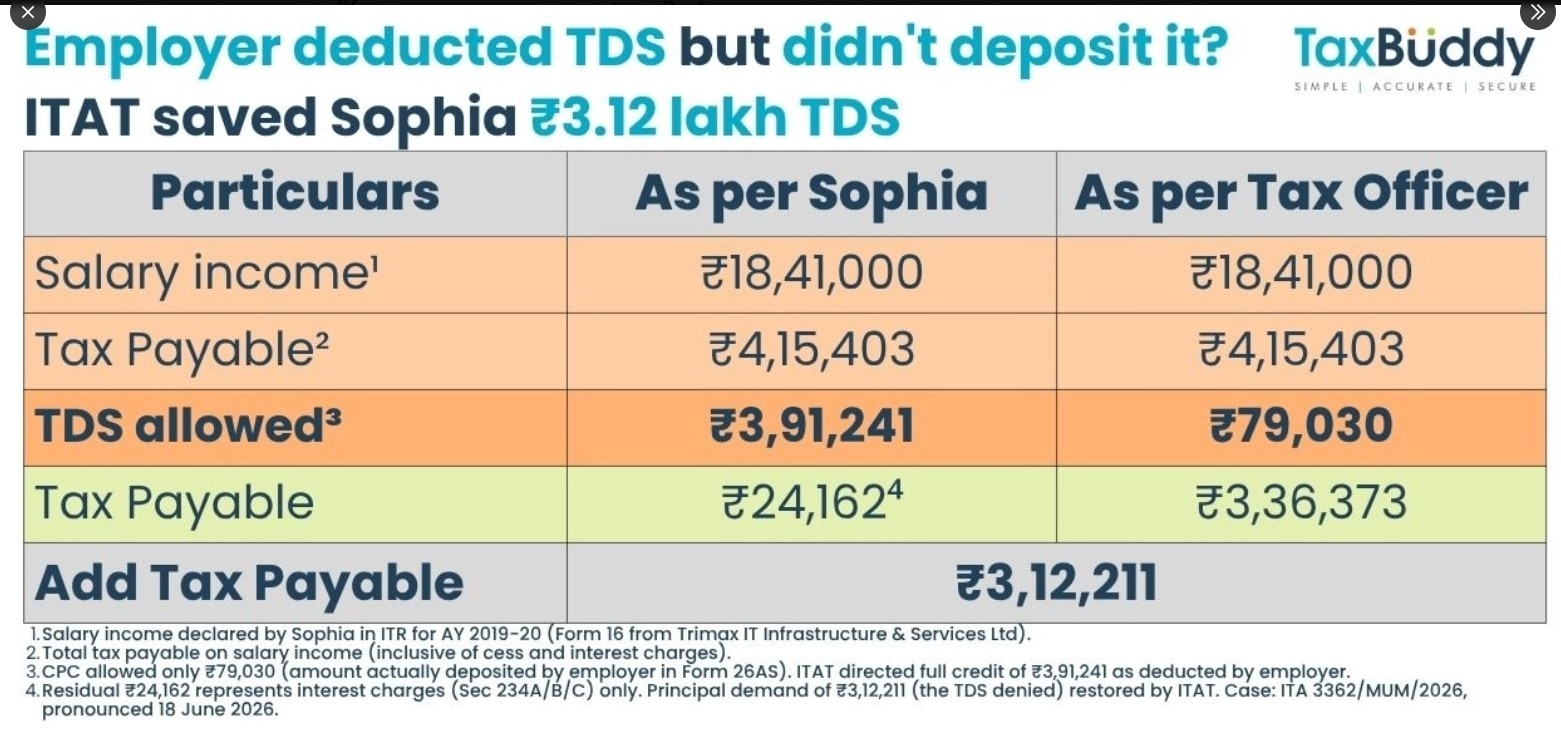
A Mumbai bench of the Income Tax Appellate Tribunal (ITAT) has delivered a significant ruling for salaried taxpayers, holding that employees cannot be asked to pay tax a second time merely because their employer deducted Tax Deducted at Source (TDS) but failed to deposit it with the government.
The tribunal granted full credit of ₹3.91 lakh in TDS to an employee and quashed a tax demand of over ₹3.12 lakh, reiterating that the liability to deposit deducted tax rests with the employer, not the employee.

 NSE IPO: Exchange raises Rs 6,746 crore from 189 anchor investors; LIC, GIC, Fidelity among buyers
 India’s chip push goes global: Semiconductor heavyweights deepen footprint ahead of SEMICON 2026
 NSE IPO opens tomorrow: Brokerage weighs growth prospects, valuation; what GMP indicates
 UPI MDR: No rollback of 0.4% fee above Rs 2,000; govt says move will make UPI self-sustainable
 From Rs 300 to Rs 25,000: How the wage ceiling under EPFO has increased over the years
 “Onion Prices Down 9% In 9 Days”: Nidhi Khare On Availability And ₹35/Kg Retail Sales
 Indian Markets At A Crucial Juncture: Nifty, Crude, Fed & Smallcaps | Jaipuria
 Nifty At 23,200: Crude Oil, U.S. Fed Rate Hike Fears & Market Outlook Explained
 “7.8% Growth Is Not Random”: FM Sitharaman Credits India’s People, Industry And MSMEs
 Indian I.T. Stocks: Why AI Disruption & Weak Growth Are Making Investors Rethink Their Bets
 NSE IPO: Exchange raises Rs 6,746 crore from 189 anchor investors; LIC, GIC, Fidelity among buyersNSE IPO opens tomorrow: Brokerage weighs growth prospects, valuation; what GMP indicates
 Paytm, KRN Heat Exchanger, Ather Energy, Vishal Mega Mart: Expert shares key entry levels, targets
 FOMC outcome: How stock market may react if Fed rate is hiked by 25 bps today
  Exit PTC India shares on rally, average L&T Technology Services on dips: Market expert
 Congress opposes UPI charges now. But 5 of its MPs were present when Finance panel sought MDR
 PIL filed in Supreme Court against new UPI MDR
 'There is no boundary between Pakistan and China': India rejects joint commission over Indian territory
 ‘Do it without borrowing money’: Nithin Kamath recalls how a ₹25,000 credit card debt changed his money habitsNSE IPO: Exchange raises Rs 6,746 crore from 189 anchor investors; LIC, GIC, Fidelity among buyers


