












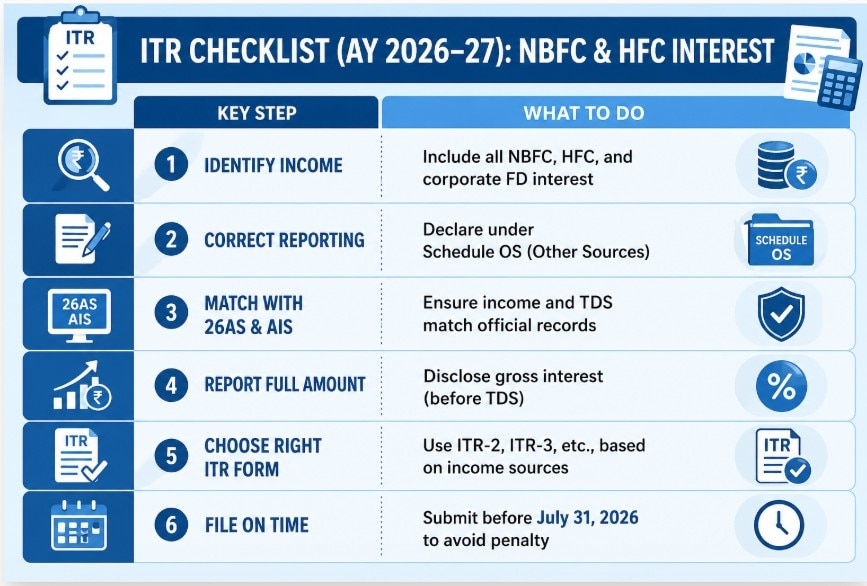



 The Income Tax Department has revised return forms to ensure clearer reporting under Schedule OS (Income from Other Sources), reducing ambiguity and improving compliance.
Taxpayers earning interest income from Non-Banking Financial Companies (NBFCs), Housing Finance Companies (HFCs), and corporate fixed deposits will face tighter disclosure requirements while filing Income Tax Returns (ITR) for Assessment Year (AY) 2026–27. The Income Tax Department has revised return forms to ensure clearer reporting under Schedule OS (Income from Other Sources), reducing ambiguity and improving compliance.
Clearer categorisation

 BRICS must remove top 10 trade barriers, secure sea routes for seamless trade, says PM Modi
  NSE's selling shareholders set to rake in bonanza amid a weak broader market
 Solar scale must now give way to resilient grids, storage and finance: Prahlad Joshi
 Apple launches AppleCare One: Includes one plan, six people, and multiple Apple devices
 RBI’s record forex deposit drive to generate additional income, says Governor Sanjay Malhotra
  Market Commentary: Arun Kejriwal On Nifty, Stocks & The Next Big Move
 Gadkari: FASTag Is More Than Toll Payment, It’s Digital Mobility Infrastructure
 Russia Eyes Bigger India Investments: Sberbank CEO Herman Gref On The Next 2-3 Years
 India’s Cybersecurity Is Still In The Awareness Phase?
 Modi-Putin Meet: Trade Deficit, Defence And The Next Phase Of India-Russia Ties In Focus
 NSE IPO: Haven't applied for shares to trade on own platform, says MD and CEO ChauhanNSE's selling shareholders set to rake in bonanza amid a weak broader market
 Milky Mist shares hit 5% upper circuit; here's what analysts say
 Sensex, Nifty settle lower but recover sharply from intraday lows; here's why
 Quantum AMC bets on cash logistics revival as consolidation boosts pricing power
 India’s BRICS trade doubles to $417 billion in five years: ASSOCHAMNSE IPO: Haven't applied for shares to trade on own platform, says MD and CEO ChauhanBRICS must remove top 10 trade barriers, secure sea routes for seamless trade, says PM Modi
  BRICS has 11 members and a queue of 30-plus more. Here's who's most likely to join next
 BRICS isn't launching a new currency this weekend — here's what "de-dollarisation" actually means


