















 Tax experts say restaurants should carefully check billing software, POS data and reported turnover.
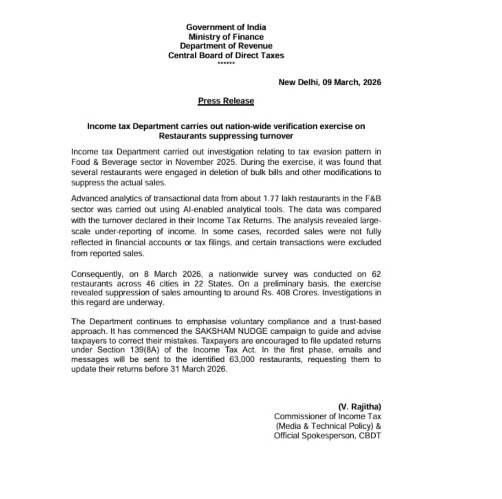
The Income Tax Department has stepped up scrutiny of the food and beverage sector, asking around 63,000 restaurants to review and update their income tax returns before 31 March 2026, after a nationwide verification exercise found evidence of large-scale under-reporting of sales. The action follows an investigation using AI-enabled analytics that detected discrepancies between actual transactions and declared income.
According to a press release dated 9 March 2026 issued by the Central Board of Direct Taxes (CBDT), the department conducted an investigation in November 2025 into tax evasion patterns in the restaurant industry. The release stated that several establishments were found to be deleting bulk bills and making software modifications to suppress actual sales, resulting in under-reporting of turnover in income tax filings.

 NSE IPO day 1 update : Issue subscribed 31% so far; NIIs, employees lead bidding | Key details
 MDR on UPI: Will examine concerns raised by stockbrokers, says SEBI chief
 Diwali demand lifts Indian food exports as global buyers seek sweets, snacks and ready-to-eat foods
 NSE IPO: SGX, LSEG, ICE and CME Group - how NSE compares with global peers
  US tariff clouds loom again: India awaiting more clarity on Russia sanctions bill
 PM Modi’s 76th Birthday: From Sardar Sarovar To Cheetahs, His Birthday Milestones Over The Years
  Café Mondegar Shut: FDA Suspends Licence Over Alleged Food Safety, Hygiene Lapses
 NSE IPO Opens Today: ₹22,568 Crore Mega Issue, Valuation, Growth Outlook & Sona Select IPO
 Gold Finance & Jewellery Stocks: Expert Outlook Ahead of Festive Season | Sky Gold in Focus
 Best Stocks To Buy Now? Power, Hotels, Auto & Pharma Stocks For Long-Term Investors
 NSE vs BSE valuation: Does NSE’s larger scale give it an edge?
 Kanohar Electricals stock: Two-day rally takes gain from IPO price to 40%, here's why
  NSE IPO: CBDO Sriram Krishnan on retail growth, product diversification, new opportunitiesNSE IPO day 1 update : Issue subscribed 31% so far; NIIs, employees lead bidding | Key details
 Alembic Pharma shares rise 4% on receiving USFDA EIR for Vadodara facility
 From China to Japan, births are plunging across major economies. Sanjeev Sanyal shares data
 India Wants To Build Chips For The World: Applied Materials On Semiconductor Mission 2.0
 ISM 2.0: India Eyes Full Semiconductor Ecosystem As 5 Units Enter Production
 PM Modi Highlights Power Needs Of AI, Semiconductor Ecosystem
 Who let the dogs out? Yuva Sena's unique protest in Niphad Panchayat office goes viral


