The most prominent cluster lies in the Gulf Cooperation Council (GCC) region. Countries such as the United Arab Emirates, Qatar, Bahrain, Kuwait, Oman, and Saudi Arabia do not levy personal income tax on salaries or wages. This policy has been historically supported by hydrocarbon revenues, although fiscal diversification is underway. For instance, the UAE has introduced a 9% corporate tax on mainland businesses, while most GCC nations now apply Value Added Tax (VAT) ranging from 5% to 15%.
Beyond the West Asia, several Caribbean and Atlantic island economies operate zero-income-tax regimes. The Bahamas, Cayman Islands, Bermuda, British Virgin Islands, and St. Kitts and Nevis are notable examples. These jurisdictions typically impose no income, capital gains, or inheritance taxes, relying instead on tourism, financial services, import duties, and consumption taxes. Their legal and financial systems are often structured to support offshore wealth management and global capital flows.
MUST READ: Is Greece the new Dubai? Why HNI Indians are shifting their investments
In Europe, Monaco stands out as a high-profile exception. Residents (excluding French nationals) benefit from zero personal income tax, alongside the absence of capital gains and wealth taxes. However, this comes with stringent residency requirements and a very high cost of living, effectively limiting access to ultra-wealthy individuals.
Other jurisdictions include Brunei in Southeast Asia and Vanuatu in the Pacific, both of which maintain zero personal income tax regimes supported by alternative revenue sources such as natural resources or citizenship programs.
Why zero tax
The sustainability of zero income tax models typically depends on one or more of the following:
Natural resource revenues (e.g., oil and gas in GCC countries, Brunei)
Offshore financial services (e.g., Cayman Islands, Bermuda)
Tourism-driven economies (e.g., Bahamas, Maldives-like structures though not strictly tax-free)
Indirect taxation systems, including VAT, customs duties, and licensing fees
This diversified revenue mix allows governments to operate without directly taxing personal income, while still maintaining fiscal stability.
MUST READ: Sending money overseas? New tax rules could delay transfers if done wrong
Investors and expats
Despite the appeal, “tax-free” does not equate to “cost-free.” Several structural considerations apply:
Indirect Taxes: VAT, excise duties, and import tariffs can materially increase the cost of living.
Residency Barriers: Securing residency often requires employment sponsorship, business incorporation, or significant capital investment.
Corporate and Sectoral Taxes: Certain industries (notably oil, banking, or large corporates) may face specific tax regimes.
Global Compliance Pressures: Many of these jurisdictions are under heightened scrutiny for transparency, anti-money laundering (AML), and tax information exchange.
Additionally, some countries such as Panama or Costa Rica follow a territorial taxation system, where foreign-sourced income is not taxed. While not strictly “zero-tax,” this structure can effectively deliver similar outcomes for globally mobile individuals.
DID YOU KNOW: Form 156 rule triggers compliance concerns as e-filing utility remains unavailable; here's what it means
Advantages and framework
Zero personal income tax jurisdictions offer clear headline advantages, but the real decision calculus involves residency feasibility, total tax incidence (including indirect taxes), regulatory environment, and lifestyle considerations. For investors and professionals, these destinations can be powerful tools for tax optimization—provided they are evaluated within a comprehensive financial and legal framework rather than in isolation.
Important FAQs
Is Dubai truly tax-free?
Dubai is often labelled tax-free, but that’s only partly true. While there is no personal income tax and most businesses enjoy low or no corporate tax, indirect taxes exist. A 5% VAT applies, along with excise duties and customs charges. Notably, oil-related businesses face a high tax rate of up to 55%.
Is Qatar really a zero-tax country?
Qatar offers a tax-friendly environment with no personal income tax, making it attractive for expatriates. However, it is not entirely tax-free. A 5% VAT applies on goods and services, and certain sectors may be subject to additional levies or fees.
Is the UAE completely tax-free for individuals and businesses?
The UAE does not impose personal income tax, which is a major draw. However, it is not entirely tax-free, as VAT and some corporate taxes (especially for specific sectors) are in place. Compliance requirements have also increased in recent years.
Is Singapore a low-tax or tax-free economy?
Singapore is not tax-free but is known for its efficient, low-tax regime. Personal income tax ranges from 0% to 22%, and corporate tax stands at 17%. Importantly, there is no tax on capital gains or inheritance.
Does Kuwait impose any taxes at all?
Kuwait does not levy personal income tax on individuals. However, foreign companies may be subject to corporate taxes, and indirect charges like customs duties are applicable.
Is Oman still a tax-free country?
Oman currently has no personal income tax and does not tax capital gains or inheritance. However, the government is evaluating the introduction of personal income tax as part of fiscal reforms.
Is Canada a high-tax jurisdiction?
Canada has a comprehensive tax system. Residents are taxed on global income, while non-residents are taxed on income earned within Canada, including employment and business income.
Is Switzerland a tax haven or just low-tax?
Switzerland is not tax-free, but it offers relatively lower tax rates. Taxes are levied at federal, cantonal, and local levels, with each region setting its own rates.



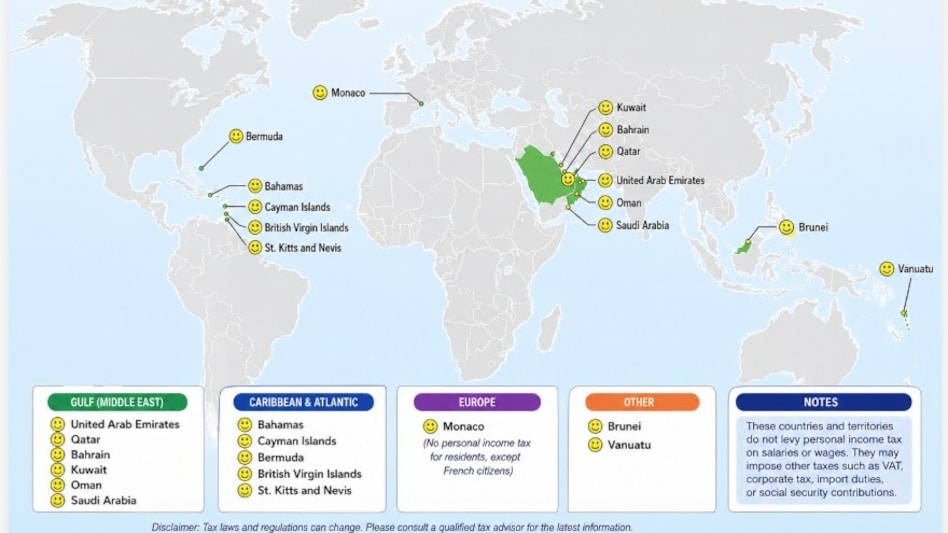 Zero income tax jurisdictions are attractive, but decisions should factor in residency, indirect taxes, regulations, and lifestyle.
 'Majority among two is two': Tata Trusts says Chandrasekaran reappointment failed AoA condition, has no legal effect
 ICAI plans further reforms to scale up homegrown accounting firms
 'Modi admin has done a phenomenal job': Blackstone's Jon Gray on what changed in India
 'SC/ST Act is being weaponised': Tech CEO backs IIT Bombay Professor, calls for case withdrawal
 West Asia tensions: Iran hands 7 terms to US via Qatar, warns of all-out war if Trump rejects deal
 Gold Price Target 2026: Expert Sees MCX Gold At ₹1.8 Lakh By Year-End Amid Strong Demand
 Health Insurance: Why Pre-Existing Diseases And Waiting Periods Matter For Buyers
 Crude Oil Above $100: How High Energy Prices And Rupee Weakness Impact Gold Prices In India
 CEA On India’s Manufacturing Rise, Atmanirbhar Bharat And Modi’s Economic Policy
 Health Insurance Buying Guide: 7 Things First-Time Buyers Must Check Before Choosing A Policy
 SpaceX weight in Nasdaq 100 to jump to 2.82% following quarterly index rebalance: Report
 Tata Motors or Ashok Leyland? Analyst reveals his preferred auto stock for near-term gains
 Maharashtra Scooters, Dixon Tech, Bharat Dynamics, Jai Corp among stocks to turn ex-dividend on Monday
 Jindal Supreme, SS Retail, Hero Motors IPOs subscribed up to 181 times on final day; details here
 Sensex, Nifty post sixth weekly loss; TCS, Titan among top laggards, slip up to 4%
 'AI ending humanity is nonsense': Ex-Infosys CEO Vishal Sikka rejects growing doom warnings
 IMD warns of extremely heavy rain as Bay of Bengal low-pressure system heads towards Andhra-Odisha coast
 EAM S Jaishankar, former Army chief get SIR notices in Delhi
 New CBFC rules mandate anti-drug warning in films depicting drug use












