









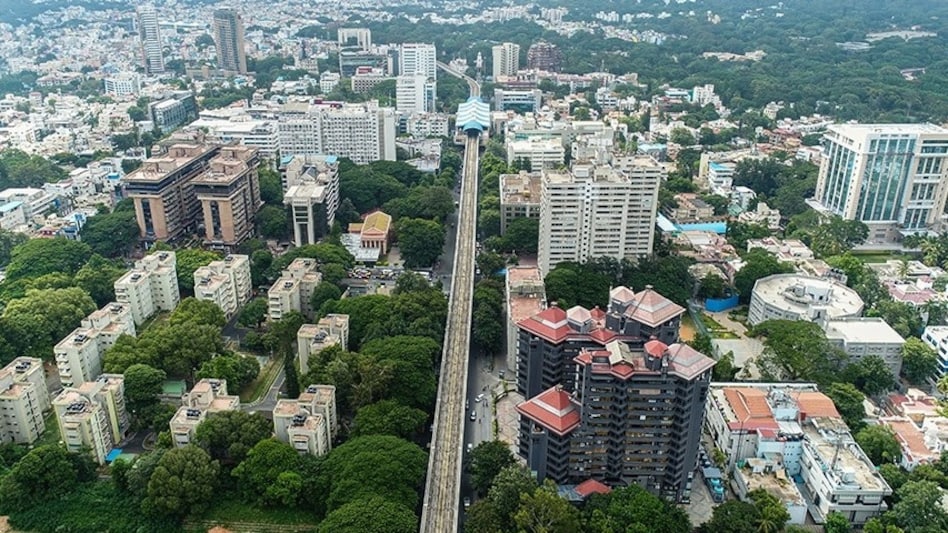
 Indian REITs outperform their global peers, says report
 Indian REITs outperform their global peers, says report
India’s Real Estate Investment Trust (REIT) sector has reported average distribution yields of 6-7 per cent, positioning itself ahead of established global markets such as the United States and Singapore. According to the report ‘Indian REITS: A Gateway to Institutional Real Estate’, released by ANAROCK Capital and CREDAI at the 2025 CREDAI NATCON event in Singapore, the Indian REIT market capitalisation reached approximately $18 billion in August 2025. With the addition of three more REITs anticipated in the next four years, the market is projected to surpass $25 billion by 2029.
“Indian REITs are late to the party, but now lead the dance. Despite its late entry compared to global peers, India has strong fundamentals. The distribution yields, currently averaging at 6-7 per cent, are well above many mature markets such as the US and Singapore among others. Average distribution yields of Indian REITs are competitive with fixed-income instruments but have the added potential for capital appreciation. We take a deep dive into this phenomenon in the report,” stated Shobhit Agarwal, CEO, ANAROCK Capital.
The sector’s current market value is largely driven by a limited number of dominant players focused on Grade A office assets in the IT and Banking, Financial Services and Insurance (BFSI) sectors. “Over 60 per cent of India’s REIT market value today rests with a very small set of players, with a strong base in Grade A offices linked to IT and BFSI. The future, however, holds far wider promise. As India’s cities grow, infrastructure strengthens, and the economy diversifies, REITs will expand into retail, logistics, housing, and new-age assets. This transformation will unlock unprecedented opportunities for investors and firmly place India among the most dynamic REIT markets in the world,” said Shekhar Patel, President, CREDAI.
Despite only accounting for 20 per cent of the institutional real estate market – compared to the USA’s 96 per cent, Singapore’s 55 per cent, and Japan’s 51 per cent – the Indian REIT sector is rapidly maturing. This limited penetration is attributed to a concentration in Grade A offices, offering scale and stable returns. However, diversification is under way, with industrial and logistics REITs gaining traction due to heightened e-commerce and digital demand.
The report highlights a 60 per cent year-on-year rise in industrial and logistics leasing in H1 2025, alongside a 30 per cent increase in warehousing absorption and a threefold jump in institutional investment to $2.5 billion in 2024.
Progressive regulatory reforms, including reduced lot sizes, simplified capital gains, and dividend tax exemptions introduced by SEBI in 2025, have improved transparency and encouraged retail participation, the report stated. Although Indian REIT dividends face higher tax rates compared to the US and Singapore, the combination of attractive yields, steady rental escalations, and a proactive regulatory environment is drawing increasing domestic and global investor attention.
 Centre to launch new series WPI, producer price indices on June 15
 Oyo parent Prism gets Sebi nod for ₹6,650-cr IPO; eyes $7-8 bn valuation
 Mother Dairy expects 5% growth in FY27; eyes expansion beyond Delhi-NCR
 IT stocks stage a comeback: Five factors supporting the strong upmove
 ‘This is an incredible time to be a…’: Nvidia CEO Jensen Huang said on ‘SaaSpocalypse’
 From Global Uncertainty To India's Opportunity: The Big Economic Outlook
 Godrej Industries Is Entering The Wealth Management Space As It Looks To Scale Up Financial Services
 SIP Vs SWP: The Two-Step Mutual Fund Strategy That Could Help Become A Millionaire & Retire Early?
 Daily Calls LIVE: Ask Your STOCK MARKET TODAY QUERIES | Market Update LIVE | Share Market News Today
 Retired At 39! How Sanjay Kathuria Turned A ₹2,000 SIP Into Complete Financial Freedom
 Tata Tech, Bharti Airtel, PFC, BLS International shares: Should you enter at current levels?Oyo parent Prism gets Sebi nod for ₹6,650-cr IPO; eyes $7-8 bn valuation
 Rs 75/share dividend by Tata Group stock – Record date next week IT stocks stage a comeback: Five factors supporting the strong upmove
 CMR Green Technologies IPO: GMP zooms 130% in a week; should you subscribe?