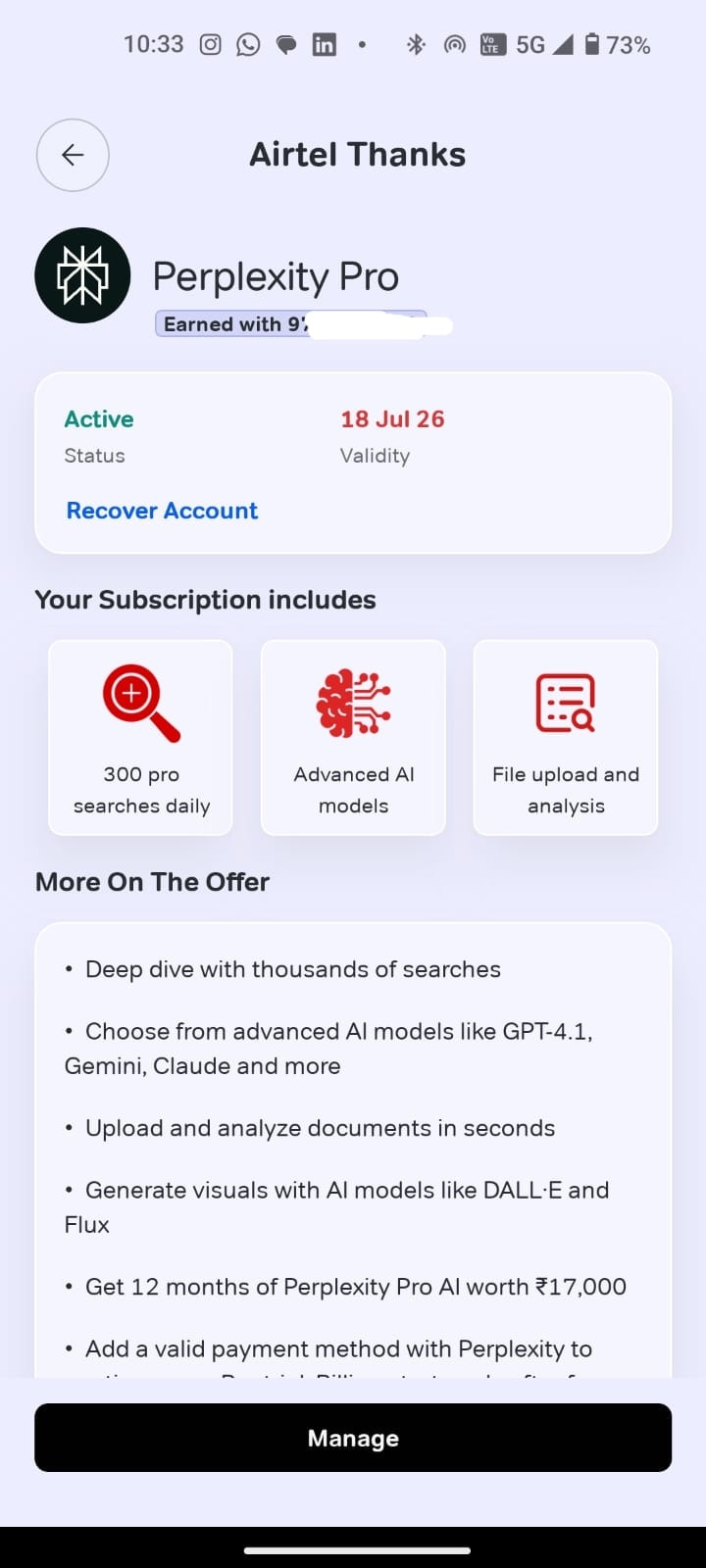
Six months later, that promise is starting to look very different.
Users who activated Perplexity Pro under the Airtel offer are now being asked to add credit or debit card details to continue using the service, despite being within the original 12-month free period promised by the telecom operator.
The change has blindsided users who signed up on the understanding that they were entitled to a full year of complimentary access. Perplexity Pro costs $17 a month or $167 annually (around Rs 15,000).
“Airtel advertised 1 year Perplexity Pro free with recharge. After just 3 months, Pro access is gone and payment is being demanded. This is not what was promised,” one user wrote on X (formerly Twitter).
Another user posted on Reddit: “Roughly six months have passed since I activated Perplexity Pro through Airtel. Now it’s asking me for card details to continue using it.”
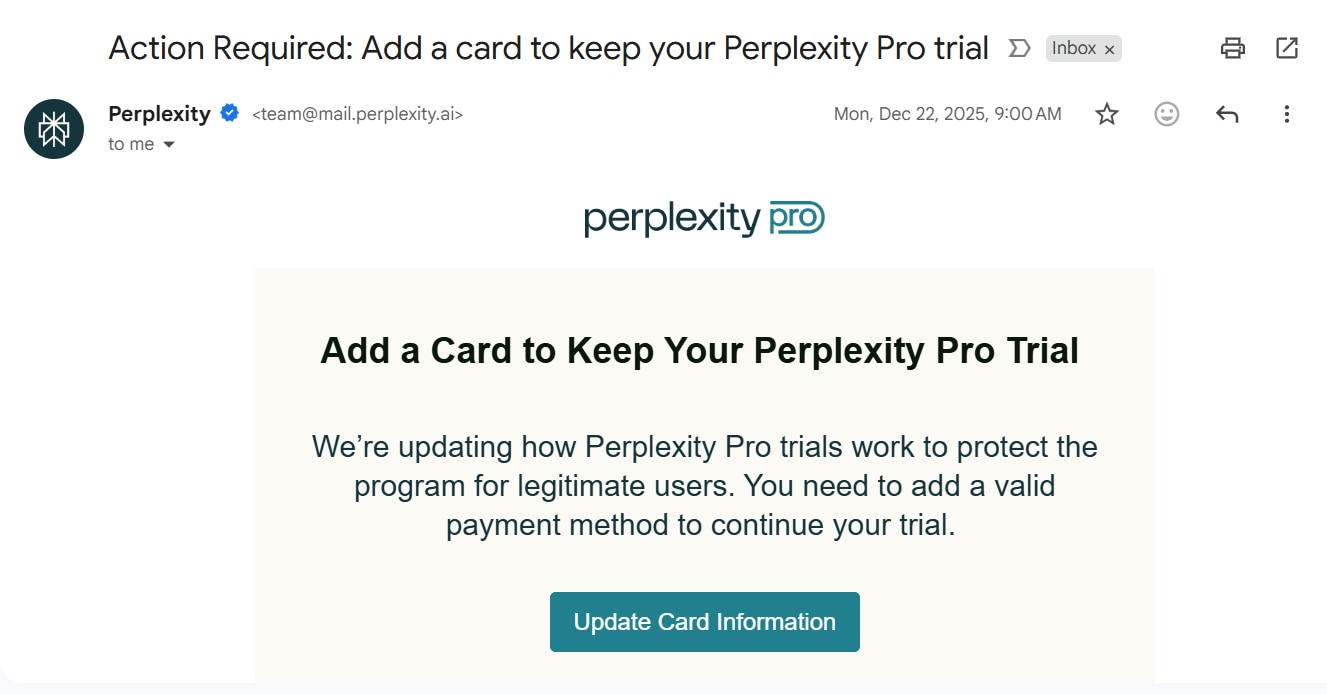
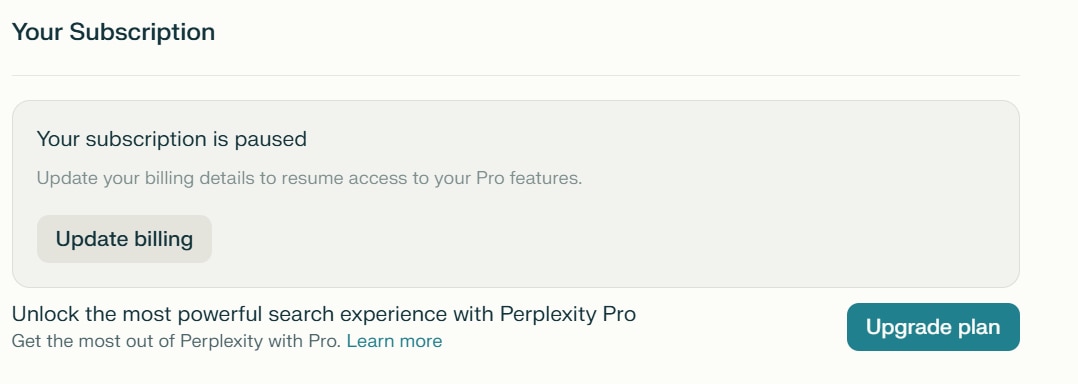
While the Airtel app still reflects the original offer terms, with no mention of any card requirement, Perplexity has quietly changed its global onboarding flow for Pro subscriptions. Several users received an e-mail, but there has been no clear public explanation from either company.
"We’re updating how Perplexity Pro trials work to protect the program for legitimate users. You need to add a valid payment method to continue your trial. Your card will only be charged after your trial offer ends, and your subscription will renew automatically unless cancelled beforehand," Perplexity had said in an email to users.
The result is a confusing and potentially risky situation for users. A benefit that was termed as “free for a year” now feels like a trial that quietly turns into a paid subscription unless cancelled in time.
A question of accountability
Airtel told Business Today that there is no change in the commercial terms of the deal from its side and that users will not be charged by default when the free period ends. However, the payment prompt originates within Perplexity’s interface and uses its global billing system. That creates a grey zone over accountability.
Business Today has reached out to Perplexity regarding the same. The story will be updated once a response is received.
“In India, Airtel introduced this as a bundled benefit. They can’t escape responsibility for user communication,” Shiv Putcha, director at GSMA Intelligence told Business Today. “At the same time, it’s Perplexity that has changed the onboarding. Ultimately, the customers are Airtel’s.” Keeping quiet, he said, is never a good strategy.
From Perplexity’s perspective, however, the card requirement acts as a filter, separating casual free users from serious subscribers.
“If you look at it positively, this gives Perplexity a clear idea of who the real converters are, the users who are serious about moving from free trials to paid subscriptions,” Pathak said.
“This tells them who has actually used the product and is willing to pay for it.”
A test of trust in India’s AI consumer market
Over the past year, India has become the world’s most competitive market for AI bundling. Airtel offered a year of Perplexity Pro and Reliance Jio followed with 18 months of Google Gemini Pro. OpenAI launched a year of ChatGPT Go for Indian users.
For global AI companies, telcos offer instant scale, millions of users, verified identities and frictionless distribution. However, for Indian consumers, these bundles were marketed as simple, no-surprises benefits. That sense of certainty is now under strain.
From a consumer trust perspective, the shift is difficult to justify, said Putcha.
“The short answer is, it’s just plain wrong,” Putcha told Business Today. “It’s either false advertising or a mid-way change because the numbers didn’t add up. Either way, it damages trust.”
According to Putcha, silent changes to onboarding and payment flows without clear communication could invite scrutiny from customer protection authorities.
“If there was intent from the beginning, then it’s false advertising. If they changed their minds midway, they still had a responsibility to explain the reasons. They didn’t do that either,” he said.
India’s card anxiety problem
The issue also reflects a harsh reality of India’s digital economy: consumers remain cautious about sharing card details, especially for services they fear they may forget to cancel.
“So far, consumer research shows that many users are not comfortable adding card details, especially when they think they might forget and get charged later,” said Tarun Pathak, research director at Counterpoint Research.
“People want to stay in control of their subscription decisions. Apart from regular services like Netflix, where they are confident about renewals, most users remain wary.”
The issue is amplified when the original offer did not disclose any payment requirement up front.
“Onboarding is extremely important when it comes to payment flow, especially when it is not communicated at the beginning,” Pathak said. “In bundled app partnerships, the onus lies more on the telco because that’s where the consumer acquisition happens. Clarity is essential.”
Can paid AI work in India?
The controversy also underlines a larger question: can paid AI tools scale in a highly price-sensitive market like India?
While millions of users have tried tools like OpenAI’s ChatGPT, Google’s Gemini and Perplexity through free tiers and telco bundles, converting those users into paying subscribers remains an open question.
“In 2026, I don’t think paid AI search has mass-market traction yet,” Putcha said. “Most users will make do with the free tier. It’s not yet compelling enough for people to pay extra for it.”
Pathak is more optimistic about long-term adoption.
“I don’t think this will hurt the adoption of paid AI services overall. Users are much more aware today,” he said. “The people who really like the product are going ahead with it. There is already a good base of Perplexity users in India, which is positive for both companies.”
















 The change has blindsided users who signed up on the understanding that they were entitled to a full year of complimentary access.
 ‘An Indian consumes 1/10th of an average American’: Amb Kwatra says energy security comes first
 Tata stock to buy: Nuvama bets on unique tech-telecom play, sees 28% upside
  NSE IPO, Hero Motors IPO, SS Retail IPO, Jindal Supreme IPO: GMP of four ongoing issues rises up to 32%
 UPI MDR: BharatPe distances itself from Ashneer Grover's remarks, says UPI to remain free for consumers
 IndiGo shares in focus as baggage, infant fee, priority boarding charges likely raised
 Corporate Health Insurance Vs Retail Policy: Why You Need Personal Health Cover Too
 How India Changed In 12 Years: PM Modi’s Journey From Economic Reforms To Viksit Bharat
 Modi @76: From Twitter To Instagram, How His Digital Outreach Has Evolved
 Stock Picks To Watch: Shibani Kurian Reveals Kotak AMC’s Market Bets
 Gold ETF vs Physical Gold: Know the Tax Rules, Charges and Key Differences
 Tata Chemicals, Tata Investment shares drop up to 8%: Why Tata stocks are falling today
 OnEMI Technology shares in focus as board clears fund raising via preferential route
  Adani Power, Adani Green, Adani Ports, Adani Energy: Jefferies shares target prices
 Kotak Bank, Auro Pharma, GE Vernova T&D: Top stocks to trade — Key levels, target price & stop loss
 What endures: The residential school in a changing world
 Only one Indian-American lawmaker voted in favour of Russia sanctions act: Who is Raja Krishnamoorthi?